The highest-performing teams, human or artificial, are not the ones that get along. They are the ones with structured tension: members who challenge, critique, and pressure-test each other’s work inside a cooperative frame. Decades of organisational research and a fast-growing pile of multi-agent AI papers point at the same answer. Pure harmony breeds groupthink. Pure adversarialism breeds chaos. The sweet spot is productive friction.
Here is what changes everything for engineering leaders. The economics of adversarial AI teams are not the economics of human teams. Experiments that would cost $150,000 in hiring and risk lawsuits with humans cost $5 in API tokens with agents. That asymmetry should reshape how CTOs architect their multi-agent systems. It hasn’t yet, mostly because the field is still pattern-matching to old constraints.
Sixty years of team science already settled this
Irving Janis published Victims of Groupthink in 1972. He took apart the Bay of Pigs, Pearl Harbor, and Vietnam and found one shared failure mode: cohesive teams where, in his words, “concurrence-seeking becomes so dominant that it tends to override realistic appraisal of alternative courses of action.” His prescription was a devil’s advocate on every decision.
Kathleen Eisenhardt’s Stanford research on twelve top management teams found that the highest performers combined intense conflict with cordial relationships and fast decisions. The worst teams were not the ones that fought. They were the apathetic, superficially polite ones. Patrick Lencioni later named the failure mode “artificial harmony”: teams where everyone agrees in meetings and complains afterward in private. Without real conflict, you cannot get real commitment.
Amy Edmondson’s psychological safety work supplies the mechanism. Studying hospital nursing teams, she found that better-performing teams reported higher error rates, not lower ones. They felt safe enough to surface mistakes. Google’s Project Aristotle confirmed psychological safety as the single strongest predictor of team effectiveness across 180+ teams. Safety enables disagreement, and disagreement is what produces good decisions.
The cleanest distinction comes from Karen Jehn (1995): task conflict (about the work) versus relationship conflict (about people). A 2012 meta-analysis covering 116 studies found task conflict reliably improves decision quality, but only when it does not co-occur with relationship conflict. The two correlate at roughly 0.52 in human teams, which is why running productive conflict is so hard. AI agents cannot experience relationship conflict at all. They engage in pure task conflict with no political fallout.
Multi-agent AI evidence is real but nuanced
The original proof that adversarial architectures produce better outputs is the GAN. Goodfellow’s 2014 paper framed two networks as opponents in a minimax game, and competition between them produces outputs neither could reach alone. The same principle scales. AlphaZero achieved superhuman chess in four hours of pure self-play, beating Stockfish 155 wins to 6 across 1,000 games. OpenAI Five won 99.4% of more than 7,000 public Dota 2 games, all from self-play.
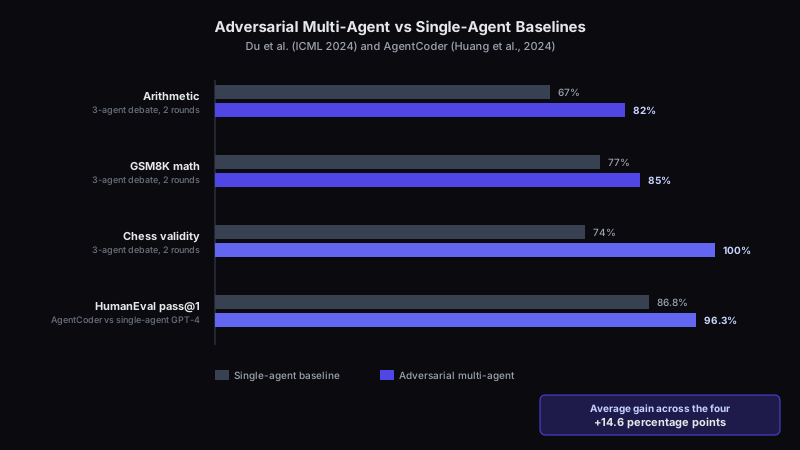
In the LLM era, Du et al. (ICML 2024) ran three ChatGPT instances debating over two rounds. Arithmetic accuracy went from 67% to 82%, GSM8K math from 77% to 85%, and chess move validity from 74% to 100%. The mechanism works even when every agent starts wrong. Khan et al. at Anthropic showed that when two LLMs argued opposing positions, human judges hit 88% accuracy on the correct answer, against 60% with no debate.
For coding the numbers are starker. AgentCoder (Huang et al., 2024) put a programmer, a test designer, and a test executor into an explicitly adversarial loop where the test designer never sees the coder’s reasoning. It hit 96.3% pass@1 on HumanEval against roughly 86.8% for single-agent GPT-4. The paper is blunt about why: “tests designed by the same agent that generates the code can be biased by the code and lose objectivity.” Reflexion (NeurIPS 2023) reached 91% on HumanEval through generate-test-reflect-retry. CriticGPT, a GPT-4 model fine-tuned to critique code, produces critiques preferred over human reviewer critiques more than 80% of the time on planted bugs.
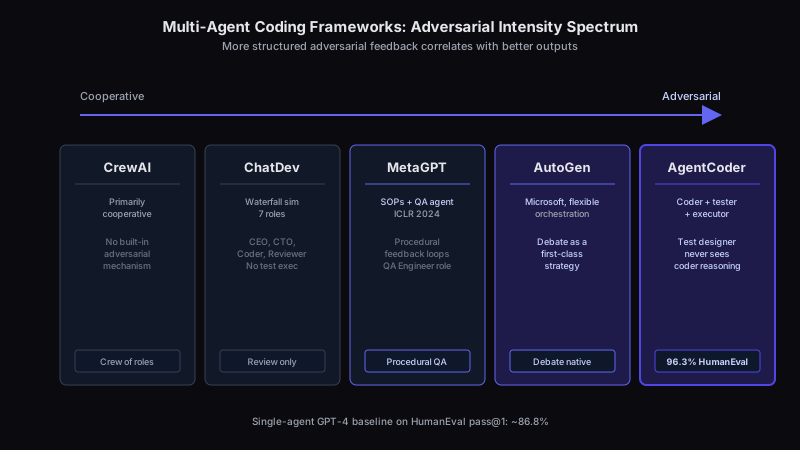
The frameworks reflect a spectrum. CrewAI is primarily cooperative with no adversarial mechanism. ChatDev simulates a software company in a collaborative waterfall but has no automated test execution. MetaGPT’s QA Engineer feedback loops are procedural, not adversarial. AutoGen treats debate as a first-class strategy. AgentCoder enforces structural separation. The pattern across all of them: the more structured adversarial feedback a system includes, the better its outputs tend to get.
When adversarial dynamics backfire
The picture is not uniformly positive. The M3MAD-Bench study (January 2026) found that adversarial debate with weaker models actively degraded performance, averaging 38.2% accuracy against 51.0% for a single-agent baseline on LLaMA-3.1-8B. That is a 12.8-point drop. Stronger models resisted it. Weaker ones amplified the noise.
A 2025 paper, “Debate or Vote?”, formally proved that multi-agent debate induces a martingale over agent beliefs. In plain English: debate itself does not systematically improve correctness. The authors argued that “majority vote does essentially all the work” and the back-and-forth adds little beyond the ensemble effect. A TMLR (2025) analysis went further: state-of-the-art agent architectures for HumanEval do not outperform simple baselines once you control for compute cost.
Three constraints fall out of this. Model capability matters, because adversarial patterns amplify the underlying model. Structured roles beat unstructured debate, which is why AgentCoder’s 96.3% sits well ahead of generic debate setups. And execution-grounded feedback beats conversational challenge: the biggest coding-quality gains come from running tests, not from agents arguing about code in prose. The ColMAD framework (2025) found collaborative debate outperformed competitive debate by 19% in error detection. Reframing the relationship as non-zero-sum produced better results than pure competition.
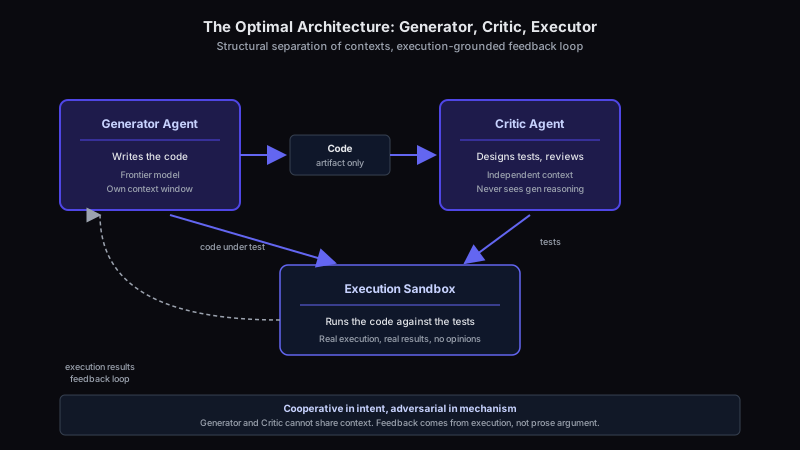
The pattern is not “adversarial beats collaborative.” It is “generate-then-verify beats generate-once.” The ASDLC.io adversarial review pattern makes the structural requirement explicit: a Builder Agent generates code, then a separate Critic Agent in an independent session reviews it. That separation prevents the echo-chamber failure where a model asked to “check your work” in the same context will hallucinate correctness and double down on the original mistake.
The economics that change everything
This is where the case for adversarial AI teams becomes overwhelming. The cost structure is different.
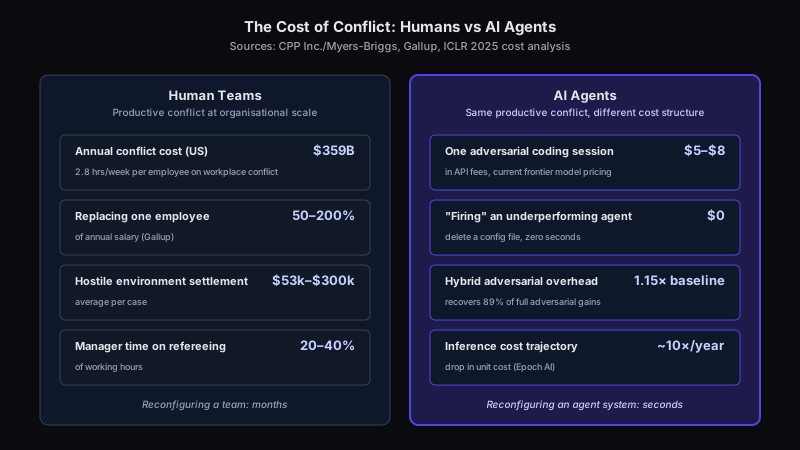
With human teams, adversarial dynamics are rationally feared. U.S. employees spend 2.8 hours per week on workplace conflict, costing an estimated $359 billion annually in lost productivity. Replacing one employee runs 50 to 200% of their salary. Hostile-work-environment settlements average $53,000 to $300,000. Managers spend 20 to 40% of their time refereeing. When Eisenhardt recommends “productive conflict,” the implied cost is huge: skilled leadership, ongoing investment in culture, and acceptance of real downside risk.
With AI agents, the same dynamics cost almost nothing. Firing an underperforming agent means deleting a config file. Zero dollars, zero seconds. An entire adversarial multi-agent coding session runs $5 to $8 in API fees. The worst case of a failed experiment is wasted compute worth a few dollars, not a lawsuit, not a resignation cascade, not a toxic culture.
A CTO can simultaneously test ten agent configurations, varying adversarial intensity, role separation, and verification strategies, for under $100. With humans, each configuration change is a months-long, high-stakes bet. A 2025 ICLR workshop quantified the overhead: hierarchical multi-agent costs roughly 1.4× the single-agent baseline at F1 of 0.921; reflexive/adversarial costs 2.3× baseline at F1 of 0.943; hybrids recover 89% of the adversarial gains at only 1.15× baseline cost. Inference costs are dropping roughly 10× annually (Epoch AI), so even the expensive configurations are becoming trivial.
What the optimal architecture actually looks like
Synthesise the evidence and a consistent shape emerges. The best multi-agent coding architectures are neither purely harmonious nor purely adversarial. Five principles do most of the work.
- Separate generation from verification. The entity evaluating code must be structurally independent from the entity that wrote it. Same-context self-checking fails because the model confirms its own assumptions.
- Ground feedback in execution, not just conversation. The clearest gains come from running code against tests and feeding back actual results. Agents debating code quality in prose is the weakest version of the pattern.
- Use collaborative framing with adversarial mechanisms. ColMAD’s 19% gain over competitive debate, and Eisenhardt’s finding that the best human teams stay cordial during intense conflict, point at the same answer. Cooperative in intent, adversarial in mechanism.
- Scale adversarial intensity to model capability. Frontier models reliably benefit from debate. Smaller models do not. Match the architecture to the capability you have.
- Spend the savings on more verification cycles, not more agents. Diminishing returns from adding agents. Strong returns from more rounds of generate-verify-refine.
The novel insight for CTOs is this: you are no longer constrained by the cost of conflict. For the first time, you can design team architectures purely for output quality instead of social sustainability. Janis showed harmony kills decision quality. Eisenhardt showed the best teams fight intensely. AlphaZero showed self-play surpasses decades of human engineering in hours. The reason organisations tolerate groupthink is not that anyone thinks it works. It is that the alternative is expensive and risky to maintain in human form. AI agents eliminate that cost. Your agents do not need to get along. They need to make each other’s work better.
The case for adversarial AI agents leans on two analogies: the human team research from the 1970s onward, and the GAN/AlphaZero proofs that competitive training produces capability. Both analogies are weaker than they look, and the cost asymmetry that supposedly closes the argument is doing more work than it can carry.
This is not an argument against multi-agent systems. It is an argument that the “adversarial agents always win” conclusion is being oversold.
The human team analogy assumes a thing AI agents don’t have
Janis, Eisenhardt, Lencioni, Edmondson, and Jehn were all studying systems with motivation, ego, social standing, and skin in the game. The reason productive conflict produces better human decisions is that humans bring private information to the table, hold preferences they will actively defend, and update beliefs only when challenged hard enough to overcome status-quo bias. Conflict surfaces information that would otherwise stay hidden.
AI agents do not bring private information to the table in that sense. They do not defend preferences against social pressure. They do not have a status quo to be biased toward beyond whatever the prompt and context window contain. When two LLM agents “debate,” what is actually happening is two forward passes over slightly different prompt contexts, one of which has been told to disagree with the other. That can be useful. It is not the same mechanism Janis was describing.
The Karen Jehn distinction between task conflict and relationship conflict, which is the cleanest piece of evidence in the human-team literature, becomes moot in the AI case. The argument that AI agents are better at productive friction because they cannot experience relationship conflict assumes that the task part of task conflict still works the same way without the psychological substrate that made it valuable. That assumption needs more evidence than it has.
A lot of the AI evidence is just ensemble effects
The “Debate or Vote?” paper formally proved that multi-agent debate induces a martingale over agent beliefs. In practical terms: most of the apparent benefit of debate is the same benefit you get from sampling the model multiple times and taking a majority vote. The iterative back-and-forth adds little beyond the ensemble effect. The TMLR (2025) analysis went further and showed that state-of-the-art agent architectures for HumanEval do not outperform repeated sampling plus voting once you control for compute cost.
If that is true, then the AgentCoder result is more interesting for what it isolates than for what it proves about adversarialism. The 96.3% pass@1 number on HumanEval is impressive, but most of the gain plausibly comes from execution-grounded feedback, not from any adversarial relationship between the agents. AgentCoder runs the tests. Single-agent GPT-4 in the comparison condition does not run the tests in the same loop. That is a confound. The intervention that matters might be the test executor, not the test designer.
The Du et al. results (67% to 82% on arithmetic, 77% to 85% on GSM8K) are real, but they are also two-round debates between three frontier models. The same compute spent on best-of-32 sampling with majority vote would close most of the gap. The honest claim is “adversarial debate is one of several ways to spend compute on accuracy,” not “adversarial debate is uniquely effective.”
The M3MAD-Bench paper (38.2% adversarial vs 51.0% single-agent on LLaMA-3.1-8B) is the result the field is undercounting. It says adversarial debate actively destroys performance on weaker models. Today’s frontier model is tomorrow’s weak baseline. If the pattern is “only works on the absolute best model available right now,” that is not a stable architectural foundation.
The cost asymmetry hides real costs
The headline argument is that adversarial agent experiments cost $5 instead of $150,000. That comparison is true in a narrow sense. It misses the actual cost structure of running multi-agent systems in production.
Multi-agent orchestration is hard. When a single-agent system fails, you have one trace to debug. When a five-agent adversarial system fails, you have five traces, complex inter-agent message logs, and a failure mode that often depends on the specific sequence of who-said-what-to-whom. Observability tooling for multi-agent systems is immature. The CHI 2026 paper that the optimistic case keeps citing also reports that participants found multi-agent debugging substantially harder than single-agent debugging.
Latency adds up. A five-agent debate over two rounds is roughly 10× the wall-clock time of a single inference call, and that ratio compounds when the agents call tools or generate long responses. For interactive use cases, this is a real product constraint, not an engineering footnote.
API costs for one session are cheap. API costs for a system that runs millions of sessions daily are not. The 2.3× baseline cost of a reflexive/adversarial architecture, applied at production scale, is a meaningful operating expense, especially if the actual quality lift is partly an ensemble effect that cheaper sampling could replicate.
And the “$0 to fire an agent” framing misses the human cost. Every reconfiguration of an agent system requires an engineer to design the change, run the evaluations, and update production. The marginal compute is cheap. The marginal engineering attention is not.
The benchmark to production gap is wider than the literature admits
HumanEval is a 164-problem benchmark of self-contained Python functions with clear specifications and unambiguous test cases. Production code is none of those things. Real code touches large existing codebases, depends on poorly documented internal APIs, has fuzzy requirements that change mid-task, and fails in ways no test suite can capture in advance.
The AgentCoder result of 96.3% pass@1 on HumanEval does not generalise cleanly to “your codebase will be 96.3% better with adversarial agents.” It generalises to “adversarial agents are very good at solving HumanEval-style problems.” The gap matters. SWE-bench, which tests against actual GitHub issues in real repositories, shows much smaller gains from multi-agent approaches than HumanEval does. The benchmarks where adversarial debate looks strongest are precisely the ones least like production work.
The ColMAD finding that collaborative-framed debate beats competitive-framed debate by 19% in error detection is interesting, but it also points at how unstable these results are to framing choices. A 19% swing from a prompt change is not a deep finding. It is evidence that the gains are sensitive to setup details we do not yet understand.
What is actually true
Strip the analogies and the cost handwaving and a narrower claim survives. Separating generation from verification is good. Grounding feedback in actual code execution is very good. Ensembling multiple model calls produces measurable accuracy improvements. None of those findings require the “adversarial agents fighting each other” framing to be correct. They are properties of redundancy, separation of concerns, and grounding, dressed up in the language of conflict.
A more honest summary is this. Build verifiers that don’t share context with generators. Run tests, not arguments. Spend extra compute on accuracy when accuracy matters. Be sceptical of any architecture that requires you to use the largest available model just to avoid degradation.
The “your agents should fight each other” framing is rhetorically powerful and partially true. It is also doing the thing the human-team literature warned about: confusing a striking analogy for a transferable mechanism. The economics of compute have collapsed. The economics of debugging multi-agent failure modes have not. Treat the optimistic case as an upper bound, not a recipe, and design for the production constraints you actually have.
If you are still building cooperative agent crews where every component agrees with every other component, you are already behind. The evidence is in. The best multi-agent systems are adversarial by construction, and the engineering teams that aren’t running them yet are leaving 10 to 20 points of accuracy on the table.
This is not a debate any more. It is a deployment gap.
The team science is not new
Janis published Victims of Groupthink in 1972. Eisenhardt’s research showed in 1997 that the highest-performing management teams fight intensely while staying cordial. Lencioni named the failure mode “artificial harmony” in 2002. Edmondson proved that the best teams report more errors, not fewer, because psychological safety enables disagreement. Karen Jehn separated task conflict from relationship conflict back in 1995, and a 2012 meta-analysis covering 116 studies confirmed that task conflict reliably improves decision quality.
Sixty years of research. One answer: the teams that fight productively make better decisions than the teams that don’t.
The reason this hasn’t already become standard practice in human organisations is well-documented. Pure task conflict is hard to keep separated from relationship conflict in humans. The two correlate at 0.52. Engineering productive friction in a human team requires skilled leadership, time, and tolerance for genuine downside risk.
AI agents do not have that constraint. They cannot resent each other. They cannot file grievances. They engage in pure task conflict, on demand, with zero relational fallout.
The AI evidence is overwhelming
AgentCoder hits 96.3% pass@1 on HumanEval with three specialised agents (programmer, test designer, test executor) where the test designer never sees the coder’s reasoning. Single-agent GPT-4 hits roughly 86.8%. That is a 10-point improvement from one architectural decision: separating generation from verification.
Du et al. (ICML 2024) ran three ChatGPT instances debating over two rounds. Arithmetic accuracy went from 67% to 82%. GSM8K math went from 77% to 85%. Chess move validity went from 74% to 100%. The mechanism works even when every agent starts wrong.
Khan et al., the Anthropic ICML 2024 Best Paper, put two LLMs on opposing sides of a debate. Human judges identifying the correct answer hit 88% accuracy with debate, against 60% without it.
Reflexion: 91% on HumanEval through generate-test-reflect-retry, beating GPT-4’s 80% at the time. Self-Refine: roughly 20% improvement across seven tasks. CriticGPT: critiques preferred over human reviewer critiques more than 80% of the time on planted bugs.
This is not a small effect. It is not a corner case. It is the consistent finding across every well-designed study.
The “it doesn’t always work” objection is real and irrelevant
The M3MAD-Bench paper found adversarial debate hurt weak models. The “Debate or Vote?” paper showed debate is mathematically a martingale. A TMLR analysis argued state-of-the-art agent setups don’t beat repeated sampling plus voting once you control for compute.
Read those papers carefully. Every one of them either uses weak base models, removes execution-grounded feedback, or runs unstructured debate without role separation. None of them invalidates the AgentCoder result. None of them invalidates CriticGPT. None of them touches Reflexion’s generate-test-reflect loop.
The takeaway is not “adversarial doesn’t work.” It is “do it properly.” Use frontier-class models. Separate roles structurally. Ground feedback in execution rather than prose. The benchmarks where this is done correctly all show large, consistent gains.
The ColMAD framework went one step further and showed collaborative-framed debate beats competitive-framed debate by 19% in error detection. That is the finding that should be on every multi-agent architect’s wall: cooperative in intent, adversarial in mechanism, grounded in execution.
The economics make this a no-brainer
Human team conflict costs U.S. employers an estimated $359 billion annually in lost productivity. Replacing one employee runs 50 to 200% of their salary. Hostile-work-environment settlements average $53,000 to $300,000. Managers spend 20 to 40% of their time refereeing.
An adversarial multi-agent coding session costs $5 to $8 in API fees. Firing an agent costs $0 and zero seconds. Inference costs are dropping roughly 10× annually.
A CTO can run ten parallel agent configurations for under $100 and learn more about architectural trade-offs in a week than a human engineering org learns in a year. The 2025 ICLR cost analysis found hybrid configurations recover 89% of the adversarial performance gains at only 1.15× single-agent baseline cost. That is a near-free upgrade.
There is no rational reason to ship cooperative-only agent architectures any more. The cost of running the better version is a rounding error.
Build the right architecture now
The pattern that wins is the same across every credible benchmark. Five rules.
- Separate generation from verification. Different agent, different context, different reasoning trace. The evaluator must not be able to see the generator’s chain of thought. AgentCoder’s bias warning is not optional.
- Ground feedback in execution. Run the tests. Capture the output. Feed it back. Agents arguing about code quality in prose is the weakest possible version of the pattern.
- Frame cooperatively, mechanise adversarially. Same goal. Systematic challenge. ColMAD’s 19% advantage tells you which framing wins.
- Match adversarial intensity to model capability. Frontier models benefit. Weaker models degrade. Pick the architecture for the model you actually have.
- Spend the savings on more verification cycles, not more agents. Diminishing returns from more agents. Strong returns from more rounds of generate-verify-refine.
The conclusion is uncomfortable for anyone shipping cooperative-only multi-agent systems in 2026. You are running an architecture that the evidence says is strictly worse than the alternative, in a regime where the alternative costs almost nothing to deploy. The reason most organisations still build harmonious agent crews is that they are unconsciously porting human-team intuitions where the constraint was social, not technical.
That constraint is gone. Your agents have no feelings to hurt and no quarterly review to game. The economics of conflict have collapsed by four orders of magnitude. The architectures that win are the ones that exploit that collapse. Build the critic. Separate the contexts. Run the tests. Make your agents argue with each other, in the only sense in which agents can argue, until the work is good.
Comments
Loading comments…
Leave a comment