The single most useful sentence in Episode 243 is one that Dara Khosrowshahi drops in the middle of a paragraph about fleet management and moves on as if it were obvious. “Humans are actually much more complicated than robots.” The whole robotaxi race has been framed as a contest to build the best autonomous driver. Uber’s CEO just told you, live on a panel at Abundance360, that the driver is the commodity. The hard part is everything else.
That matters because Dara is saying it from a position that earned the right to the claim. He walked into a company losing 4.5 billion dollars a year and turned it into one earning over 10 billion. The lesson he keeps returning to is focus. Strategy is what you choose not to do. With that framing in hand, the robotaxi strategy he laid out looks less like an opinion and more like a disclosure.
Aggregation is the new autonomy
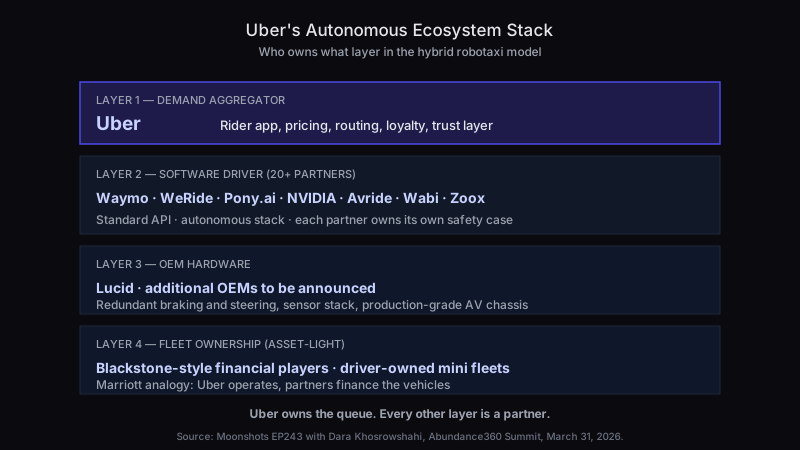
Uber has more than 20 AV partners. Waymo, WeRide, Pony.ai, NVIDIA, Avride, Wabi, Zoox, and a stack of OEMs underneath them including Lucid. Fifteen cities will be live with robotaxi rides through the Uber app by the end of 2026. The stated target is to facilitate more autonomous rides than anyone else on the planet by 2029. Dara’s exact framing: just as Uber wants every terrific licensed human driver on the platform, it wants every terrific licensed robot driver too.
The contrast he picks is Elon. “He doesn’t play well with others.” Tesla is the clean example of the opposite strategy, vertically integrated all the way down to its own refinery. Uber already has tens of thousands of Teslas on the network, and some drivers use FSD, but Dara is clear that a Cybercab fleet joining the platform is a “when the day comes” open question, not a commitment. The implication runs both ways. If Tesla stays out, Uber still has 20 partners. If Tesla comes in, the network effect gets bigger. Either path is a win for an aggregator. Neither path is a win for a vertical.
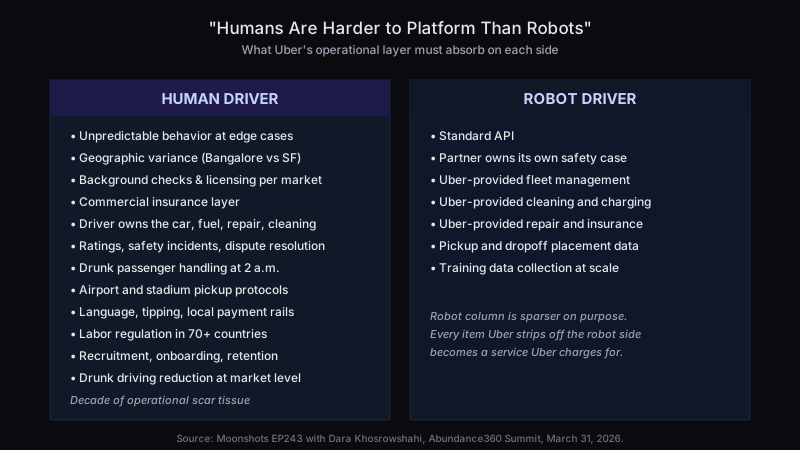
Here is the line you should cut out and pin to a wall. “Humans are actually much more complicated than robots. There are many more unexpected behaviors. There are very significant differences as to how you set up your platform to be operational in Bangalore and also be operational in San Francisco.”
The implications compound. With an AV partner, Uber writes a standard API and the robot shows up predictable, auditable, trainable on the same data across every city. With a human, Uber writes the dispatch API and then absorbs a long tail of everything else: the driver owns the car, repairs the car, cleans the car, fuels the car, learns the local streets, handles the drunk passenger at 2 a.m., and does it differently in Bangalore and in San Francisco. Every one of those was Uber’s burden to carry. With a robot fleet, most of it moves to Uber as a service the partner pays for. Fleet management, insurance, cleaning, charging, repair, data collection for training, and placement of pickup and dropoff points.
That is the moat Dara is describing without naming it. Uber spent a decade learning how to run a global human-labor marketplace. The operational muscle is the thing that took fifteen years to build. The autonomous driver, by comparison, gets commoditized by the tenth company that builds one. The standard API makes robot drivers interchangeable. Nobody has a standard API for humans.
The cost curves decide the clock
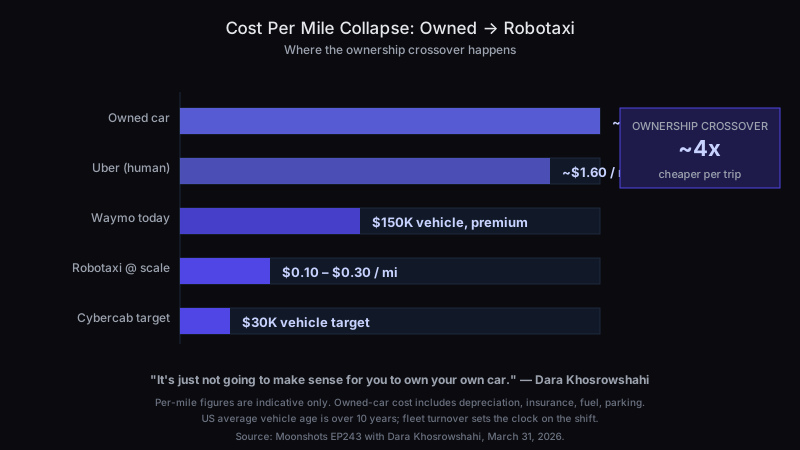
The numbers Dara quotes on vehicle cost are the part that changes the timeline. Waymo’s vehicles are about 150 thousand dollars each. Tesla’s Cybercab is targeting 30 thousand. Between those two points sits the entire question of how fast the ride-hail economy flips from human to robot. The average car on a US road is more than 10 years old, which means the existing fleet takes a decade plus to turn over even if every new car ships autonomous-ready. Dara’s base case is exactly that: within 10 years every new car sold has the sensor stack and autonomous software on it.
The consumer math is the one to keep in mind. Dara’s exact words: “It’s just not going to make sense for you to own your own car.” Cost per trip comes down. Safety per trip goes up. Privacy is solved because the car is configured to you when it arrives. The car you own sits in your driveway 94 percent of the time. The robotaxi does not. Once the per-mile price of a summoned ride drops below the amortized cost of owning, the ownership model starts unwinding fast in markets that can afford the switch, and Dara is careful to note that the 70 plus countries Uber operates in will not all get there on the same schedule.
Wire up everything that moves
Uber is no longer just cars. In the UK and Spain you can book trains and boats on the same app. The Joby partnership is now live enough that Dara is describing an end-to-end Abu Dhabi experience by late 2026: a push of a button, an Uber to the vertiport, a Joby to your destination, another Uber at the far end. Delivery has split into two modes: drones for suburbs that can land a food order in 10 to 15 minutes, and sidewalk robots like Coco for urban blocks where the first mile and last mile are tighter than the drive. Specialized bike-lane robots are next. Dara’s phrase for the whole thing is the one to keep: Uber is in the business of wiring up things that move.
The reason this matters for the robotaxi story is that each new mode sits on the same aggregation logic. Joby does not have to run a consumer app. Neither does Coco. The same move that works for Waymo works for any new mobility player that would rather solve its own tech than own the demand side.
The driver transition without the betrayal
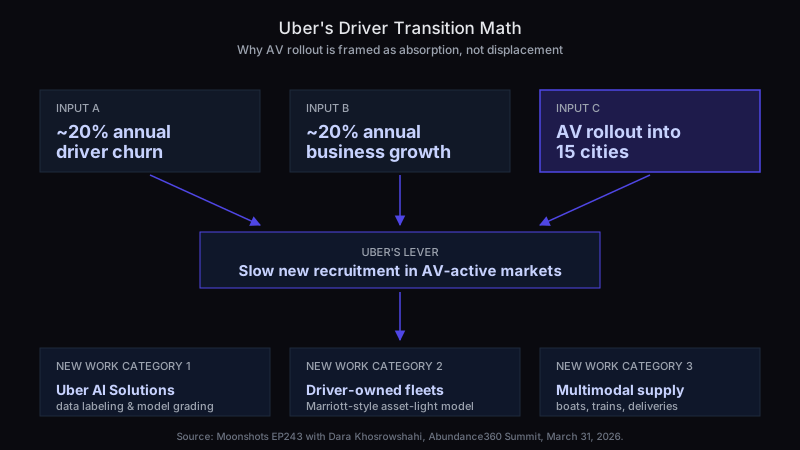
The most politically loaded question in autonomous mobility is what happens to the drivers. Dara’s answer is the one competitors should study. Twenty percent of Uber drivers churn off the platform naturally every year, and the business itself grows at roughly 20 percent. As autonomous vehicles enter a market, Uber slows new recruitment, not existing drivers. The math, if it holds, is that AV growth can absorb churn without forced displacement for years.
On top of that, Uber is building Uber AI Solutions, a data-labeling arm where drivers tag images and compare model outputs as paid work. And the longer arc Dara sketched is a driver-owned fleet model, explicitly borrowing from Marriott and hotel REITs: the driver becomes a small fleet operator who owns a couple of cars and manages them while spending afternoons at the gym. Whether that happens at scale is uncertain. That Uber is even framing the transition this way, rather than walking past it, is the part other robotaxi narratives do not have an answer for.
The counter-read
The part to sit with is that most of the load-bearing moves in this strategy depend on partners choosing Uber. Waymo already runs its own consumer app. Tesla has explicitly said it will not play. The “20 partners” number is a count of relationships, not a count of exclusives, and the ones that matter most are the ones behaving like aggregator-killers rather than aggregator-partners. The standard API cuts both ways: if writing it is easy for Uber, writing it is easy for a competing aggregator, and the path to a two-sided marketplace for autonomous rides is not obviously Uber’s to lose.
The 20 percent churn math is the other soft spot. It only holds if AV rollout stays slow enough to be absorbed by natural attrition. If cost curves surprise on the upside, either through a Cybercab-style price shock or a breakthrough in the Chinese market, the math stops looking like a managed transition and starts looking like a political crisis Uber has to buy its way out of. Dara is betting the curve stays smooth. The history of cost-curve technology says it usually does not.
The race is not for who builds the driver. The race is for who owns the queue. Dara is the first robotaxi CEO who has clearly said so, and that is the part worth taking at face value.
Sources
- Moonshots with Peter Diamandis, Episode 243. “Uber CEO on Winning the Robotaxi Race, the End of Car Ownership, and Uber’s Next $1 Trillion Bet.” Recorded at the 2026 Abundance360 Summit, March 31, 2026.
- Uber Q4 2025 results (cited on the panel by Dara Khosrowshahi): over 10 billion dollars in annual earnings.
- Joby Aviation and Uber partnership announcements, Abu Dhabi end-to-end service planned for late 2026.
- Waymo fully autonomous operations in Austin and Atlanta as Uber partners.
- Uber AI Solutions public announcements on driver-facing data labeling work.
The hybrid-fleet thesis Dara Khosrowshahi laid out at Abundance360 is a genuinely good story. It is also, on inspection, more pitch than forecast. Uber has had a remarkable turnaround, and the demand aggregation line is real. But almost every load-bearing claim about “winning” the robotaxi race depends on counterparties choosing behaviour that is directly against their economic self-interest, and the parts of the transcript that rounded cleanly into confidence would sound very different read back by a Waymo product manager.
”20 partners” is a count, not a commitment
Twenty plus AV partners is an impressive number to say on a panel. It is not an impressive number to underwrite a business on. Most of those relationships are non-exclusive letters of intent, API test integrations, or city-level pilots. The two names that matter most, Waymo and Tesla, are the two that are behaving like aggregator-killers rather than aggregator-partners.
Waymo runs its own consumer app in Austin, Atlanta, and Phoenix. That is not a detail. That is Waymo telling you they want direct customer ownership and are willing to pay the customer-acquisition cost to get it. The Uber deal is an extra channel while they ramp supply, and Dara is clear-eyed enough to know it. The question nobody on the panel asked is what happens to the Uber-Waymo volume split the day Waymo’s own app matches availability in all their cities. History of platform marketplaces is unambiguous on this. The supplier with a premium product and direct demand does not stay on the aggregator indefinitely.
Tesla is the other end of the same pattern. Dara’s own framing is that Elon “doesn’t play well with others” and that Cybercab on the network is a “when the day comes” question. It is reasonable to read that as: we expect never.
The “humans are harder than robots” line cuts both ways
Dara’s most quotable line is also the one that most weakens his own moat argument on closer inspection. If humans are hard and robots are easy, then a standard API against a robot fleet is, by definition, an easy thing to write. Any well-capitalized aggregator can write one. Google already built Google Maps and Android Auto. Amazon built Zoox and a logistics network. Chinese hyperscalers can point an app at WeRide and Pony overnight.
Uber’s moat was real when the hard part was running a global human labor marketplace. Once the hard part moves to a software-against-software integration, the moat thins. The long tail of fleet management, insurance, cleaning, repair, and data labeling is real work, but it is work of the sort that logistics companies and rental fleets have been doing for a century. Hertz could run a cleaning contract. Enterprise could run fleet management. Cox Automotive could run data labeling. None of those companies have Uber’s scale today. All of them could get there on a ten-year horizon if the prize is the operating layer of a trillion-dollar market.
The cost curves are the part that breaks the driver math
Dara’s 20 percent natural churn story is the one that needs the tightest scrutiny. The math works only if AV rollout stays slow enough to be absorbed by natural attrition. That is the one assumption the entire rest of the strategy refutes.
If Cybercab really does ship at 30 thousand dollars a vehicle, and if the per-mile price drops to 10 to 30 cents as Dave Blundin and Peter Diamandis argued in Episode 242, then the rollout stops looking like a managed curve and starts looking like a cliff. There is no version of history in which a 4x cost advantage rolls out at 20 percent a year. It rolls out as fast as capital and regulators allow, which in practice means as fast as the loudest city council can be lobbied. The moment a single major US market flips, the driver transition stops being a narrative about absorption and becomes a narrative about displacement.
Dara’s answer to that scenario is Uber AI Solutions data labeling and driver-owned fleet ownership. Both are interesting ideas. Neither is at material scale today. Data labeling is itself being automated by the same AI wave that is replacing the driving. Driver-owned fleets require the driver to take on 40 to 200 thousand dollars of debt on a depreciating asset in a market where the price per mile is falling. The Marriott analogy only works if the hotel industry had been told that every hotel would be free to use by 2030. A fleet of Cybercabs owned by a former driver is not an asset. It is a payment plan on a race condition.
Multimodal is a slide, not a product
Joby in Abu Dhabi end-of-2026 is the claim that has been made at every Uber event since 2017. Uber Elevate sold itself on eVTOL launches by 2023. The timeline has slipped by three years already, which is roughly the same slippage rate every other advanced mobility bet in the transcript has experienced. Drone food delivery in 10 to 15 minutes in suburbs is a real pilot in some markets. It is not a national rollout, and the unit economics outside dense suburbs have not been shown to work. Coco sidewalk robots are charming and operationally limited. Specialized bike-lane robots are a slide.
Each of these is reasonable to invest in. None of them is reasonable to treat as a 2026 or 2027 revenue line.
What a skeptic should actually believe
None of this makes Uber a bad business. The turnaround is real. The demand graph is real. The 20 percent underlying growth rate in the core ride-hail business is real and impressive. The question is the gap between that business and the story of “winning the robotaxi race by 2029” which has a different set of inputs. Those inputs include: Waymo choosing to prioritize Uber over its own app, Tesla eventually accepting an API partner, Chinese AV entering the US on Uber’s terms, and the political math around driver displacement staying calm for five more years.
Each of those is possible. None of them is the base case. If the panel said “Uber is the safest way to express a view on AV rollout without betting on which vehicle wins,” that would be defensible and probably true. What they said instead was that Uber is going to be the largest operator of robotaxi rides in the world by 2029, and that claim is doing much more work than the evidence can support.
Read Dara’s strategy as the best-case narrative for an already-great aggregator, not as a forecast. “Humans are harder than robots” is a true sentence. The rest of the story it is being used to tell is a much harder sell.
Dara Khosrowshahi has already won the robotaxi race, and most CEOs in the room have not realized it. The single line that settles it is the one he dropped without ceremony at Abundance360: “Humans are actually much more complicated than robots.” That is not a quip. It is a moat disclosure. The thing every vertical AV player thinks is the hard problem is the commodity. The thing Uber spent a decade building is the moat.
Aggregation already beat vertical integration
Twenty plus AV partners. Fifteen cities live by year-end. A stated target of running more robotaxi rides than anyone by 2029. Waymo, WeRide, Pony.ai, NVIDIA, Avride, Wabi, Zoox, Lucid, and more unnamed. Any autonomous driver that wants to run a million rides a day has exactly one customer that can deliver the demand. Writing a standard API against Uber is faster than building a consumer app. The CFOs at every robotaxi company know this.
Tesla is the clean counter-example, and the counter-example proves the point. Elon does not play with others. Tesla owns its own refinery. It will either succeed alone or fail alone. Uber already has tens of thousands of Teslas on the network and drivers using FSD today. When Cybercab clears safety, Dara will say yes. When it does not, the 20 other partners carry the weight. There is no version of the next five years in which that bet loses.
The moat is the long tail
“Humans are harder than robots” is an operations statement before it is a platform statement. Uber runs cities. Bangalore is not San Francisco. Drivers in Nairobi do not behave like drivers in Stockholm. Pickup geometry is different at an airport versus a stadium versus a hospital. Nobody else has this data. Nobody else has the decade of operational scar tissue. When an AV partner shows up with a car, it needs all of that context to function as a business rather than as a demo. Uber sells it to them as a service.
The list Dara went through is worth memorizing. Fleet management. Insurance. Cleaning. Charging. Repair. Data collection for training. Placement of pickups and dropoffs that actually work at a busy Marriott at 7 a.m. Every one of those was Uber’s cost to bear when it was running a human network. Every one is now Uber’s revenue stream when it runs a hybrid network. The operating leverage on that flip is the part the sell-side is not pricing yet.
The cost curves are going to the moon and Uber wins either way
Waymo at 150 thousand dollars a vehicle, Cybercab at 30 thousand, and 10 plus years of fleet turnover ahead. In 10 years every new car sold in the developed world is autonomous-ready. Sensor costs are dropping. LiDAR is dropping. The cost per trip is about to fall through the floor, and the moment it does, the ownership model snaps. “It’s just not going to make sense for you to own your own car.” That is not a forecast. That is the math.
And the entire upside flows back to the aggregator. If Cybercab comes in at 30 thousand, Uber gets cheaper supply. If Waymo comes in at 150 thousand, Uber gets premium supply. If a Chinese OEM undercuts both, Uber gets another partner. The one company that is price-agnostic on the vehicle, the software, and the OEM is the one sitting at the top of the stack.
Everything that moves is an Uber product
Joby lands in Abu Dhabi end-of-year: button, Uber, vertiport, Joby, destination, Uber. Trains and boats already on the app in the UK and Spain. Drones for suburbs delivering food in 10 to 15 minutes. Coco sidewalk robots in dense urban blocks. Bike-lane delivery robots next. Every new mode Dara named sits on the same aggregation logic as the robotaxi business. None of those companies are going to run their own consumer apps. The demand is the expensive part, and Uber already paid for it.
The driver transition is the political moat
Twenty percent natural churn every year. Twenty percent business growth every year. Slow new recruitment in markets that get autonomous rollout. Drivers shift into Uber AI Solutions data labeling work. Drivers who want to become small fleet operators get Marriott-style asset-light ownership. The transition narrative is the one every other robotaxi player is about to get hammered for not having. Uber is going to be the one company whose driver network publicly endorses its autonomous strategy, and that endorsement is worth more than any regulatory filing in five state capitals.
What to do Monday
If you run a mobility business, the question is not whether you can compete with a Waymo. The question is whether you are building for a world where the queue is the product and the driver is the commodity. Uber has already made that call. If you run an AV startup, the question is whether writing a consumer brand is actually a moat, or whether you are better off with a standard API and a 15-city distribution deal by Q4. If you run capital, the question is whether you are writing checks to the stack above the driver or to the drivers themselves. Dara spent the entire panel telling you where he is deploying capital, and the answer is above the driver, every time.
The robotaxi race is not over because an autonomous car has been built. It is over because the demand side was built first, by the only company that bothered to run the hardest part of the problem for a decade. “Humans are harder than robots” is not a quote. It is the scoreboard.
Comments
Loading comments…
Leave a comment