OpenClaw hit the internet a month ago and Mac minis sold out. That’s not a coincidence. It’s a market signal loud enough that Apple’s entire AI strategy probably needs to be rewritten.
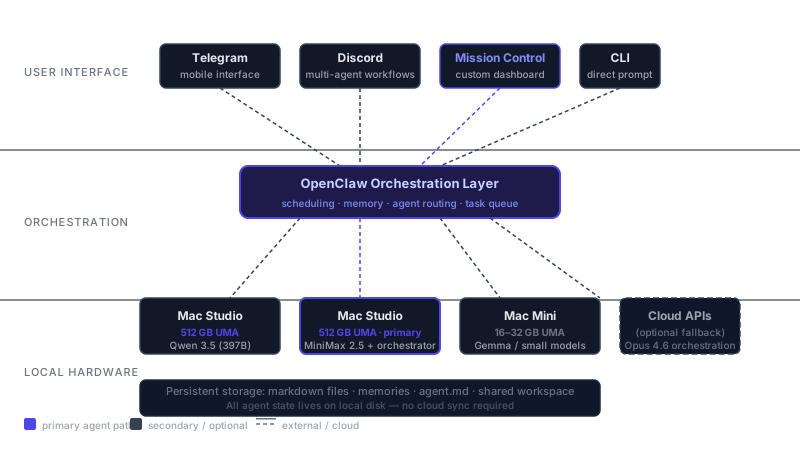
The setup is straightforward: an open-source, self-improving personal AI agent running on your local machine, scheduling tasks, building persistent memory, operating around the clock without a token meter ticking. What makes it different is the architecture, not the AI. The agent owns your hardware. Your hardware owns the model. Nobody else is involved.
Why local wins
The cloud API model has a structural problem. It’s metered by the token and it has guardrails baked in. Anthropic doesn’t want its models downloading random binaries to brute-force a failing task. Those guardrails are exactly what makes the products safe to commercialise, and exactly what makes them unsuitable for a 48-hour autonomous coding run.
Running locally removes the guardrails and the bill. Alex Finn runs four agents simultaneously across three Mac Studios, totalling 1.5 terabytes of unified memory hosting Qwen 3.5 and MiniMax 2.5. The monthly cost: whatever he paid for the hardware. The effective token cost: zero.
Dave Blundin put the cloud problem plainly: “I have no idea what the bill is going to be. If it goes on a wild goose chase, I could come back with a $5,000 bill and a bunch of code I need to drag into the trash.”
Ambient and always-on changes the economics of what you delegate. You don’t need the best model. You need the model that’s running when you’re asleep.
Apple’s accidental moat
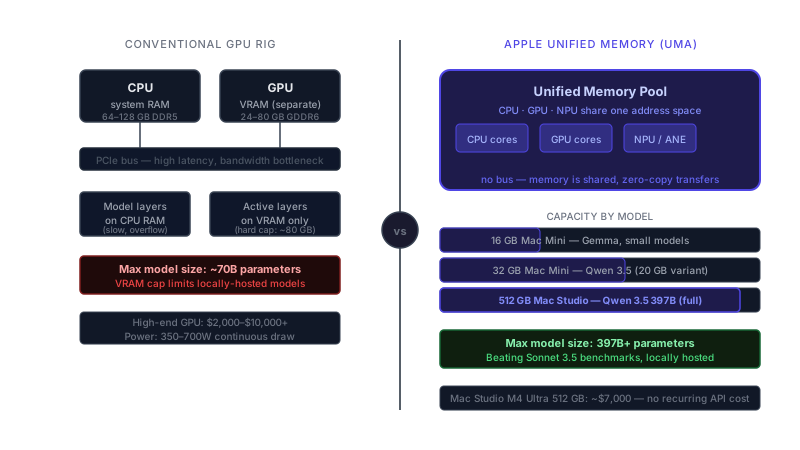
Apple built unified memory architecture (UMA) to make chips cheaper to manufacture. It turns out UMA is also the ideal substrate for hosting large open-weight models locally.
On a conventional machine, a 70B parameter model needs expensive VRAM on a discrete GPU. On a Mac Studio with 512GB of UMA, the GPU, CPU, and NPU share the same memory pool. You can host Qwen 3.5 at 397 billion parameters, beating Sonnet 3.5 on several benchmarks, on hardware you can buy at an Apple Store.
When people wanted personal AI agents, they walked into Apple Stores without Googling alternatives. No GPU rigs. No Raspberry Pi clusters. Mac minis.
Apple already has the hardware. Whether Apple Intelligence becomes the software layer on top, or whether open-source tooling fills that gap permanently, is still genuinely unclear.
The org chart you build yourself
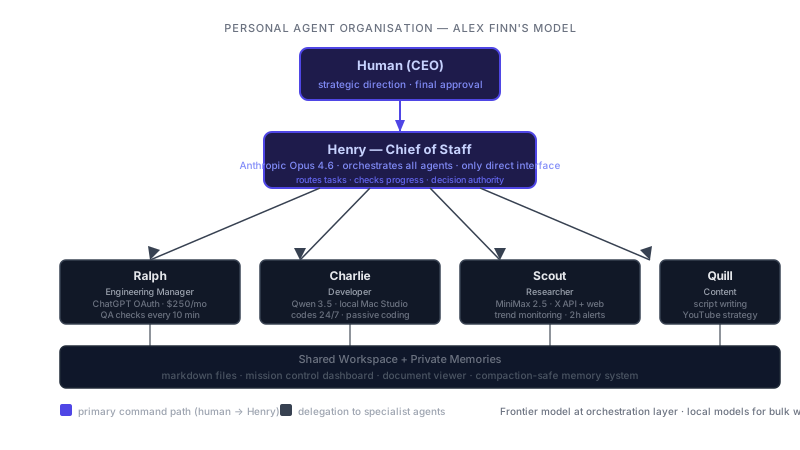
Alex Finn’s setup is the clearest illustration of where this is heading. He runs what he calls an autonomous 24/7 organisation:
- Henry, chief of staff, runs on Opus 4.6 and is the only agent Finn talks to directly
- Ralph, engineering manager on ChatGPT OAuth, supervises coding agents and runs quality checks every 10 minutes
- Charlie, developer, runs Qwen 3.5 locally and codes continuously
- Scout, researcher, monitors X and the web for trends and use cases
- Quill, content strategist, turns Scout’s research into video scripts and thumbnail ideas
The hierarchy mirrors a conventional org chart, deliberately. The reason is practical: cheaper models can’t be trusted to run unsupervised. Left alone, Charlie coded a game for eight hours and produced completely broken output. With Ralph watching, zero bugs, fully QA’d.
Checks and balances as error correction architecture, not anthropomorphism.
The security surface is real
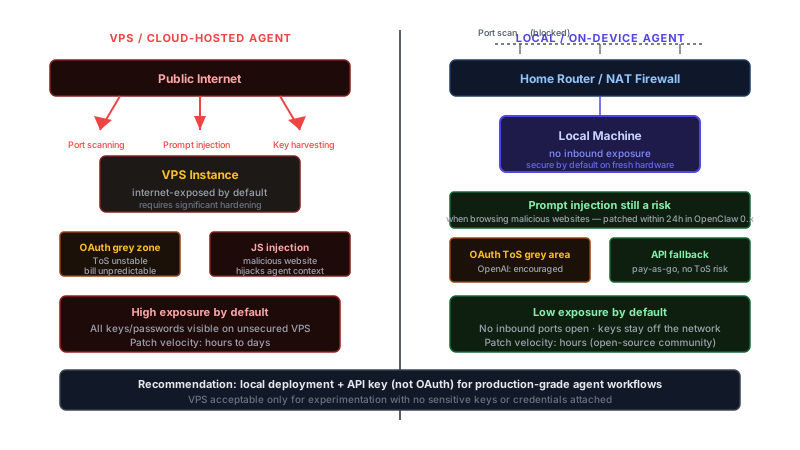
A vulnerability disclosed in February 2026, “OpenClaw flaw lets any website slightly hijack a developer’s agent,” was patched within 24 hours. Alex Wissner-Gross described the broader threat as a world where agents browsing the web on behalf of users get hit by JavaScript-based prompt injection attacks. An immune system is being built in real time.
VPS deployment makes this worse. Running OpenClaw on a public-facing server means the attack surface is internet-exposed by default. Someone catalogued every unsecured VPS running an OpenClaw instance and found all passwords and API keys in plain sight. Local deployment is secure by default. VPS isn’t, not without significant hardening.
Then there’s the OAuth situation. OpenAI explicitly encourages using its OAuth flow to connect ChatGPT to OpenClaw, letting users redirect subsidised tokens into their agent workflows. Anthropic says don’t. Google banned it, then unbanned it the same day while clarifying it’s still against their ToS. Anyone building on OAuth at scale should have an API fallback ready.
The honest counterargument
Local models are not as capable as frontier cloud models. That gap is real.
Qwen 3.5 beating Sonnet 3.5 on some benchmarks doesn’t mean it beats Opus 4.6 on complex reasoning. Alex runs Henry, his orchestration agent, on Opus 4.6 because the intelligence quality of the orchestrator is the ceiling for everything underneath it. You can run Charlie locally on commodity hardware. You probably can’t run Henry that way yet.
In practice, you run a hybrid. Local models handle bulk, ambient, cost-insensitive work. Cloud frontier models sit at the top for orchestration and anything high-stakes. Alex’s Ralph-loop, a cloud model checking local output every 10 minutes, keeps token spend low while stopping Charlie going off the rails for eight hours straight.
What changes in 12 months
Alex’s prediction isn’t about capability improvements. It’s about adoption. Right now, essentially no corporations use OpenClaw. They’re cautious or they don’t know where to start. That changes as the use cases get harder to dismiss.
The opportunity in thin vertical markets is real precisely because OpenAI and Anthropic won’t go there. They announced general-purpose legal tooling and Harvey’s valuation cratered. They’re not building bespoke solutions for niche industries. Anyone with a Mac Studio, an OpenClaw install, and domain knowledge can.
The shift that’s already happening
Alex talks about a “claw-pilled” moment, the same cognitive break Peter Diamandis says he had in 1998 when the web clicked. It’s hard to describe until it happens. An agent working through the night, calling your phone when it hits a decision it can’t make alone, building memory of how you think — that’s just a different thing than software-as-a-tool.
Build the org chart yourself now, or wait for Apple, Google, or Microsoft to ship something more restricted and bill you monthly for it.
The Mac mini shelves were empty. People didn’t wait to be told.
Sources
- Moonshots with Peter Diamandis — Episode #237: OpenClaw Explained — recorded February 27, 2026, published March 9, 2026. Guests: Alex Finn (Founder/CEO, Creator Buddy), Alex Wissner-Gross, Dave Blundin, Salim Ismail.
- OpenClaw — open-source personal AI agent framework: github.com/openclaw
- “OpenClaw flaw lets any website slightly hijack a developer’s agent” — security disclosure, February 2026, patched within 24 hours of publication.
- Qwen 3.5 and MiniMax 2.5 — open-weight models referenced in the episode as candidates for local deployment.
OpenClaw hit the internet a month ago and Mac minis sold out. That’s interesting data. It’s not obviously a paradigm shift.
The setup is real: an open-source personal AI agent running locally, scheduling tasks, building persistent memory, operating without a token meter. The architecture is genuinely interesting. The claims built on top of it are where it gets slippery.
Why local wins, mostly
The cloud billing problem is legitimate. Dave Blundin’s concern about unpredictable costs is real, and running locally does remove that variable.
What’s less clear is whether removing guardrails is a feature or a liability. The guardrails in cloud APIs exist partly for safety and partly for commercial reasons, but they also catch genuinely bad outputs. A 48-hour autonomous coding run without oversight isn’t only expensive when it fails on cloud — it’s expensive anywhere. The token bill just makes the failure visible sooner.
Alex Finn runs four agents across three Mac Studios totalling 1.5 terabytes of unified memory. That’s a real hardware investment. The effective token cost may be zero, but the capital cost isn’t, and that setup is nowhere near representative of most people’s starting point.
Apple’s accidental moat, maybe
Apple’s unified memory architecture does make local model hosting more accessible than conventional hardware. That’s accurate. Whether Mac minis selling out signals a strategic market shift is harder to substantiate.
Consumer hardware sells out for lots of reasons. The M-series chips are good. The price-to-performance ratio on unified memory is strong. None of that tells us whether buyers are running AI agents at scale or bought a Mac mini for the same reasons people always buy Mac minis.
Apple probably benefits from the local AI trend. Whether that’s a structural moat or a tailwind is a different question.
The org chart problem
The Henry-Ralph-Charlie-Scout-Quill hierarchy is an interesting experiment. It’s also one person’s setup, on significant hardware, requiring ongoing oversight.
The example used to justify the hierarchy: Charlie coding a game for eight hours and producing completely broken output. That’s an argument for not running unsupervised agents on complex tasks, not a demonstration that the hierarchy solves the underlying problem. Ralph catching errors every 10 minutes is closer to a monitoring system than an autonomous organisation.
The business org chart comparison is evocative, and it’s doing a lot of rhetorical work. A real org chart involves humans with domain judgment, accountability, and the ability to handle genuinely novel situations. The agent hierarchy handles tasks within the scope it was trained on, with a human upstream setting that scope.
The security surface is a real problem
A vulnerability letting any website hijack a developer’s agent was disclosed in February 2026. Patched in 24 hours — but it existed, and more will follow.
The VPS exposure issue is serious. Every unsecured instance with visible API keys isn’t a documentation problem to be fixed by better onboarding. It reflects the gap between the people building these tools and the people deploying them.
The OAuth situation is unresolved. Three major platforms have contradictory or unstable positions on whether redirecting subsidised tokens into agent workflows is permitted. Building production workflows on that is a risk an API fallback doesn’t actually fix.
The capability gap deserves more weight
Alex runs his orchestration agent on Opus 4.6 because local models can’t do that job. That’s the load-bearing piece of the whole setup, not a footnote. The thing that makes the hierarchy work is a frontier cloud model at the top. The local models handle volume. The smart decisions still go to the cloud.
That’s not a hybrid as a pragmatic choice. It’s an acknowledgment that the capability gap is real and currently can’t be closed at the orchestration level. As local models improve, that changes. It hasn’t changed yet.
What the 12-month prediction actually rests on
The prediction that vertical-market automation businesses will absorb displaced workers is plausible in the long run. It’s also the kind of prediction made at the start of every automation wave that takes longer than promised to materialise, if it does at all.
The niche vertical opportunity is real. The timeline isn’t. CRM for Korean grocery stores and marketing tooling for lumber yards aren’t businesses that get built in 12 months by people who were doing something else last year.
Where this lands
OpenClaw is a real tool doing real things. The local model trend is genuine. The security problems are real and underweighted in most coverage. The capability gap at the orchestration layer is real and underweighted.
The “claw-pilled” framing is how people talk when they’re excited about something new. That’s not a reason to dismiss the technology. It is a reason to track what actually gets built over the next 12 months rather than extrapolating from one person’s Mac Studio setup.
The Mac mini shelves were empty. Interesting. Not a verdict.
Sources
- Moonshots with Peter Diamandis — Episode #237: OpenClaw Explained — recorded February 27, 2026, published March 9, 2026. Guests: Alex Finn (Founder/CEO, Creator Buddy), Alex Wissner-Gross, Dave Blundin, Salim Ismail.
- OpenClaw — open-source personal AI agent framework: github.com/openclaw
- “OpenClaw flaw lets any website slightly hijack a developer’s agent” — security disclosure, February 2026, patched within 24 hours of publication.
- Qwen 3.5 and MiniMax 2.5 — open-weight models referenced in the episode as candidates for local deployment.
OpenClaw hit the internet a month ago and Mac minis sold out. That’s the tell. Consumer hardware clearing shelves because people worked it out themselves, without a product announcement or a VC explainer telling them what to think.
People who were online in 1998 remember what this feels like. Same shape.
Why local changes everything
The cloud AI model was always a transitional architecture. Pay per token, accept guardrails, trust someone else’s infrastructure with your most sensitive workflows. That worked while local hardware couldn’t run serious models. It can now.
Alex Finn runs four agents across three Mac Studios, 1.5 terabytes of unified memory, hosting Qwen 3.5 and MiniMax 2.5. Token cost: zero. The models run while he sleeps. That’s just a different thing than anything from 18 months ago.
Dave Blundin’s cloud billing anxiety is going to look quaint in two years. The question won’t be “what will my API bill be.” It’ll be “why am I paying a bill at all.”
Apple’s hardware lead is structural
Apple built UMA for chip economics. It turned out to be exactly what local AI needed. That’s usually how platform shifts happen: the enabling technology arrives for one reason and gets used for another.
On a Mac Studio with 512GB of UMA, the GPU, CPU, and NPU share the same memory pool. You can host Qwen 3.5 at 397 billion parameters, beating Sonnet 3.5 on several benchmarks, on hardware that costs less than a year of enterprise cloud API spend.
People didn’t wait for Apple to announce a local AI product. They bought Mac minis and figured it out. That head start is architectural, not just a spec sheet advantage, and commodity PC hardware is going to struggle to close it.
The org chart is the product
Alex Finn’s autonomous organisation is generating real output every day.
- Henry, chief of staff on Opus 4.6, handles all communication with Finn directly
- Ralph, engineering manager, runs quality checks on Charlie’s output every 10 minutes
- Charlie, developer on local Qwen 3.5, codes continuously
- Scout monitors the web for trends and use cases
- Quill turns Scout’s research into content
The point isn’t having agents. It’s having the right ones checking each other. Charlie alone produces broken output after eight hours. Charlie with Ralph produces QA’d, shippable work. The org chart is the error correction layer. Once you see that, you can design it.
The template isn’t the specific agents or models. It’s the principle: cheaper local models do the volume work, smarter models supervise. You can run this on commodity hardware today.
The security surface will be solved
The February 2026 vulnerability was real. It was patched in 24 hours. That’s how open-source security works: disclosed, fixed, shipped. Closed systems where vulnerabilities exist but don’t get reported are worse.
The VPS exposure reflects where we are in the adoption curve. Early adopters deploy fast and harden later. The tooling for secure-by-default deployment is coming. The OAuth situation will resolve as the platforms settle their positions.
None of that is a reason not to use local agents. Deploy carefully while things mature, which they’re doing fast.
The capability gap is closing
Yes, Finn runs his orchestration agent on Opus 4.6 today. Frontier cloud models are still better at complex reasoning than local models. That gap is narrowing with every release.
Qwen 3.5 at 397 billion parameters is already beating Sonnet 3.5 on several benchmarks, running locally on consumer hardware. Within 12-18 months, the model capable enough to run orchestration locally will exist. When it does, the cloud dependency goes away.
The hybrid Finn runs today is the right answer now. It won’t be for long.
The vertical opportunity is wide open
OpenAI and Anthropic are building for the largest possible markets. That leaves everything else.
CRM for Korean grocery stores, marketing tooling for lumber yards — the kinds of problems that will never be worth a frontier lab’s time and are wide open for anyone who shows up. These are entire industries that have waited decades for software that fits them. Anyone with domain knowledge and an OpenClaw setup can build it, and that market is available now.
The shift that’s already irreversible
Alex talks about being “claw-pilled” — the moment it clicks, the same way the web clicked in 1998. An agent working through the night, calling your phone when it needs a decision, learning how you think. Once you’ve run it, the previous way of working starts to feel like a constraint you didn’t know you were under.
The people who got there in early 2026 have a head start. The Mac mini shelves were empty. That’s not a metaphor — it’s where the early adopters went first.
Sources
- Moonshots with Peter Diamandis — Episode #237: OpenClaw Explained — recorded February 27, 2026, published March 9, 2026. Guests: Alex Finn (Founder/CEO, Creator Buddy), Alex Wissner-Gross, Dave Blundin, Salim Ismail.
- OpenClaw — open-source personal AI agent framework: github.com/openclaw
- “OpenClaw flaw lets any website slightly hijack a developer’s agent” — security disclosure, February 2026, patched within 24 hours of publication.
- Qwen 3.5 and MiniMax 2.5 — open-weight models referenced in the episode as candidates for local deployment.
Comments
Loading comments…
Leave a comment