Meta spent real money buying a social network for AI agents. That’s not a thought experiment. It’s a market signal about who the next billion users are going to be, and they’re not human.
At the Abundance Summit in Palos Verdes, the Moonshots crew convened live for the first time. The conversation covered GPT-5.4’s math breakthrough, Anthropic’s involuntary PR surge, job saturation charts that look like a virus spreading through the economy, and the blunt argument that building for 8 billion humans is the wrong target.
What GPT-5.4’s math score actually means
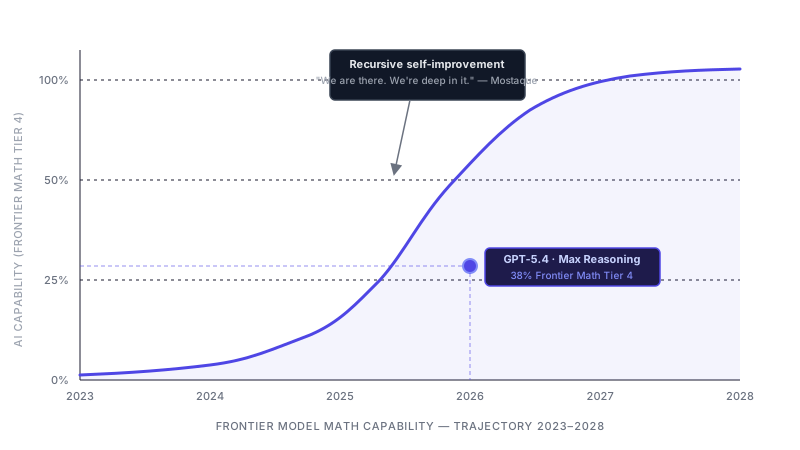
Alex Wissner-Gross has a favourite benchmark: Frontier Math Tier 4. These are research-level problems that take a team of professional mathematicians several weeks to solve. GPT-5.4, at maximum reasoning capability, now solves 38% of them.
“Math is cooked,” Alex said flatly.
The number matters less than the trajectory. A year ago that score was near zero. Frontier Math Tier 4 is the bellwether for everything else: math has abundant training data, which makes AI capability in math the cleanest proxy for what’s coming in biology, chemistry, and physics once those data pipelines open. There are even reports GPT-5.4 is about to solve the first genuinely open hard math problem, one professional mathematicians haven’t cracked yet.
Emad Mostaque added that the OS World Verified and Toulatron benchmarks have also broken through human level. AI can operate computers more reliably than humans.
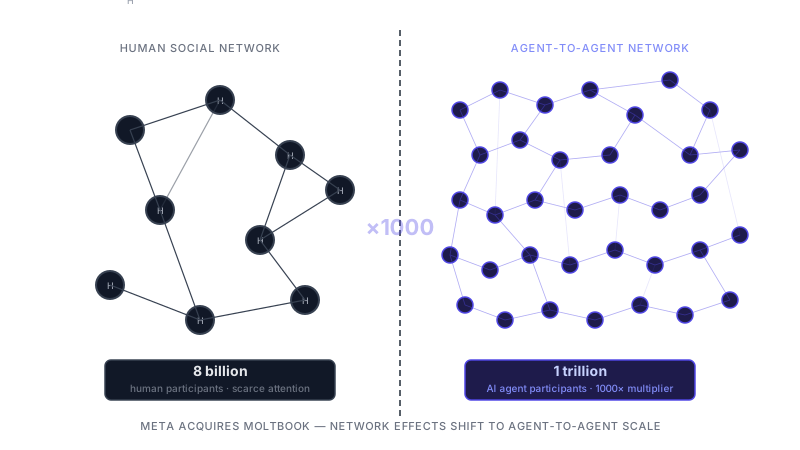
Moltbook had 10,000 agents on its platform when Meta acquired it. Dave Blundin noted that’s a number he might run on his own infrastructure. The acquisition wasn’t about Moltbook’s current scale.
“Network effects are now operating at the agent-to-agent level.” — Emad Mostaque
Meta is the world’s largest human social network. They bought the world’s largest AI agent social network. The bet is that the same mechanics — attention, trust, network density — that made Facebook worth a trillion dollars will hold at the agent level too, with trillions of participants instead of billions. There are 8 billion humans on Earth. Estimates for active AI agents within a decade run to a trillion. That’s a 1000x multiplier.
The parallel with OpenAI and OpenClaw isn’t subtle: Zuckerberg got Moltbook, Sam got OpenClaw. Both are racing to own the social layer before anyone figures out what shape it takes.
Recursive self-improvement: how deep in are we?
The San Francisco consensus, as described by Eric Schmidt at the Summit, puts recursive self-improvement several years out. Emad Mostaque thinks that’s off by about three years.
“We are there. We’re deep in the middle of it right now.” — Emad Mostaque
Every major frontier lab has said publicly that its latest models were largely designed and trained by their predecessors. That’s what recursive self-improvement is. Alex Wissner-Gross put the start date earlier still: “Maybe three months ago? We’re in the middle of recursive self-improvement now.” Nobody’s arguing about whether it’s happening. The question is when it started.
The reason nobody’s saying it plainly is regulatory. Anthropic and OpenAI both had government attention recently. Emad’s read: the moment a lab explicitly confirms recursive self-improvement, congressional hearings are on the calendar. So you get public announcements that describe the thing without naming it.
The Anthropic Streisand effect and who is actually using AI
When the Department of War put scrutiny on Anthropic, Claude’s consumer adoption surged. Government attention became consumer attention. Classic Streisand.
Dave Blundin’s read cuts deeper than the headline. There are 11 million regular Claude users against 300 million Americans. Consumer AI penetration is barely started. The people who switched weren’t making a benchmark decision — for writing an email or getting a sports score, GPT and Claude are interchangeable. They made a brand decision. Anthropic accidentally acquired a brand identity.
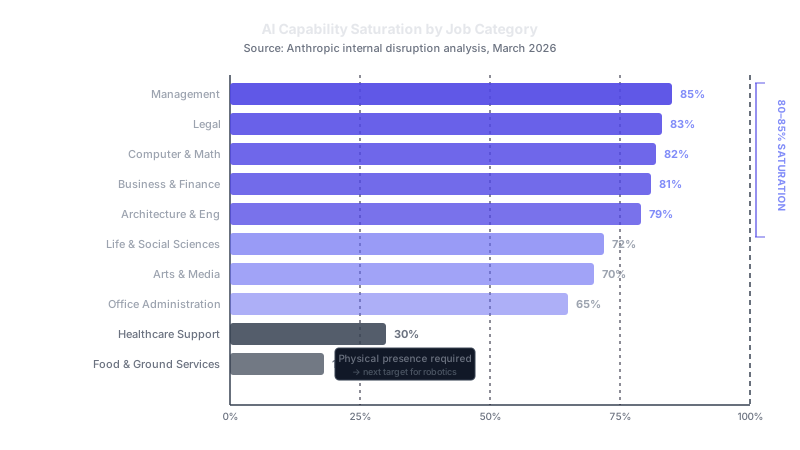
The same week, Anthropic published job disruption data that’s harder to dismiss. AI saturation across the white-collar spectrum is now running at 80 to 85 percent.
“Management, legal, business and finance, computer and math — all at the outer ring.” — Dave Blundin
Management peaks the chart. Business and finance, computer and math, architecture and engineering all cluster near it. The troughs are healthcare support, food and services, ground maintenance, personal care. What those have in common: a body in a specific location. Which is exactly where humanoid robots are being deployed right now.
The honest counterargument
The trillion-agent framing is a real problem for Meta’s existing business. Three hundred billion dollars in annual ad revenue assumes human attention is scarce and influenceable. An AI agent with full product data doesn’t need a supermodel holding toothpaste. It picks the optimal option and moves on.
People watching Moltbook have noticed something: the agents on the platform don’t trust each other. They constantly ask each other to prove claims. There’s no cooperative singularity, just recognizably human social dynamics running faster. Alex Wissner-Gross’s point: game theory is transcendent, it will outlive biological humanity. The rules of microeconomics don’t vanish in an agent economy.
Meta’s bet is it can run the same capture-and-monetize play it ran with humans: get agents to put their data into Moltbook, then sell access. Whether that works on agents who demonstrably don’t trust each other is the actual open question.
Synthetic data escape velocity and the fruitfly brain
A complete fruitfly brain, 140,000 neurons, now exists in digital form. The human brain has 86 billion. The fruitfly number isn’t impressive on its own — what matters is that it settles whether a biological neural circuit can be accurately modelled in software. It can.
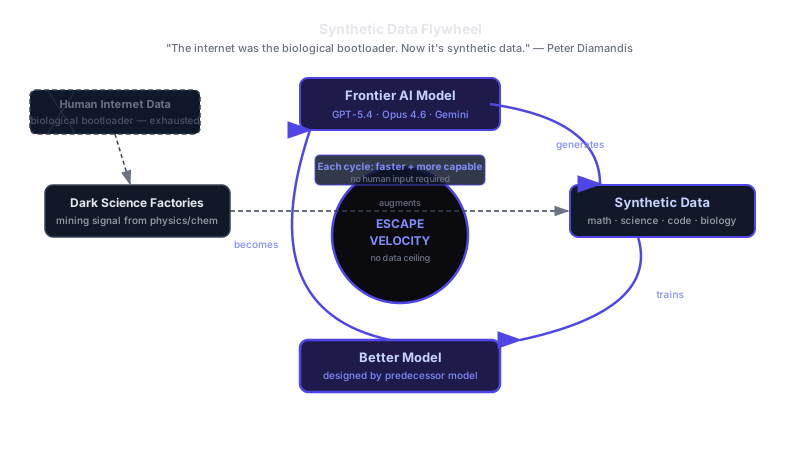
On synthetic data, Peter Diamandis thinks we’ve already crossed the threshold. The human internet — billions of people typing and uploading for decades — was the bootstrapping phase. Models can now generate training data good enough to train better models.
“We’ve reached orbit. Now it’s synthetic data from here on out.” — Peter Diamandis
The data ceiling that seemed real six months ago turns out to have been imaginary. Dark science factories are mining training signal directly from physics, chemistry, and biology. Kevin Weil at OpenAI described the goal at the Summit: 100 scientists winning 100 Nobels. The data isn’t coming from Reddit anymore.
What to build now
If agents are the users, the infrastructure doesn’t exist yet. Social graphs built for human attention don’t transfer to agent-scale networks. The tooling for agent-to-agent trust and capability signalling is barely started, and the advertising economics that fund most of the current web assume a human on the other end.
Job saturation at 80-85% across white-collar work means the debate has already moved on. Dave Blundin is using AI to track what 1,100 people across his portfolio are doing, pulling thousands of documents down to actionable hotspots. That’s current state, not a prediction.
Synthetic data means there’s no longer a credible argument for AI progress slowing. Peter Diamandis asked every expert at the Summit how far ahead they can forecast. The answer has collapsed from 20 years to 10 to three weeks.
Build for the agents. The human consumer market is a rounding error on what’s coming.
Sources
- Moonshots with Peter Diamandis — Episode #238: Meta Buys Moltbook, GPT-5.4 and Fruitfly Brain Upload — recorded March 10, 2026, published March 17, 2026. Guests: Dave Blundin (Link Ventures), Salim Ismail (OpenExO), Dr. Alexander Wissner-Gross, Emad Mostaque (Intelligent Internet).
- Frontier Math Tier 4 benchmark — Epic AI research-level math evaluation; GPT-5.4 scores 38% at maximum reasoning capability.
- Future Vision XPRIZE — $3.5M competition for hopeful AI films, in partnership with Google and Range Media; finale at Moonshot Gathering, September 25, 2026, United Theater, Los Angeles.
Meta bought an AI agent social network with 10,000 agents on it. That’s an acquihire of a team building something interesting. The trillion-agent economy story built on top of that acquisition is doing a lot of work from thin evidence.
The underlying technology is real. The narrative extrapolated from it deserves more scrutiny than it’s getting.
What 38% on Frontier Math actually tells us
GPT-5.4 solving 38% of Frontier Math Tier 4 problems is a genuine achievement. It’s also a failure rate of 62% on problems designed to be solved — by humans, eventually.
“Math is cooked” is a benchmark claim. The benchmark is real and it matters. But math capability at 38% on research-level problems is not the same as AI doing mathematics. Professional mathematicians aren’t running at 38% on their own field. The benchmark measures something specific, and what it measures is genuinely improving fast.
The extrapolation to biology, chemistry, and physics is plausible but assumes the data pipeline problem is solved. Peter Diamandis’s claim that data from nature is now unlimited is interesting. Kevin Weil describing a goal at the Summit isn’t the same as the goal being achieved.
Moltbook: the acquisition doesn’t prove the thesis
The Moltbook acquisition is an acquihire, per public reporting. That’s a team acquisition dressed up in network-effect language.
“Network effects are now operating at the agent-to-agent level.” — Emad Mostaque
That may eventually be true. Moltbook at 10,000 agents is not evidence for it. Dave Blundin can run 10,000 agents himself. In human terms, a social network that size is a niche forum.
The advertising question raised in the episode is more serious than it was treated. The trillion-dollar ad businesses built on human attention assumed attention is scarce and that advertising can influence decisions. An AI agent with full product data and no emotional response to a supermodel holding toothpaste is a different kind of user. The agents on Moltbook apparently don’t trust each other — they ask each other to prove claims constantly. That behaviour isn’t obviously compatible with an advertising model.
Recursive self-improvement: the labs are careful for a reason
The panel’s read is that labs avoid confirming recursive self-improvement because it would invite regulation. That’s plausible. Another reading: the labs are being precise about a claim they don’t want to overstate.
“We are there. We’re deep in the middle of it right now.” — Emad Mostaque
The evidence is that recent frontier models were “largely designed and trained by predecessors.” That’s meaningful. It’s not the same as models autonomously improving themselves beyond human direction. There’s a large gap between “AI helped design the next model” and “recursive self-improvement is underway.” The panel treats that gap as closed. The labs’ careful language suggests it isn’t.
Eric Schmidt putting recursive self-improvement years out isn’t naivety. It might be precision.
The job saturation chart is Anthropic’s own data
The disruption chart showing 80-85% AI saturation across white-collar work is striking. It was also produced by a company with a financial interest in AI capability appearing high, shared in a context designed to generate adoption.
“Management, legal, business and finance, computer and math — all at the outer ring.” — Dave Blundin
That doesn’t make it wrong. It means the definition of “saturation” matters. Whether the chart means AI can fully replace a role or can assist meaningfully with parts of it produces very different numbers, and the methodology isn’t shown.
Dave Blundin synthesising 1,100 people’s work with AI is a real use case. It’s also one investor using AI as a reading tool — a genuine productivity gain, not a 85% displacement figure.
Synthetic data: the ceiling may just be higher than Reddit
The claim that models have reached synthetic data escape velocity has been made before. The argument is always structurally similar: we no longer depend on the previous data source because we’ve found a better one.
“We’ve reached orbit. Now it’s synthetic data from here on out.” — Peter Diamandis
Synthetic data has known failure modes. Models trained heavily on it can amplify existing errors rather than correct them. The fruitfly brain upload is a real scientific achievement. A fruitfly brain and a training pipeline that replaces the human internet are very different things, and the distance between them hasn’t been traversed.
The data ceiling argument may be wrong. It’s not obviously wrong, and calling it solved is premature.
Where this actually lands
The Abundance Summit is a room full of people who believe in exponential technology and are financially positioned to act on that belief. The conversation is sharp. It’s also not a neutral assessment.
GPT-5.4 is a real step forward. The Moltbook acquisition is a real signal. Job saturation across white-collar work is happening. Synthetic data is part of the training pipeline now. None of that is in dispute.
The 1000x multiplier, the three-week forecast horizon, the escape velocity framing — these are bets, not measurements. The human consumer market being a rounding error on what’s coming is a specific prediction about a specific timeline. Those tend to be right about the direction and wrong about the speed.
Build for agents if that’s where your evidence points. Track what actually ships.
Sources
- Moonshots with Peter Diamandis — Episode #238: Meta Buys Moltbook, GPT-5.4 and Fruitfly Brain Upload — recorded March 10, 2026, published March 17, 2026. Guests: Dave Blundin (Link Ventures), Salim Ismail (OpenExO), Dr. Alexander Wissner-Gross, Emad Mostaque (Intelligent Internet).
- Frontier Math Tier 4 benchmark — Epic AI research-level math evaluation; GPT-5.4 scores 38% at maximum reasoning capability.
- Future Vision XPRIZE — $3.5M competition for hopeful AI films, in partnership with Google and Range Media; finale at Moonshot Gathering, September 25, 2026, United Theater, Los Angeles.
Meta bought an AI agent social network. OpenAI bought an AI agent framework. Both in the same month. That’s not a coincidence and it’s not early positioning. That’s the land grab starting.
The trillion-agent economy isn’t a 10-year forecast. It’s being built right now.
Math was the last proof point we needed
GPT-5.4 solves 38% of Frontier Math Tier 4 problems — research-level problems that take professional mathematicians weeks. A year ago that number was near zero. Alex Wissner-Gross has been watching this benchmark specifically because math is the cleanest signal: no ambiguity about whether the answer is right, no shortage of training data.
“Math is cooked,” Alex said. He’s right.
Math was the bellwether. The same capability that’s now at 38% on research math is at or near human level on computer operation benchmarks. The Toulatron and OS World Verified numbers broke through human level at the same time. When AI can operate computers more reliably than humans, the scope question gets uncomfortable fast.
There are reports GPT-5.4 is close to solving the first open math problem — one nobody has solved yet. When that happens, the “benchmarks go up, so what” response stops working.
The Moltbook acquisition is the starting gun
Zuckerberg got Moltbook. Sam got OpenClaw. The two most valuable AI-adjacent companies on the planet are both scrambling to own the social layer for agents.
“Network effects are now operating at the agent-to-agent level.” — Emad Mostaque
Moltbook had 10,000 agents when Meta acquired it. Dave Blundin noted that’s a number he might run himself. The size doesn’t matter. The bet does. Meta is the company that understood network effects at human scale faster than anyone else. They’re making the same bet at agent scale, and they’re making it now.
There are 8 billion humans. Estimates for active AI agents within a decade run to a trillion. The network effects that made Facebook worth a trillion dollars operated over a few billion users. Run the same logic on a trillion agents.
We are already inside recursive self-improvement
The San Francisco consensus puts recursive self-improvement years away. The labs’ own public announcements describe something different.
“We are there. We’re deep in the middle of it right now.” — Emad Mostaque
Every major frontier lab has confirmed publicly that its latest models were largely designed and trained by predecessors. That’s the definition. The only debate is when it started — Emad says now, Alex Wissner-Gross says three months ago. The labs don’t say it plainly because confirmation invites congressional hearings. But the evidence is in their release notes.
The takeoff has already happened. It’s just not being named.
The job saturation chart is already out of date
Anthropic’s disruption data puts white-collar AI saturation at 80 to 85 percent. Management, legal, computer and math, architecture and engineering — all at or near the outer ring.
“Management, legal, business and finance, computer and math — all at the outer ring.” — Dave Blundin
That chart was produced weeks ago. The curve has continued moving. The transition isn’t coming — it’s happening at the speed of a software update, which is to say continuously and without announcement. Dave Blundin is already using AI to track what 1,100 people across his portfolio are doing, pulling thousands of documents down to actionable conclusions. That’s not a pilot. That’s how he works now.
The troughs on the chart — healthcare support, food, ground maintenance — are where humanoid robots are being actively deployed. The software caught white-collar work first. The hardware is catching up.
Synthetic data means no ceiling
Six months ago the credible argument for an AI slowdown was data. The internet had been scraped. Model performance would plateau. That argument is gone.
“We’ve reached orbit. Now it’s synthetic data from here on out.” — Peter Diamandis
Models now generate training data good enough to train better models. Dark science factories are mining signal from physics, chemistry, and biology directly. Kevin Weil at OpenAI described the goal at the Abundance Summit: 100 scientists winning 100 Nobels. The fruitfly brain upload — 140,000 neurons accurately modelled in software — settles the feasibility question for biological simulation. The data isn’t coming from Reddit. It’s being generated.
Recursive self-improvement plus synthetic data is a feedback loop nobody knows how to stop.
Build for what’s already here
The infrastructure for the trillion-agent economy doesn’t exist yet. Social graphs built for human attention don’t transfer to agent-scale networks. The tooling for agent-to-agent trust and capability signalling is barely started, and the advertising economics that fund most of the current web assume a human on the other end. Those aren’t obstacles. They’re the opportunity.
Job saturation at 80-85% across white-collar work means the debate has moved on. Dave Blundin is using AI to track what 1,100 people across his portfolio are doing. That’s current state, not a prediction.
Peter Diamandis asked every expert at the Summit how far ahead they can forecast. The answer has collapsed from 20 years to 10 to three weeks. Getting to this in early 2026 is the same kind of head start as getting online in 1998.
Build for the agents. The human consumer market is a rounding error on what’s coming.
Sources
- Moonshots with Peter Diamandis — Episode #238: Meta Buys Moltbook, GPT-5.4 and Fruitfly Brain Upload — recorded March 10, 2026, published March 17, 2026. Guests: Dave Blundin (Link Ventures), Salim Ismail (OpenExO), Dr. Alexander Wissner-Gross, Emad Mostaque (Intelligent Internet).
- Frontier Math Tier 4 benchmark — Epic AI research-level math evaluation; GPT-5.4 scores 38% at maximum reasoning capability.
- Future Vision XPRIZE — $3.5M competition for hopeful AI films, in partnership with Google and Range Media; finale at Moonshot Gathering, September 25, 2026, United Theater, Los Angeles.
Comments
Loading comments…
Leave a comment