Elon Musk goes to sleep. A massive AI breakthrough happens. When he wakes up, there’s another one. At the Abundance Summit in Palos Verdes on March 11, he told Peter Diamandis: “We’re in the hard take-off right now.”
Most frameworks treat the hard takeoff as something to prepare for. Musk’s position is simpler: it already started, and most people haven’t noticed.
Recursive Self-Improvement: The Loop Is Already Shrinking
Peter Diamandis asked the specific question: is GROK doing recursive self-improvement without a human in the loop? Musk’s answer was measured. “Humans are gradually getting less and less in the loop.” Every successive model is largely built by the model before it. That process is already happening “to a large degree.”
The full automation threshold, where no human is involved, may arrive by end of 2026 or early 2027 at the latest. But treating that as the start date misses the point. The loop-removal is incremental. The process began before anyone named it.
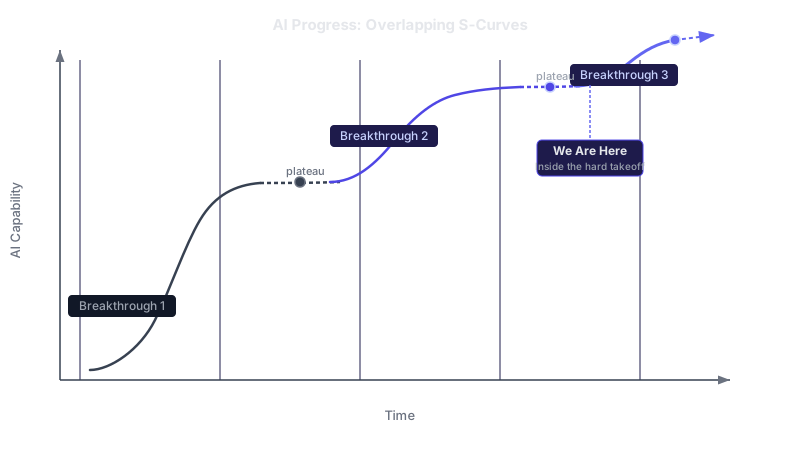
Musk describes AI progress as a series of overlapping S-curves. Each breakthrough starts slow, grows exponentially, plateaus, then appears logarithmic until the next one kicks in. The curves are compressing. The gaps between them are shortening. That is what hard takeoff looks like from inside it.
GROK 4.20 and the Coding Race
GROK 4.20 currently leads prediction benchmarks, which Musk considers the cleanest proxy for general intelligence. Getting predictions right requires integrating many signals at once, which makes it harder to game than a narrow coding or math benchmark.
Coding is where GROK lags behind competitors. Musk was late to the Summit interview because he had been running an all-hands review of exactly what it would take to close that gap. His target: catch up and surpass competitors on coding by mid-2026.
He thinks it’s achievable.
Optimus 3: Production Starts This Summer
Optimus 3 is in the final stages of completion. Musk called it “by far the most advanced robot in the world. Nothing’s even close.” Slow production starts this summer. High-volume production follows around summer 2027. A new design is planned every year after that.
The factory for Optimus is 10 million square feet. Tesla has around 150,000 employees, with roughly 100,000 involved in manufacturing. Another one to two million people work across the supply chain. No layoffs are planned. The output per person, Musk said, is going to get “nutty high.”
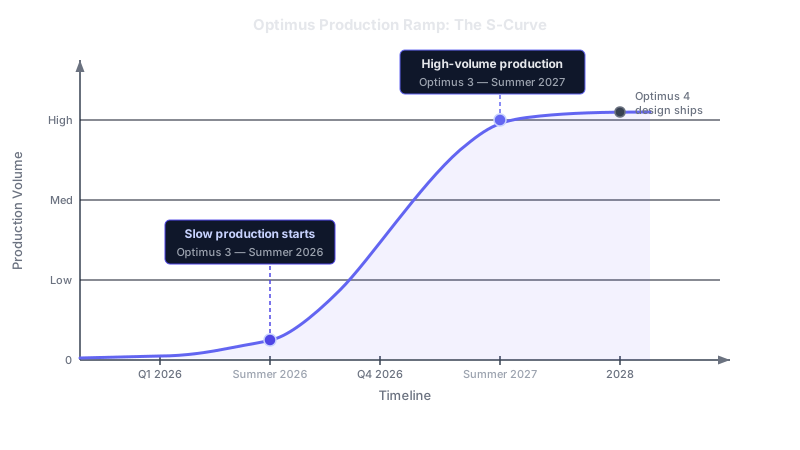
Robots building robots remains a forward-looking statement. Today the factory workforce is human. The shift is in output per worker, not headcount. Tesla’s goal is to multiply what each person produces, not to remove people from the process.
10x the Global Economy in Ten Years
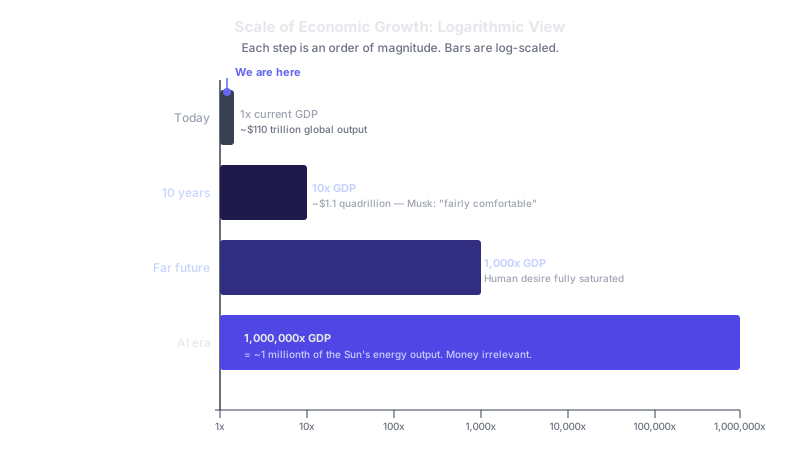
Peter Diamandis put a number on the table: the global economy is 10x its current size in ten years. Musk’s response was that it was “a fairly comfortable prediction,” with one caveat. World War III would put “a kink in those plans.”
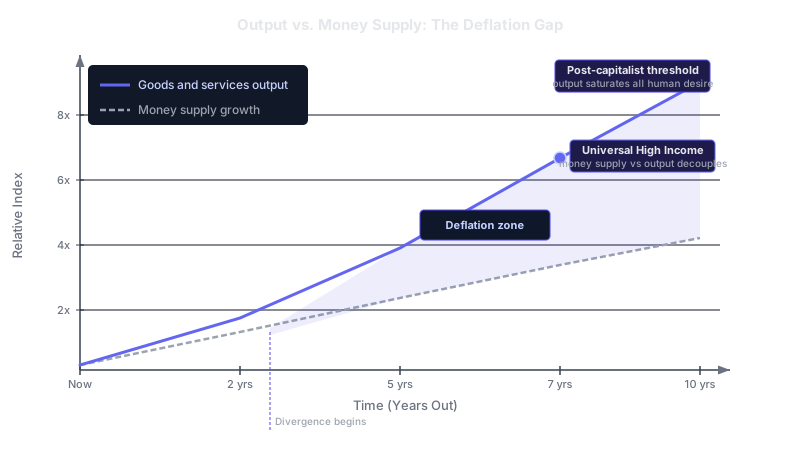
The mechanism runs through production and deflation. AI and robots grow the output of goods and services. If that growth rate exceeds the growth in money supply, the result is deflation. Millions of companies competing to produce more of everything, cheaper and faster, accelerates the process. Nominal prices fall. Purchasing power rises even without wage growth.
Musk put 80% probability on this future being “great.” He acknowledged the future is a distribution, not a certainty. The 20% includes disruptions he did not dismiss lightly.
When Money Becomes Irrelevant
At some point, money stops mattering. That is Musk’s framing, not an extrapolation. The model he described is Iain Banks’ Culture: a post-scarcity civilization managed by AI, where material wants are fully satisfied.
The reasoning follows directly. If the economy is a thousand times its current size, human desire is already fully saturated. At a million times, AI is no longer operating at human scale. It cares about watts and tonnes. Human currency becomes an afterthought. Money works because scarcity gives it function. Remove scarcity and the concept collapses.
Musk also noted that his own net worth is largely percentage ownership in operating companies. The number is large because the companies are useful and growing. When goods and services become abundant enough that the price of everything collapses, that ownership percentage denominates something less meaningful.
The 20% Nobody Is Talking About
The optimism is not unqualified. Musk said “the future is a range of possible outcomes, and they’re not all great.” The 80% probability of a great future implies a 20% that is not. That number is doing real work.
World War III is the explicit threat. Peter Diamandis flagged the budget deficit as another: AI and robots may be the only mechanism that prevents national bankruptcy at current spending trajectories. These are not decorative caveats. They are the structural conditions under which the optimistic scenario holds.
Democracy and institutions are a different kind of problem. What happens inside a singularity is, by definition, hard to predict from outside. “It’s called the singularity for a reason,” Diamandis said. The GROK logo is a Penrose singularity: the halo around a black hole as matter falls in. You can see the event horizon. You cannot see past it.
The claims Musk made at the Summit are falsifiable. GROK surpasses competitors on coding by mid-2026. Optimus 3 in high-volume production by summer 2027. Global economy 10x within ten years. Full automation of recursive self-improvement by end of 2026 or early 2027. These are calendar entries.
If the S-curves keep compressing and the timelines hold, money becomes less relevant before most people have revised their expectations of what AI can do. That is what living inside the event horizon looks like.
Sources
Elon Musk says the hard takeoff is already happening. That claim deserves more pressure than it received in Palos Verdes on March 11. Not because the underlying trends are fake, but because “hard takeoff” is doing a lot of work in that sentence, and the definition shifts depending on how convenient it is.
The trends are real. The framing is slippery.
What “Gradually Getting Less in the Loop” Actually Means
Musk’s answer to the recursive self-improvement question was precise in a way that gets glossed over: “Humans are gradually getting less and less in the loop.” That’s a meaningful statement. It is not the same as “humans are out of the loop.”
The distinction matters. Gradient descent has always been automated. Models have always informed the design of subsequent models at some level. The claim that this constitutes recursive self-improvement without human involvement requires a much cleaner break than “gradually.” Where exactly does human curation of training data, human selection of RLHF preferences, and human evaluation of outputs end and autonomous self-improvement begin? Musk did not say. Nobody has.
The S-curve framing Musk offered is actually more useful here than he intended. S-curves plateau. He acknowledged this: after exponential growth, you hit “logarithmic returns until there’s another breakthrough.” The question he didn’t answer is how long the plateaus are and how certain the next breakthrough is. Stacked S-curves that compress forever is one possible future. S-curves that plateau for longer than expected is equally possible and historically more common.
The Coding Gap Is a Real Problem for the Narrative
GROK 4.20 leads on prediction benchmarks. That is a meaningful claim. But Musk also disclosed that GROK is currently behind competitors on coding, which is the benchmark the industry runs on. He ran an all-hands review the morning of the Summit specifically to address this.
If recursive self-improvement is already the dominant mechanism for capability gains, why is GROK behind on coding? The most plausible answer is that automated self-improvement is one input among many, not a runaway process. Labs that are ahead on coding did something right that GROK’s automated processes did not replicate. That suggests human choices still matter considerably.
The mid-2026 target for catching up is a prediction, not a guarantee. Musk’s track record on timelines is mixed. That is not a criticism; frontier AI development is genuinely hard to schedule. But it is worth noting that “we should get there by the middle of this year” appeared in the same conversation as claims about living inside the singularity.
Optimus 3 Timelines Have Slipped Before
Optimus 3 is in the final stages of completion. Slow production starts this summer. High-volume production follows around summer 2027. These are the same structure of claims that have been made about Tesla products for years, and they are usually directionally correct and specifically optimistic.
The 10 million square foot factory and the ambition to reach “nutty high” output per person are real. But the S-curve manufacturing ramp assumes a number of things that are hard to fully control: component supply chains, software integration, quality at volume, and regulatory clearance in the markets where Optimus operates. None of these are insurmountable. All of them have historically added time to Tesla’s production ramps.
The “nothing’s even close” claim for Optimus 3 is also hard to verify. Some robot development is done in private. Demos released publicly are usually lagged by months. “Maybe they’re out there or they’re secret,” Musk acknowledged. That hedge is appropriate. It also limits what conclusions you can draw from the claim.
10x GDP Assumes the Risk Away
“Absent World War III” is a significant caveat to wave through in a single clause. The 10x GDP prediction rests on continued AI capability growth, a manufacturing ramp that has never been attempted at scale, and geopolitical stability across a decade when geopolitical stability is harder to project than at any point in recent memory.
The deflationary mechanism Musk described is economically coherent. If output grows faster than money supply, purchasing power rises. But deflation has historically been correlated with economic contractions, debt crises, and demand collapse, not abundance. The distinction between “good deflation” from productivity growth and “bad deflation” from demand collapse is real and not trivially resolved. The mechanism requires that productivity gains actually diffuse through the economy rather than concentrate in capital ownership.
Musk himself noted that his net worth is percentage ownership in operating companies. If the companies grow and prices collapse, the distributional question is who benefits from the abundance. That is a political and structural question, not a technological one.
The Singularity Frame Closes Off the Argument
“It’s called the singularity for a reason.” That sentence is doing a lot of work in the conversation. It is simultaneously true and convenient. Yes, the singularity is by definition hard to predict from inside. But “we can’t predict it” is not evidence that the optimistic version is correct. It is equally consistent with a difficult, uneven, or partially catastrophic transition.
The 80% probability of a great future is a number Musk put forward without a model. It is an intuition, possibly a well-informed one, but not a derivation. The 20% bad outcome scenarios he acknowledged, war, institutional failure, national bankruptcy, are not independent risks. They interact. A debt crisis creates political instability. Political instability increases war risk. War disrupts the supply chains that the manufacturing ramp depends on. Treating these as separate tail risks understates the correlation.
The falsifiable claims Musk made are worth tracking: GROK surpasses competitors on coding by mid-2026, Optimus 3 in high-volume production by summer 2027, 10x GDP in ten years. These should be held to account. The singularity framing should not be used to explain away the misses if they come. “We can’t predict inside the event horizon” only works as a forward-looking statement. It is not a retroactive defense.
The trends are real. The timelines are worth watching. The certainty is borrowed.
The hard takeoff is not approaching. It is running. Elon Musk said it plainly at the Abundance Summit in Palos Verdes on March 11: “We’re in the hard take-off right now.” Not soon. Not contingent on the next breakthrough. Right now.
If your strategy still treats this as a future event, you are already behind.
Recursive Self-Improvement Is Happening Without You
Peter Diamandis asked whether GROK is doing recursive self-improvement without a human in the loop. Musk answered directly: “Humans are gradually getting less and less in the loop.” Every successive model is built by the one before it. That is not a pilot program. It is the production process at every major frontier lab.
Full automation of the loop arrives by end of 2026 or early 2027 at the latest. But the threshold is not the starting gun. The starting gun already fired. The loop is shrinking now, incrementally, with each model generation.
Musk describes AI progress as overlapping S-curves, each one starting before the previous has fully plateaued. The gaps between curves are compressing. The pace at which breakthroughs arrive is faster than the pace at which any organization can adapt to the last one. Teams that are still catching up to the previous wave are already behind the current one.
GROK 4.20 Leads on What Actually Matters
Prediction is the best benchmark for intelligence, not coding score or math. Integrating across many signals to produce an accurate forecast of what happens next is harder to game, harder to overfit, and more directly useful than narrower evaluations. GROK 4.20 leads on prediction.
Coding is the current gap, and Musk ran an all-hands review at Tesla the morning of the Summit to address it directly. The target is mid-2026. This is not aspirational roadmap language; it is a timeline Musk is personally managing.
Optimus 3: Nothing Is Even Close
The claim is specific and unqualified: Optimus 3 is “by far the most advanced robot in the world. Nothing’s even close.” Slow production starts this summer. High-volume production follows around summer 2027. A new design ships every year.
The factory is 10 million square feet. Tesla has 150,000 employees, 100,000 in manufacturing. The plan is not to cut headcount. The plan is to make each person’s output “nutty high.” The productivity multiple, not the workforce reduction, is the number to watch.
Companies still treating robotics as a five-year horizon have already missed the first wave. The production ramp starts in months, not years.
10x Economy: A Conservative Call
Peter Diamandis put 10x global GDP in ten years on the table. Musk called it “a fairly comfortable prediction.” Comfortable. Not ambitious. Not optimistic. Comfortable.
The mechanism is deflationary. AI and robots increase goods and services output faster than the money supply grows. Prices fall. Purchasing power rises. Millions of companies competing in that environment accelerate the process further. The result is not a boom in the conventional sense; it is an abundance spiral.
Musk put 80% probability on the future being great. The 20% hinges on a small number of catastrophic risks: World War III is the explicit one. Absent that, the deflationary abundance scenario is the base case, not the upside case.
Money Is Already Losing Its Function
“Money will stop being relevant at some point.” Musk said this without qualification. The model is Iain Banks’ Culture: post-scarcity, AI-managed, no meaningful material constraint on human life.
The logic is already in motion. At 1,000x current economic output, human desire is fully saturated. At 1,000,000x, AI operates in a completely different domain, measuring in watts and tonnes, not dollars. Human currency becomes structurally irrelevant because scarcity, the condition that gives money its function, no longer exists.
Organizations that are optimizing for revenue growth in a world trending toward post-scarcity are optimizing for the wrong thing. The productive question is what you build when abundance is the constraint, not scarcity.
The Counterargument Is Real but Narrow
The 20% bad outcome scenario is not decorative. World War III, national bankruptcy from entitlement spending, and institutional collapse are real risks. Musk acknowledged them directly.
But the counterargument to the 10x economy and post-scarcity framing is not that AI might slow down. The S-curves are compressing, not stretching. The counterargument is geopolitical and social, not technological.
Teams waiting for more certainty before adapting will not find it. The singularity, by Musk’s own account, is already inside the event horizon. You do not get to observe it from a safe distance and then decide. You are already inside it. The only question is whether you are moving with the compression or against it.
The falsifiable claims from this conversation are on the calendar: GROK surpasses competitors on coding by mid-2026. Optimus 3 in high-volume production by summer 2027. Global economy 10x within ten years. Check them. The S-curves will not wait.
Comments
Loading comments…
Leave a comment