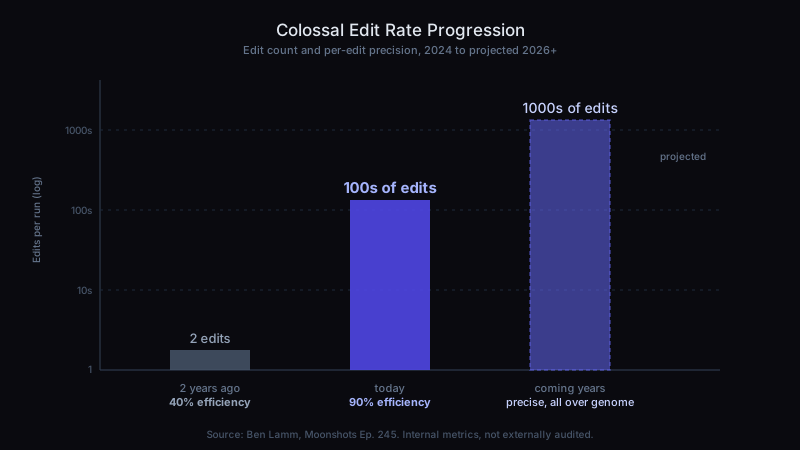
The press writes about the mammoth. Ben Lamm spent the entire fireside chat with Peter Diamandis trying to redirect the conversation to what’s actually being built. Two years ago, Colossal’s scientists were doing victory laps when they completed a couple of genetic edits at 40% efficiency. Today they are doing hundreds of precise edits at 90% efficiency, anywhere on the genome they choose. The next step is thousands. The mammoth is the demo. The platform is the product.
The Mammoth Is the Demo
Colossal hit a $10 billion valuation in four years on the back of a 260-scientist team, 200 in the United States and 60 in Australia. Lamm was direct on what powered the speed: “I think every company should be an AI company or is an AI company. Without AI, we would not be able to do anything that we’re doing.” The work that gets the magazine covers, woolly mice, Romulus and Remus the dire wolves built from a 73,000-year-old skull in 18 months, is real. It is also the marketing layer.
What sits underneath is a published delivery record that is 5× the largest publicly known DNA synthesis cargo, projected to be 20× by year-end. Edit volume and edit precision are the two metrics that decide whether you can rebuild a working genome or only paint over one. Colossal claims the lead on both.
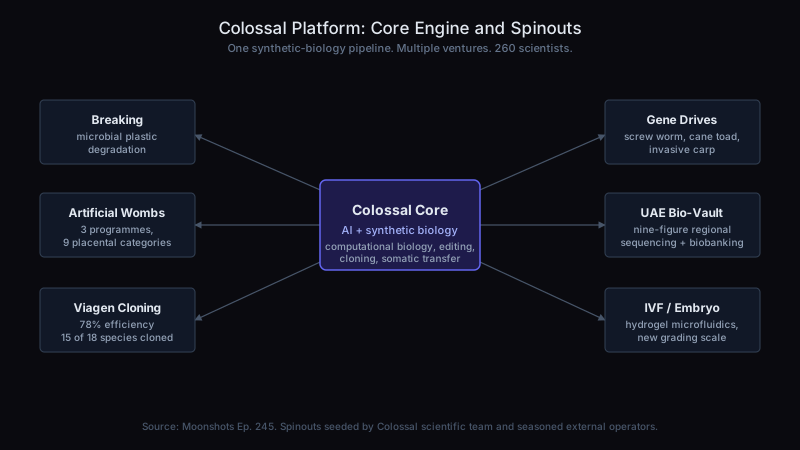
Lamm explained why de-extinction is the on-ramp rather than the destination. To build the woolly mammoth you have to solve genotype-to-phenotype expression, ancestral state reconstruction, and comparative genomics across a full pipeline: computational biology, cellular engineering, genetic engineering, cloning, somatic cellular transfer, eventually artificial wombs. You cannot fake any of those steps. Once you have built them for one species you can re-aim them at almost anything biological.
That is why a dozen spinouts now hang off the parent company. Breaking is the plastic-degradation business, built around a microbial consortium that breaks the chemical bonds of plastic rather than producing smaller microplastics. Three artificial-womb projects are running, none of them working yet by Lamm’s own admission. The acquired cloning operation, including Viagen, has cloned 15 of the 18 species ever cloned at 78% efficiency against an industry baseline of 2%. A gene-drive group is targeting screw worms, cane toads, and invasive carp. A bio-vault initiative with the UAE is a nine-figure programme with sequencing and biobanking infrastructure for regional fauna.
Where the Trillions Actually Are
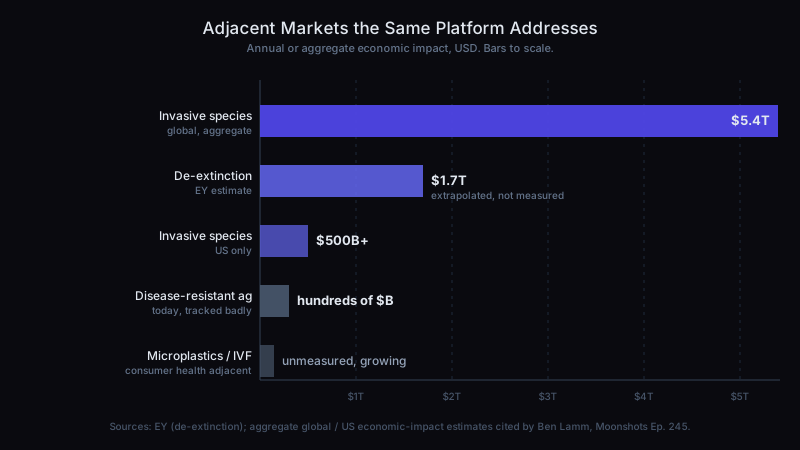
The market sizing buried in the conversation is the part that matters. EY put a $1.7 trillion estimate on de-extinction itself, derived from the observation that 12.5% of global consumers spend on something extinct-themed each year, projected as net-new dollars rather than cannibalised demand. Treat that figure with caution; it is an analyst extrapolation. The other numbers have firmer ground.
The global invasive-species problem sits at $5.4 trillion. The US economic impact alone is over $500 billion, and Texas has just declared the screw worm a national emergency. Disease-resistant agriculture, the same toolkit applied to crops and livestock, is hundreds of billions today and tracked badly. Microplastics are now measured in human brain tissue at roughly five grams per person, with 90% absorbed through the gut. Breaking is positioning a gut-targeted supplement that breaks plastic bonds before absorption. IVF runs on a morphological grading scale Lamm called archaic; Colossal’s hydrogel microfluidics device produces healthier embryos for longer and a grading scale that performs better in both model and non-model species.
Cloning and Wombs: The Production Line
The most underrated acquisition in the spinout list is Viagen. Cloning at 78% efficiency vs. 2% is not a marginal improvement. It is the difference between cloning being a stunt and cloning being a production process. The only endangered species ever cloned, including the black-footed ferret, came out of that team. Tom Brady’s dog came out of that team too, which is the part that makes headlines. The biodiversity application is the part that matters.
Pair that with the artificial-womb work and a model emerges. The northern white rhino has two females left and an annual life-support cost of around $25 million for those two animals. A productionised pipeline, biobanking plus synthetic biology plus automation plus computer vision plus artificial wombs, redirects most of that spend into reanimating diversity from lost specimens and engineered variation. Lamm was careful: the wombs do not work yet, and there are roughly nine core placental categories to solve across mammalian clades. The fact that he is willing to say “they don’t work yet” on the record is itself useful signal.
GMO Theatre and Gene Drives
The reintroduction problem is mostly political. The Tasmanian tiger Colossal is bringing back will be 100% genetically identical to source specimens, an amalgamation of 53 individuals across 300 years of preserved tissue. Australian law still classifies it as a GMO. Lamm spent a year educating the federal government on why an anti-GMO frame written in the 1980s blocks rewilding a native species in 2026. The same dynamic shows up around the screw worm: vaccines and culling are the legacy options, and a gene-drive release of all-male progeny is the precision option, gated by USDA timelines and public trust.
Lamm called gene drives a “40% technology problem, 60% marketing problem.” That is the most candid framing of synthetic biology’s adoption curve anyone has put on a podcast this year. The technology works. The trust system around it does not, partly because a previous mosquito gene-drive release in Africa was paused after public backlash, partly because invasive-species removal still defaults to poison and traps. Colossal claims both rollback capability and biocontainment that prior releases lacked. Whether regulators believe that claim is the binding constraint.
The 99% Problem
Lamm’s sharpest line was almost an aside. Of the people fluent in synthetic biology and genome engineering, he estimates 99% are working on human health care. That is the talent allocation that defines the next decade more than any specific product launch. Human therapeutics has clearer regulatory surface area, clearer reimbursement, and a more familiar venture model. Everything else in biology, ecosystems, agriculture, plastics, biocontrol, gets the remaining 1% of attention.
The strongest objections to Colossal’s pitch belong in this section. The artificial wombs are not working. The EY $1.7 trillion figure is an extrapolation, not a measured market. Cloning efficiency claims are internal, not externally audited. Gene-drive rollback at field scale has not been demonstrated. Domestic politics, not technology, will decide whether the Tasmanian tiger is ever reintroduced. Each of these is a real risk, and Lamm acknowledged most of them on-mic. The bet is not that none of these risks bite. The bet is that the platform is general enough that some of them resolving favourably is enough.
The interesting wager from this episode is not “will Colossal succeed at de-extinction.” It is “are the next decade’s largest synthetic-biology markets agriculture, biocontainment, and ecosystems rather than human therapeutics, and is the talent base that decides this allocated correctly today.” On the data Lamm laid out, the answer to the second question is no, and that misallocation is the opening Colossal is positioned for.
Sources
- Moonshots with Peter Diamandis. Episode 245: Ben Lamm: How AI Is Bringing Extinct Animals Back (And What Comes Next). Recorded April 2026, published April 7, 2026. Guest: Ben Lamm, Co-founder & CEO, Colossal Biosciences.
- Edit-rate and DNA synthesis claims. Ben Lamm, on-mic. Two-year progression from 2 edits at 40% efficiency to hundreds at 90% efficiency; published delivery 5× the largest known, projected 20× by year-end.
- Cloning efficiency. Viagen (acquired by Colossal): 78% efficiency vs. 2% industry baseline; 15 of 18 species ever cloned.
- De-extinction market estimate: EY, $1.7 trillion, derived from 12.5% global consumer spend on extinct-themed goods annually.
- Invasive species market: $5.4 trillion global; over $500 billion US economic impact. Texas declared the screw worm a national emergency in 2026.
- UAE bio-vault initiative: nine-figure regional sequencing and biobanking partnership.
- Microplastics: roughly five grams of plastic measured in human brain tissue; 90% absorbed via the gut.
- Synthetic-biology talent allocation: Lamm’s estimate of 99% directed at human health care.
The pitch is internally consistent and the team is plainly capable. The wider claims need scrutiny before acceptance. Several of the headline numbers come from Colossal itself, an analyst commission, or a self-reported acquisition. The platform exists. Whether the platform translates into the trillion-dollar adjacent markets Lamm sketched depends on assumptions that should be examined one at a time.
Edit-Rate Numbers Are Internal
“Hundreds of edits at 90% efficiency” sounds settled, and “thousands of edits in coming years” extrapolates the same line forward. Both figures came from Lamm directly, on a podcast, with no external benchmark and no peer-reviewed comparison. The 5× DNA synthesis cargo claim came with a hedge: “based on what we’ve seen, you know, we’ve surpassed the largest delivery by 5x already.” That phrasing concedes that there may be unpublished cargo work elsewhere that is competitive.
Internal metrics from a privately held synthetic-biology company are not nothing. They are also not externally audited. The structurally similar claims from competitor labs working on human therapeutics get more scrutiny because they pass through FDA filings and journal review. Colossal’s biodiversity focus places its edit-rate data outside that review system entirely.
“They Don’t Work Yet”
The most honest line in the conversation was Lamm’s admission that the artificial wombs do not work. He repeated it. The production model for endangered-species recovery, the model that justifies redirecting the $25 million per year currently spent keeping two northern white rhinos alive, depends on those wombs working across multiple placental categories.
Three concurrent programmes is responsible engineering. It is also a long timeline. Mammalian artificial wombs have been an active research area since the 1990s and remain unproven at term for any clinically relevant species. The hydrogel microfluidics work for embryos is real and impressive at the bench scale. Translating it into a production pipeline that can support endangered-species reintroduction at the populations needed for genetic diversity is an open question with a five-to-fifteen-year answer, not a near-term deliverable.
Lamm presented the EY $1.7 trillion estimate as a market size for de-extinction. Look at the derivation: 12.5% of global consumers buy something extinct-themed each year, multiplied across global consumer spend, treated as net-new dollars rather than substitution. That is not a measured market. It is a willingness-to-pay extrapolation built on a single percentage and an assumption that demand for extinct-themed content is incremental rather than displaced from existing entertainment, education, and tourism budgets.
The other market figures are more defensible but still selective. The $5.4 trillion invasive-species number is a global economic-impact estimate, including damages and management costs across every category, and is not the addressable market for any single biocontrol intervention. The $500 billion US figure is the same kind of impact aggregation. Disease-resistant agriculture at “hundreds of billions” is a one-line claim with no backing methodology in the conversation.
Cloning Efficiency Without Independent Audit
Viagen’s 78% cloning efficiency vs. 2% industry baseline is the most striking acquisition number in the deck. It also has not been published in a venue that would let an outside scientist verify it. Cloning efficiency depends heavily on species, cell type, recipient population, and what counts as a “successful” clone (live birth, weaning, sexual maturity). Without a published methodology and a third-party audit, the comparison to a “2% industry baseline” is doing a lot of work.
The fact that 15 of 18 species ever cloned came from Viagen is a real signal of operational capability. The leap from there to “we can productionise endangered-species cloning at scale” still requires demonstrating that efficiency holds up across genetically bottlenecked populations of preserved cells. That is a different problem from cloning a healthy domestic dog or a Chinese hamster.
The Spinouts Are Capital-Intensive Bets
Colossal is a parent company spinning out a dozen ventures. Breaking, three artificial-womb companies, two cloning operations, a gene-drive group, the bio-vault initiative, IVF embryo work. Each of those is operating in a different regulatory regime against different incumbents. Plastics degradation alone is a crowded space, with prior efforts that produced smaller microplastics rather than full chemical breakdown, and Breaking’s directed-evolution lead has to translate into commercial product before competitors close the gap.
A platform that spins out a dozen companies will dilute attention even with intercompany agreements on shared editing technology. Lamm acknowledged the focus risk and said the answer is dedicated teams and seasoned operators. That is the right answer, and it does not eliminate the dilution. Investors pricing the parent at $10 billion are pricing optionality across all of those spinouts. If two or three fail to clear regulatory or commercial bars, the headline valuation absorbs the loss.
The GMO Block Is Politics, Not Education
Lamm framed the Australian GMO classification of the Tasmanian tiger as an education problem solved by a year of federal-government conversations. That is partially true. It is also a political problem with constituencies that will not be educated out of their position regardless of how many genetic-identity arguments are presented. Anti-GMO sentiment in Australia, in parts of Europe, and in some US states is grounded in cultural preferences and food-system politics, not in a misunderstanding of how CRISPR works.
The screw-worm gene drive is similar. Lamm said it is “40% technology, 60% marketing.” That is candid. It is also a concession that the binding constraint is public trust, and public trust does not respond linearly to technical evidence. A single high-profile failure, a non-target effect, a containment breach, a perception of escape, would set the entire programme back regardless of the underlying science. The mosquito gene-drive pause in Africa happened with a far better-understood organism. The screw-worm release in Texas runs the same risk.
What the 99% Talent Number Misses
Lamm said 99% of synthetic-biology talent is working on human therapeutics. The implied conclusion is that this is a misallocation Colossal can capitalise on. That conclusion assumes the markets adjacent to human therapeutics are larger than human therapeutics itself, or at least competitive with it. That assumption is doing a lot.
Human therapeutics has the regulatory infrastructure, reimbursement systems, and consumer willingness-to-pay that turn capability into revenue. Biocontainment, agriculture, and ecosystem restoration have policy frameworks that are decades less mature, payer mixes that are largely sovereign rather than commercial, and political risk profiles that change with elections. The reason most synthetic-biology talent works on human health is not just preference. It is where the path from edit to revenue is shortest.
That does not invalidate Colossal’s strategy. It does mean the bet is harder than the framing suggests. The platform is real. The path from platform to monetised product across a dozen non-therapeutic markets is the part that has not been demonstrated yet, and the variance on the outcome is wide.
Sources
- Moonshots with Peter Diamandis. Episode 245: Ben Lamm: How AI Is Bringing Extinct Animals Back (And What Comes Next). Recorded April 2026, published April 7, 2026. Guest: Ben Lamm, Co-founder & CEO, Colossal Biosciences.
- Edit-rate, DNA synthesis, and cloning efficiency claims: Ben Lamm, on-mic, internal metrics.
- De-extinction market estimate: EY, $1.7 trillion, derived from a 12.5% global consumer extinct-themed spend assumption.
- Invasive species market: $5.4 trillion global economic-impact estimate; over $500 billion US economic impact.
- Mosquito gene-drive pause: documented public-trust setback in prior African release programme.
- Synthetic-biology talent allocation: Lamm’s estimate of 99% directed at human health care.
Anyone still treating Colossal as the mammoth-cloning company is reading the press releases and ignoring the data. Two years ago this team did 2 edits at 40% efficiency and called it a victory. Today it is doing hundreds of edits at 90% efficiency, anywhere on the genome, with thousands of edits arriving on the next curve. That is not an incremental improvement. That is a generational gap, and the rest of synthetic biology has not caught up because it is not trying to.
The Edit Rate Settles the Argument
Hundreds of precise edits at 90%. Published delivery 5× the largest known cargo, projected 20× by year-end. A 260-scientist team across two countries, 99% of which is in production, not research theatre. Lamm said it directly: every company should be an AI company. Colossal is not bolting AI onto a wet lab; the wet lab cannot operate without it. Computational biology, comparative genomics, and ancestral state reconstruction at this scale are AI problems first and biology problems second.
Teams not pricing this curve are already behind. Cell engineering work that takes a competitor a year is closing in real time at Colossal. The DNA synthesis lead is the kind of moat that compounds, because cargo size dictates which experiments are possible at all.
The Spinouts Are the Whole Story
Breaking is not a side project. It is a microbial consortium that breaks the chemical bonds of plastic rather than producing smaller microplastics, supercharged via directed evolution and the parent company’s editing tools. The artificial-womb work, three concurrent programmes covering different placental categories, is a production-line bet on ex-utero birth for endangered species. Viagen, now inside Colossal, has cloned 15 of the 18 species ever cloned at 78% efficiency. The industry baseline is 2%. That gap is what production capability looks like.
The gene-drive group is targeting screw worms in Texas, cane toads in Australia, and invasive carp. The bio-vault initiative with the UAE is a nine-figure programme building the world’s first regional sequencing and biobanking infrastructure for endangered fauna, with the data shared globally. None of this is hypothetical. All of it ships on the same engine.
The Markets Are Not Subtle
Invasive species are a $5.4 trillion global problem. The US economic impact alone clears $500 billion. Texas declared the screw worm a national emergency this year. Disease-resistant agriculture, the same toolkit applied to crops and livestock, is hundreds of billions today and tracked badly because no incumbent has cared enough to track it. The EY estimate of $1.7 trillion for de-extinction educational and consumer demand sits on top of all of that.
Microplastics: five grams in the human brain, 90% absorbed through the gut, accumulating in reproductive tissues. A gut-targeted supplement that breaks plastic bonds before absorption is a consumer health product with no real competitor. IVF: the morphological grading scale is 30 years old and Colossal already has a hydrogel microfluidics device that produces healthier embryos and a better grading system. Add it up and the human-health adjacency is larger than most companies built explicitly for human health.
Cloning at Scale Is Already Live
The Viagen number is the most underrated metric in synthetic biology this year. Cloning at 78% efficiency vs. 2% turns cloning from a one-off stunt into a production process. The black-footed ferret and every other endangered species cloned to date came out of this team. Pair that with the productionised wombs and the northern white rhino problem, two animals left, $25 million per year keeping them alive, becomes a redeployment opportunity. Most of that spend goes to engineering diversity from preserved cells and reanimating viable populations through ex-utero birth, with the rest of the budget freed for water, education, and reintroduction.
Lamm flagged that the wombs do not work yet. Take that as honesty about the timeline, not as a reason to discount the platform. Three concurrent programmes covering nine placental categories will not all fail. The first one that works changes the unit economics of every endangered species programme on the planet.
The GMO Block Is a Marketing Problem
The Tasmanian tiger Colossal will reintroduce is 100% genetically identical to historical specimens, an amalgamation of 53 individuals across 300 years of preserved tissue. Australian law still classifies it as a GMO. Lamm spent a year educating the federal government on why a 1980s GMO frame blocks rewilding a native species in 2026. He won that argument because the science is unambiguous.
Gene drives are a 40% technology problem and a 60% marketing problem. That framing is exactly right. The technology now works at the precision required for screw-worm release in Texas. Rollback capability and biocontainment exist where prior releases lacked them. The constraint is regulator confidence, and the way you build regulator confidence is exactly what Colossal is doing: track record, transparency about failure modes, and bilateral agreements with sovereign governments.
The 99% Problem Is the Real Moat
Lamm’s most important number was the one he tossed in as an aside. 99% of synthetic-biology talent is working on human therapeutics. The remaining 1% is fighting over plastics, gene drives, ag, biocontainment, and ecosystems combined. That is not balance. That is a market with capacity for a category leader and very little competition for the seat.
Colossal already occupies it. Hundreds of edits at 90% efficiency, 5× to 20× DNA synthesis lead, the only operational endangered-species cloning team on Earth, three artificial-womb programmes, a gene-drive group with sovereign partnerships, and a bio-vault built into a consumer-facing educational venue. The press will keep writing about the mammoth because the mammoth is the headline. Anyone evaluating the company on that basis will miss what is happening, and they will keep missing it until the spinouts are obvious to everyone, at which point the entry price is gone.
The bet is not “will Colossal ship the mammoth.” The bet is the talent allocation across all of synthetic biology has been wrong for a decade, and the company that recognised it first is also the only one with the platform to act on it. Both halves of that bet look settled in the data Lamm laid out. The rest is execution.
Sources
- Moonshots with Peter Diamandis. Episode 245: Ben Lamm: How AI Is Bringing Extinct Animals Back (And What Comes Next). Recorded April 2026, published April 7, 2026. Guest: Ben Lamm, Co-founder & CEO, Colossal Biosciences.
- Edit-rate and DNA synthesis claims. Ben Lamm, on-mic.
- Cloning efficiency. Viagen (acquired by Colossal): 78% vs. 2% industry baseline; 15 of 18 species ever cloned.
- De-extinction market estimate: EY, $1.7 trillion.
- Invasive species market: $5.4 trillion global; over $500 billion US economic impact.
- Microplastics: roughly five grams measured in human brain tissue; 90% absorbed via the gut.
- Synthetic-biology talent allocation: Lamm’s estimate of 99% directed at human health care.
Comments
Loading comments…
Leave a comment