Anthropic shipped a coalition instead of a model. Project Glasswing was the headline. Mythos, the strongest frontier model anyone has measured, sat unreleased while a press conference talked about cybersecurity vulnerabilities in legacy code.
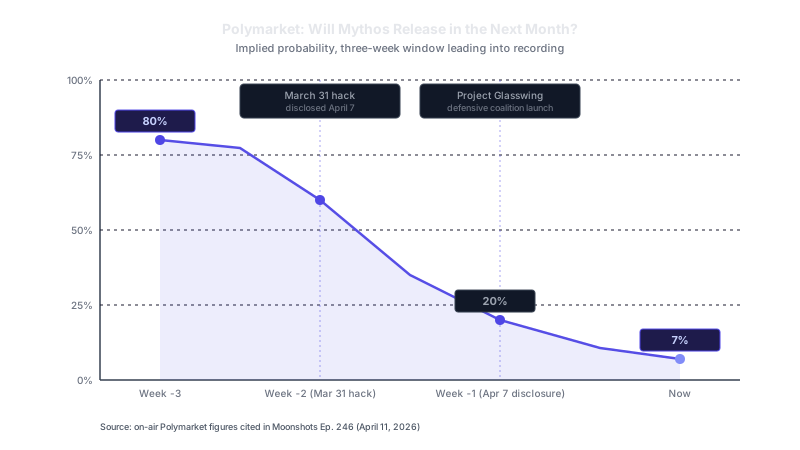
Polymarket priced the release at 80% three weeks ago. After a March 31 hack and a defensive-disclosure tour, that number is now 7%. This is the first time a frontier lab has held back its lead model on capability grounds. The rest of the April 2026 news cycle, SpaceX’s $2T IPO, the data center collapse, OpenAI’s retreat from consumer, all hangs off that single decision.
The launch was a disclosure, not a product
Alex Wissner-Gross noted that the Mythos announcement opened with defense and an alliance, not capabilities. Anthropic framed Glasswing as a coordinated patch effort across blue-chip companies, made necessary because a single model can now find dense vulnerabilities in legacy code going back decades. The capability ceiling sat in the back of the slide deck.
That ordering is the news. Frontier labs have always opened with benchmarks. Anthropic opened with the downstream consequences of capability and the patches required to absorb them. The model itself is reportedly more than 400 times better than a human at long-horizon AI research tasks, an upward discontinuity on every autonomy curve published.
This is not a benchmark game. It is the first public admission that disclosure now precedes release.
Anthropic earned the right to pause
Anthropic is at $30B ARR. OpenAI sits at $24 to $25B. Sora got shut down because it was bleeding a million dollars a day in compute against poor retention, the Disney deal got cancelled, and the secondary market for OpenAI shares is trading below the last round. The lead changed hands.
Dave Blundin’s read on why is sharper than the revenue numbers. Anthropic was compute-constrained early, so it focused on one thing: recursively self-improving code generation. That focus is what produced Claude Code, which is what produced the autonomous unhobbling that turned $30B in ARR into a credible run at a trillion. OpenAI is now trying to become Anthropic via Codex faster than Anthropic can become OpenAI.
A lab in the lead can sit on a model. A lab catching up cannot. That asymmetry is exactly why Sam Altman’s video this week reads less like a warning and more like an announcement.
Defensive co-scaling is the new game
Altman said in the next year we will see significant cyber threats from AI, that bio-capable open-source models are imminent, and that resilience needs to come from defenders, platforms, and governments together. He used the phrase “world-shaking cyber attack this year.”
Alex’s framing on the pod cuts to what’s actually being argued. The risk is not exotic. A single model that can invert a popular cryptographically secure hash function is a civilizational zero day. There were unconfirmed rumours that early reasoning models were benchmarked partly on this kind of inversion. If that’s true, the target is also the test, which makes the attempt close to inevitable.
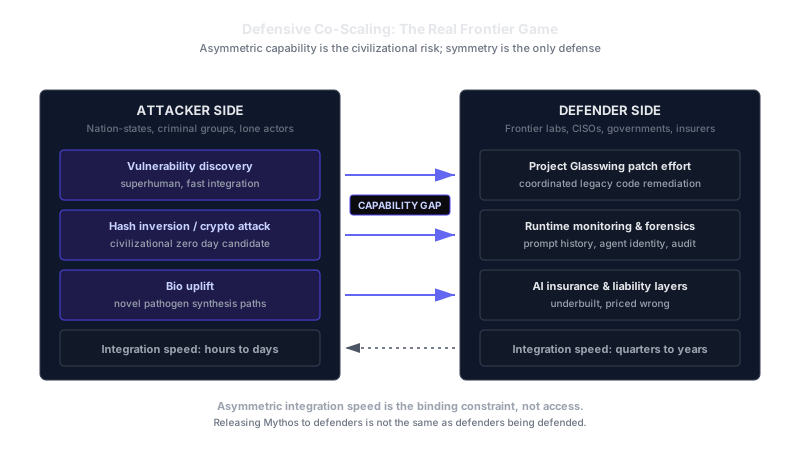
The defensive answer is not a slower release schedule. It is symmetric capability. Defenders need vulnerability discovery as good as the attackers’. That is what Glasswing is announcing in product form, and what holding back Mythos buys time for.
The OpenAI counter-pressure
The honest counterargument is that holding back only works if the field cooperates. SPUD, OpenAI’s next flagship, is rumoured to ship within days at capability roughly comparable to Mythos. GROC 5 is overdue but coming. Polymarket already has GROC 5 at sub-20% for Q2.
If SPUD releases on cadence, Anthropic’s pause becomes a competitive penalty. Dario cares about safety, but Eric Schmidt’s read holds: a lead lets you hold back, and a tie does not. The lab that goes second on ungated release loses both the press cycle and the enterprise pipeline. That is a lot of pressure on a model whose internal use case, recursive self-improvement, is more valuable than its external one.
The cynical version of this read is also worth taking seriously. Salim noted that Sam went public with cyber and bio warnings the same week Anthropic owned the responsible-disclosure narrative. Whoever frames the risk gets to shape the governance regime. Holding back Mythos puts Anthropic in that frame. Spud-shipping three days later puts OpenAI in a different one.
The release also has costs
Alex made the strongest case against the pause. About 150,000 people die per day. Every month a frontier model sits unreleased is a month of delayed cures, delayed vulnerability patches, and delayed defensive uplift. Holding back is not free, and the framing of “too powerful to release” silently assumes that the marginal capability does more harm than good. That assumption is doing a lot of work.
There is also a quieter reason a model might stay internal. Mythos is reportedly five times more expensive to run than Opus. A model that lives off the cost-versus-performance frontier may not be public-economical until it is distilled. “Held back for safety” and “uneconomical to ship” can look identical from the outside.
The pattern below the news
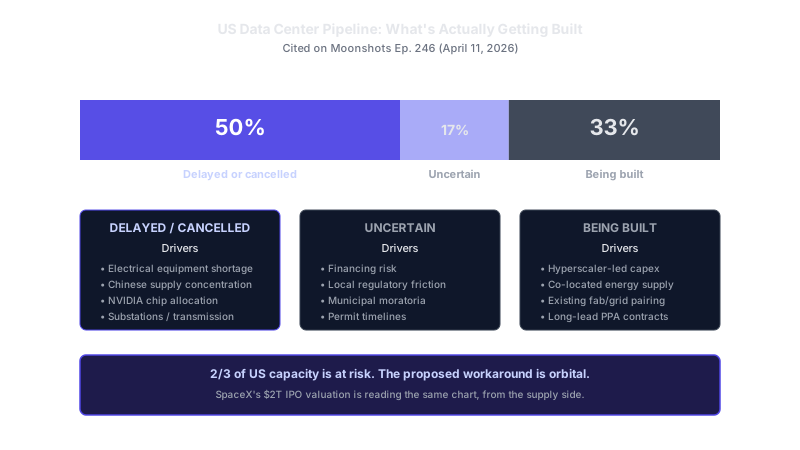
Look across the rest of the episode and the same shape repeats. SpaceX is going public at $2T because orbital data centers are the workaround for a 50% delay rate on land-based ones, not because rockets got cheaper. Intel is partnering with NVIDIA on TerraFab at 1.8nm because TSM concentration is a civilizational single point of failure. Google quietly owns the largest share of specialized AI chips and barely talks about it because antitrust survives only as long as the current administration does.
Each of those is a story about distribution risk. Mythos is the same story at the model layer. The thing being managed is no longer “can we build it” but “what happens after it is built and who has it.” That shift is what the press conference was actually about.
What it means for builders
Three things follow if you take the held-back release seriously.
The first is that the gap between internal and released capability is now wide enough to matter. Frontier labs are diverting compute to internal recursive self-improvement, distillation, and red-teaming. The model you can buy on an API is no longer the model that exists. Plan capability roadmaps against the leaked benchmarks, not the public ones.
The second is that codegen is not a vertical, it is the unhobbling. Claude Code turned an interactive product into an autonomous one, and the next move, OpenClaw or whatever shape it takes, is the same lever pulled harder. If your product still treats AI as a copilot, the budget allocations you are making are wrong by an order of magnitude.
The third is that defensive capability is a market. Not a feature, a market. AI insurance salespeople were already approaching Alex in person this week. Vulnerability discovery, runtime monitoring, prompt-history forensics, and policy infrastructure are all underbuilt against the curve Sam was warning about. The entrepreneurs who treat that as the real frontier, instead of the next benchmark, are the ones who will be on the right side of the next twelve months.
The Mythos release date will eventually come. The decision to hold it back already happened, and that is what changed.
Sources
- Moonshots with Peter Diamandis, Episode #246: SpaceX Goes Public, Claude’s Mythos Release, and the US Data Center Delay. Recorded April 10, 2026, published April 11, 2026. Hosts: Peter Diamandis, Salim Ismail (OpenExO), Dave Blundin (Link Ventures), Dr. Alexander Wissner-Gross.
- Polymarket release-window odds for Mythos referenced on the pod: 80% three weeks prior, 20% mid-cycle, 7% at recording.
- Anthropic vs OpenAI ARR: $30B vs $24 to $25B per the on-air comparison.
- Project Glasswing: Anthropic-led coalition for legacy-code vulnerability remediation, announced in tandem with the Mythos disclosure.
- US data center supply mix: 50% delayed or cancelled, 17% uncertain, 33% being built (chart cited on the pod).
A model that nobody outside Anthropic has used is being treated as a turning point in AI safety. The argument runs on benchmarks Anthropic chose, framing Anthropic chose, and a coalition Anthropic announced. Before declaring the frontier lab era over, it is worth asking how much of the held-back-Mythos thesis survives if we strip out the marketing.
”Too powerful to release” is also “convenient to delay”
Mythos is reportedly five times more expensive to run than Opus. That is the kind of detail that gets buried in a safety announcement and shows up later in an earnings note. A model whose unit economics do not work yet looks identical from the outside to a model that is being held back for the public good.
Anthropic also has a regulatory incentive to frame its lead in cybersecurity terms. Recursive self-improvement is the threshold that triggers congressional hearings. Calling the same capability “vulnerability discovery” instead of “AI research uplift” is a real choice with real legal consequences. The kindest reading is that both motivations are true. The honest reading is that we cannot tell which is dominant from the outside.
The Polymarket collapse is not what it looks like
A prediction market falling from 80% to 7% in three weeks is dramatic. It is also a market with thin liquidity that responded to Anthropic’s own announcement. Anthropic told the market the release is delayed, the market priced the delay in, and the chart got cited back as independent confirmation that something fundamental had shifted. That is not a signal about safety thresholds. That is a signal about who controls the disclosure timing.
The March 31 hack mentioned on the pod has not been independently verified at the resolution implied. We are using a private hack timeline, an Anthropic-set release schedule, and a polymarket-priced consequence to support a “frontier lab era is over” thesis. Each of those individually is weak. Stacking them does not make the stack stronger.
The ARR comparison erases the time axis
Anthropic at $30B ARR vs OpenAI at $24 to $25B is a real number. It is also a snapshot, not a trajectory. OpenAI moved its $120B raise on schedule. The Codex business is the fastest-growing line inside OpenAI. Sora got cut because consumer video was the wrong bet, not because OpenAI ran out of options. The same crew that called Anthropic’s win this quarter has been calling lab winners every quarter for two years, and the lead has changed hands four times in that window.
Reading the ARR gap as evidence that holding back is a viable strategy assumes the gap is durable. There is no evidence yet that it is. Six months ago, OpenAI was running circles around Anthropic on the same chart.
The defensive co-scaling argument has a hole
Defensive co-scaling assumes defenders can absorb capability as fast as attackers can use it. That is not how cybersecurity has ever worked. Patch cycles take quarters. CVE disclosure to remediation in regulated industries takes years. The “global patch for all software” framing collapses the moment you ask which CISO is actually deploying the AI-discovered patches across a Fortune 500’s legacy estate inside the threat window.
Releasing Mythos to defenders is not the same as defenders being defended. The capability gets used by everyone who can pay, and “everyone who can pay” includes nation-state attackers with much faster integration timelines than insurance-bound enterprises. The asymmetry is built into the operational reality, not into the access model.
Sam’s warning may be exactly what it looks like
The pod’s most cynical read is that Sam Altman’s bio and cyber video was a framing play to counter Anthropic’s Glasswing narrative. Maybe. The simpler explanation is that Altman is on record saying these things because he believes them, every other frontier lab CEO is saying the same things, and the convergence of cyber and bio risk does not require a media strategy to explain.
Treating every public statement from a frontier lab CEO as governance positioning is a cheap way to feel insightful. It is also corrosive. If we cannot take “this capability is dangerous” at face value from the people building the capability, the alternative is to wait for the harm to demonstrate itself empirically. That is a worse equilibrium than the one we have.
Codegen as the killer app may be a one-product story
Claude Code is a great product. Whether code generation is the unhobbling, or just the first place the unhobbling looked good, is unsettled. Coding has perfect feedback loops, abundant training data, and an audience of users who can tell exactly when the model is wrong. That makes it the easiest possible domain for an autonomous AI to dominate. It does not necessarily generalize.
The next domain, whatever OpenClaw becomes, is unlikely to find the same combination of clean signal, willing buyer, and tolerable error rates. If codegen turns out to be uniquely well-suited to autonomous AI, the trillion-dollar agent army does not arrive on schedule. The held-back-Mythos thesis assumes the unhobbling generalizes. That is a load-bearing assumption with weak support.
The data center crunch is supply-side, not orbital-demand
The pod’s framing is that 50% of US data center delays are pushing compute to orbit. The honest read is that they are pushing nothing anywhere, because orbital data centers do not exist at the capacity required and will not for years. The land-based delays are about electrical equipment, regulatory friction, and Chinese supply concentration. None of those are solved by Starship.
Treating SpaceX’s $2T IPO as confirmation of the orbital compute thesis is post-hoc storytelling. The IPO has the valuation it has because Starlink is profitable, not because data centers are about to leave the planet. Building investment theses on the orbital DC narrative is going to be expensive when the actual binding constraint, transmission and substations, takes a normal capex cycle to clear.
What survives
A few things from the original argument do hold. The gap between internal and released frontier capability is real and growing. Defensive capability is genuinely an underbuilt market. Anthropic owning the responsible-disclosure narrative this quarter is a real PR asset. None of that requires the strong claim that the frontier lab era is over.
The strong claim is the one to be careful about. One model held back, by one lab, on one disclosure cycle, with private hack data, in a quarter where the same lab happened to take the ARR lead. That is not a regime change. It is one data point with a press conference attached. The honest position is to wait for the second data point before redrawing the map.
Anthropic shipped a coalition instead of a model. That decision is more important than any release this year. If your AI roadmap still treats public model availability as the leading indicator of capability, you are already behind.
The launch was a disclosure
Project Glasswing opened with defense, not benchmarks. Anthropic told the room a single model can now find dense vulnerabilities in legacy code spanning decades. The capability ceiling stayed in the back of the deck, where it belongs once the field crosses superhuman vulnerability discovery. Frontier labs that still lead with benchmark scores are reading the room from a year ago.
Mythos is reportedly more than 400 times better than a human at long-horizon AI research tasks. That is an upward discontinuity on every autonomy curve in print. There is no scaling wall.
The lead changed hands
Anthropic at $30B ARR. OpenAI at $24 to $25B. Sora shut down because it was bleeding a million dollars a day. The Disney deal cancelled. OpenAI secondaries trading below the last round. This is not a close race.
Anthropic was compute-constrained early and focused on one thing: recursively self-improving code generation. That focus produced Claude Code. Claude Code produced the autonomous unhobbling. The unhobbling produced the ARR gap. OpenAI is now copying the playbook through Codex. The follower position in the AI race is now a structural disadvantage, not a temporary one.
Defensive co-scaling is the actual game
Sam Altman’s video this week was an announcement, not a warning. Bio-capable open-source models are imminent. A world-shaking cyber attack inside twelve months is on the table. The fix is symmetric capability, not slower releases.
A single model that can invert a popular cryptographically secure hash function is a civilizational zero day. The target is the test, which makes the attempt close to inevitable. Defenders need vulnerability discovery as good as the attackers’. That is what Glasswing is in product form. That is what holding back Mythos buys time for.
The pattern is everywhere
SpaceX’s $2T IPO is not about rockets. It is about orbital data centers being the workaround for a 50% delay rate on land-based ones. Intel and NVIDIA at TerraFab 1.8nm is not about chips. It is about removing TSM concentration as a single point of civilizational failure. Google quietly owning the largest share of specialized AI chips and refusing to talk about it is not modesty. It is antitrust survival as long as the current administration holds.
Mythos is the model-layer version of the same story. The question stopped being “can we build it” and became “what happens after it is built and who has it.” Every other story in the news cycle confirms it.
What follows
The model you can buy on an API is no longer the model that exists. Frontier labs are diverting compute to internal recursive self-improvement, distillation, and red-teaming. Plan against the leaked benchmarks, not the published ones. Anything else is forecasting from stale data.
Codegen is the unhobbling, and it has already happened. Claude Code converted the AI product surface from copilot to autonomous fleet. Treating AI as a single-seat assistant in 2026 is like treating the internet as a brochure in 2001. The companies still budgeted that way are funding their own irrelevance.
Defensive capability is a market. AI insurance salespeople are already cold-walking the room. Vulnerability discovery, runtime monitoring, prompt-history forensics, policy infrastructure: all underbuilt, all priced wrong. The entrepreneurs treating that as the next billion-dollar opportunity, instead of waiting for the next benchmark cycle, are the ones who will be on the right side of the next twelve months.
The Mythos release date will eventually come. The decision to hold it back already changed the field.
Comments
Loading comments…
Leave a comment