The SpaceX board just voted to hand Elon Musk 200 million super-voting shares if he puts a million people on Mars and 60.4 million more if he brings 100 terawatts of orbital compute online. The payout sits around half a trillion dollars. There is no comparable comp package in the history of capitalism. There is also no comparable corporate output on the table. Episode 253 of Moonshots, recorded live at MIT, treated that fact as the centre of gravity for every other story on the docket, from the OpenAI breach-of-trust trial to the Hangzhou ruling that AI cannot legally fire a worker.
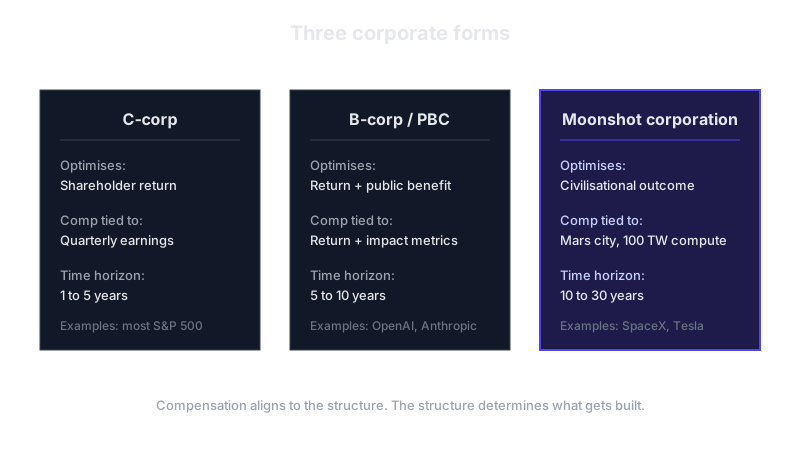
The framing that landed hardest came from Alex Wissner-Gross. He read the package as the seed of a third corporate form. C-corps maximise shareholder return. B-corps add public benefit. The Elon construct optimises for civilisational outcomes and prices compensation against achieving them. It is not a bigger C-corp. It is a different organism, and the rest of the S&P 500 has not built one yet.
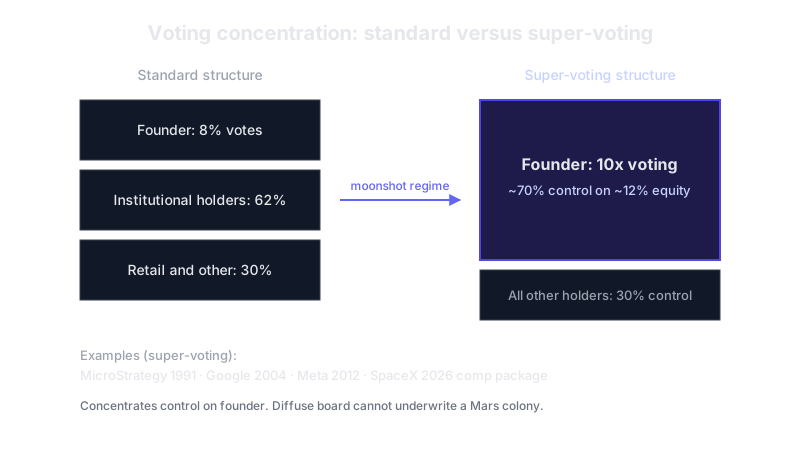
Super-voting structure as the precondition
Founder-control mechanics are not new. Mike Saylor took MicroStrategy public in 1991 with super-voting stock and Goldman Sachs walked away from the deal. Sumner Redstone used the same instrument before him. Larry and Sergey copied it at Google, Zuckerberg locked it in at Meta, and now Musk is using it for the largest single moonshot ever underwritten by public markets.
Dave Blundin’s read on this is unsentimental. The crazy outcomes only come out of founder-led, tech-forward companies. Take Cambridge as a sample, then walk to Omaha and tell the street you are putting a million people on Mars. A normal board blocks you on rational grounds. A super-voting founder does not have to ask. The governance argument against super-voting is correct on stability and wrong on output, and the output is what moonshots are paid for.
Exponential org mechanics under a top-down founder
Salim Ismail’s pushback was that Musk runs command-and-control monarchies, not exponential organisations. He then walked himself into agreeing with Alex. The MTP and the vision flow top-down with no intermediating layers. There are five layers between Jensen Huang and his ICs at NVIDIA. SpaceX has a similar shape. Once an engineer signs up for a rocket engine that gets a payload to Mars, the founder gets out of the way and the metric flows through the org.
Stephen Kotler asked the operational question of the day. If you are building a dashboard for a moonshot corporation, what goes on it that other companies miss? Salim’s answer was MTP plus a one-year operating plan instrumented in real time. The full five-year vision destroys the team cognitively, so it stays off the dashboard. The TED parable lands the point. A linear plan of five, ten, fifteen TEDx events per quarter would have produced about 2,500 events. The MTP-plus-rules approach produced 20,000.
The moonshot corporation runs on a real-time operating plan tied to a civilisational MTP. The comp package is the alignment instrument. The founder’s job is to hold the vision and stay out of the way after the engineers commit.
OpenAI v. Musk is the same governance question in court
The breach-of-trust trial running this week is a different surface of the same problem. Musk wants $150 billion in damages, OpenAI reverted to a nonprofit, and Altman and Brockman gone. Brockman’s diary is the smoking gun the prosecution is leaning on. The defence has equity emails from Musk’s own team in 2017, plus Musk’s admission that XAI distilled from OpenAI models, plus the equity offer from Altman that Musk called a bribe.
Alex’s framing is that the structural lesson got litigated three years too late. The dog catches the car. OpenAI started as a nonprofit because the founders thought AGI was a long horizon. The capability arrived and the structure could not raise the capital required to absorb it. Anthropic ran the same playbook. Pure alignment lab, then revenue, then capabilities, then for-profit public benefit corporation. The lesson is to start as a PBC. Do not fight it out in federal court four years later.
Salim disagreed and was wrong on the timeline but interesting on the destination. He argued capitalism dissolves in two to three years and the cleanest structure to hit an MTP wins, even if that structure is a nonprofit. Elon does not care about money, on his read. The package is just the cleanest legal instrument that puts a million people on Mars. The post-capital case is real but is not the design constraint for 2026. The structural choice today is PBC.
Humanoid production curves as the substrate
The same governance question shows up in the robot factories. Figure AI is scaling from one robot per day to one per hour, with a 100,000-robot target by 2030. 1X Technologies opened a 58,000-square-foot Hawthorne facility and aims for 10,000 units this year, 100,000 in 2027. Bernt Børnich promised Peter Diamandis a Neo by the fall. Musk’s Optimus prediction is one million by 2030 and ten billion humanoids by 2040.
Dave’s read from the Tesla Gigafactory is that the entire manufacturing chain is already automated. The robots assemble the automation equipment. Boxes arrive, a screw turns, a new line is online. The only unautomated step is the humanoid action itself. That is the bottleneck the next decade closes.
Salim’s counter is the form factor itself. Humanoids are good for adaptable environments and bad for repetitive work, which is exactly where most automation lives. Wheeled robots, drones, multi-armed units, anything other than a person-shaped robot would win on most tasks. Dave’s reply was care of the elderly. Human environments were built for human form factors, so we need humanoids in the loop whether or not we want them on the factory floor. Both are right. The mix sorts itself out at scale.
China’s Hangzhou ruling redefines the labour stack
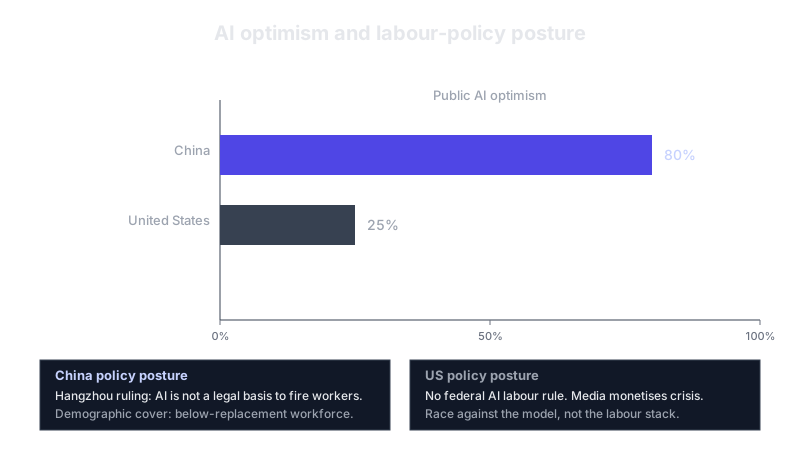
The Hangzhou court ruled a tech worker named Zhao could not be demoted from 25,000 yuan to 15,000 yuan because AI absorbed parts of his role. The court called the AI adoption a business choice rather than an external shock that voids the contract. China is setting the global default on AI labour displacement, and the default is no.
Alex called it ironic. China has gone communism to anarcho-capitalism back to communism. The country running the world’s biggest robotics build-out is also writing the rules that protect human workers from substitution. Salim’s read was that this is a signpost of a broader transformation, like a Kentucky coal museum running on solar. The artefact is the signal.
Dave added the demographic piece. China is below replacement and people are dropping out of the workforce at speed. Guaranteeing employment costs nothing because the AI adoption rate is not constrained by labour. The policy gets China the social cohesion without paying for it.
The U.S. sits at roughly 25% AI optimism. China sits at 80%. The labour-protection policy is partly cultural and partly downstream of a state that wants robotics enthusiasm and can pay for it through guaranteed jobs. Either way, the policy stack matters more than the model stack at this point.
The case for AGI in 2020 and what it implies
Demis Hassabis is now publicly at 50/50 on whether AGI needs another major breakthrough, possibly in world models. Ten years ago he thought it was five-plus breakthroughs. Alex went further and argued AGI was achieved in summer 2020 with the GPT-3 few-shot learners paper. The fundamental discovery, on his read, was that you can produce general capability by compressing general human knowledge. Everything since is incremental.
Stephen Kotler was not buying. His daily experience writing books and doing neuroscience research with AI is that the machine is narrow, misses obvious gaps, and has regressed at writing since GPT-3. Alex’s response was a science move. Build a Kotler bench. Encode the gaps. Hand it to the frontier labs and they will optimise against it. That is how the regression gets fixed, if it is real.
Dave’s framing was sharper. You can write better than Claude in five minutes. Run Claude a billion times with a selection process and the comparison flips. The self-improvement loop is not a writing competition. It is an evolution. Furry mammals after the asteroid will look like they cannot code right up until they can.
The moonshot corporation thesis depends on this. If AGI is already here or arrives by the end of the decade, then the scientific discovery engines at Lila Sciences and Isomorphic Labs are the input to every other industry. Compensation against civilisational outcomes is only rational if the outcomes are achievable, and the achievability case rests on the capability curve.
Where this lands
What episode 253 actually argued is that we now have working examples of a third corporate form. SpaceX, Tesla, OpenAI as a PBC, Anthropic, and the Chinese state itself are running variants of the same idea. The compensation aligns to civilisational outcomes. The governance concentrates control on a founder who holds the MTP. The dashboard runs on real-time OKRs against a one-year plan, not a five-year roadmap. The capital structure assumes a capability curve that is still steepening.
The conventional S&P 500 board cannot replicate this. The replacement-CEO model, the quarterly earnings cycle, and the diffuse shareholder vote are mismatched to a comp package that pays out on a Mars colony or a 100-terawatt orbital compute layer. The mismatch is the point. The team that wins the next decade is the team that figures out how to run a moonshot corporation without burning down the institutions it inherited from the C-corp era.
Sources
- Moonshots with Peter Diamandis, Episode #253: Demis Hassabis on AGI, Robots Scale Production, and Elon’s $1T Mars-Shot Comp. Recorded live at MIT, episode date May 7, 2026. Hosts: Peter Diamandis, Salim Ismail, Dave Blundin (Link Ventures), Dr. Alexander Wissner-Gross. Special guest: Stephen Kotler, co-author of We Are As Gods.
- SpaceX board vote on Musk compensation package, May 2026.
- Hangzhou Intermediate People’s Court ruling on AI-driven employee demotion, May 2026.
- Figure AI, 1X Technologies, and Tesla Optimus production targets, public statements.
- Demis Hassabis interview on AGI breakthrough timeline.
The moonshot corporation thesis is elegant on stage at MIT and shakier in the field. The episode 253 argument depends on four claims, and each one breaks down under inspection. The comp package is novel but not stable. The exponential org framework is descriptive, not predictive. The OpenAI trial is being read as a structural lesson when it might just be a tax case. And the AGI-in-2020 claim is doing the heavy lifting for a capability curve that, on Stephen Kotler’s daily evidence, is not where the panel says it is.
Super-voting concentrates risk, not just control
Super-voting structures have a longer track record than the panel admitted. Saylor used them in 1991. MicroStrategy is still founder-controlled and is not the dominant analytics company it set out to be. Sumner Redstone’s super-voting structure produced Viacom’s family lawsuits and a board paralysed by succession. Page and Brin’s Alphabet structure has produced one of the most defensive antitrust postures in the industry.
The argument that super-voting produces moonshots is selection bias. We remember Tesla and SpaceX and forget the dozens of super-voting failures that did not ship anything. The structure works when the founder is correct and breaks when the founder is wrong, and there is no governance recourse in the second case. That is not a feature. That is the bug the diffuse board model was designed around.
The $500 billion payout on a million-person Mars city is also not the same as the founder taking $500 billion. It is paper that vests on a moonshot. If the moonshot lands, the dilution sits on every other shareholder. If it does not, the package is symbolic. Either way, it is not the precedent the panel framed it as.
Exponential org mechanics describe outcomes, not produce them
The TED parable is doing more work than it can carry. TEDx produced 20,000 events because the franchise model was free, the brand carried the legitimacy, and the marginal cost of a TEDx licence was zero. The MTP-plus-rules framing is post-hoc. Most MTP-driven organisations do not produce 20,000 of anything, and the ones that do usually have a free distribution channel hidden underneath the framework.
SpaceX has fewer layers than NVIDIA. So does any startup. Layer count is a function of headcount, not governance philosophy. The exponential org dashboard is a useful tool for thinking about a one-year operating plan, but it does not explain why some founders ship Mars rockets and others ship cryptocurrencies that turn into fraud cases. The selection effect is doing the explanatory work and the dashboard is decoration.
Salim was honest about the limit. He said the moonshot corporation framing only fits when the founder does not actually care about money, which is a near-impossible filter to apply prospectively. The investor cannot tell ex-ante which founder is in it for the MTP and which is in it for the comp package. The structure is identical in both cases.
OpenAI v. Musk might be a tax case, not a structural lesson
The dog-catches-the-car framing assumes the issue was that the nonprofit structure could not raise enough capital. The trial record suggests something narrower. Musk’s 2017 equity email shows his team was negotiating equity in a for-profit subsidiary while the public-facing structure remained a nonprofit. Brockman’s diary shows the leadership knew the B-corp was the plan and used Musk’s exit as cover.
That is not a structural lesson about nonprofits and moonshots. It is a fact pattern about whether a charitable trust was used to acquire capital under one structure and convert it under another. The court will rule on the trust violation, not on whether nonprofits can hold AGI. Reading the case as a governance lesson over-generalises from a specific dispute about timing and disclosure.
Anthropic’s transition followed a different sequence with similar economics, which is what makes the panel’s argument plausible. But “two examples” is not “structural inevitability.” Mozilla Foundation runs a long-horizon mission as a nonprofit with a commercial subsidiary. Wikimedia Foundation does similar at a different scale. The PBC-only conclusion does not survive once the comparison set widens.
Humanoid production targets are marketing, not bottom-up forecasts
Elon predicted 1 million Optimus units by 2030 and 10 billion by 2040. Stephen Kotler’s point is the cleanest one on the show. Every time Musk opens his mouth about robots, he is partly selling against cheaper Chinese competitors who have not yet shipped. The same was true of the 2019 Tesla Robotaxi prediction, the 2020 full self-driving prediction, and the Neuralink human-internet link timelines.
Salim’s form-factor critique is also doing more work than the panel admitted. Humanoids are bad at the repetitive tasks that dominate manufacturing. They are useful for human environments, which is a much smaller subset of the total robot demand than the 10-billion-by-2040 number requires. The factory-floor humanoid is a transitional shape. The post-humanoid robot, with wheels or extra arms or no upright posture at all, is the long-run winner on most workloads.
Figure’s one-robot-per-hour cadence is impressive and not yet at scale. 1X’s 10,000-unit-this-year target requires the Hawthorne facility to ramp at a rate the panel did not interrogate. Production curves bend down, not just up. The case for humanoid saturation by 2040 rests on extrapolations that have failed repeatedly in other categories.
China’s labour ruling is downstream of demographics, not governance philosophy
The Hangzhou ruling makes sense once you account for China’s collapsing workforce. Dave said it himself. The country is below replacement and people are leaving the labour force at speed. Guaranteed employment costs nothing because the AI build-out is not constrained by humans anyway. That is not communism-meets-anarcho-capitalism. That is a demographic policy with cosmetic legal language attached.
The 80% versus 25% AI optimism gap is also not what the panel implied. Chinese survey responses on government-favoured topics are notoriously inflated. The actual revealed-preference data on robotics adoption is more even than the headline numbers suggest. The U.S. is not “losing” the optimism race in the way the framing implied.
The deeper problem is that the panel conflated the regulatory race with the capability race. China can write whatever labour rules it wants and still lose the frontier model race if it cannot import advanced chips. The U.S. can be 25% optimistic and still ship the trillion-parameter models. Policy and capability are independent variables and the panel collapsed them.
AGI-in-2020 is a claim that hides the work
Alex’s claim that AGI was achieved in summer 2020 with the GPT-3 few-shot learners paper is a definitional move, not a scientific one. It redefines AGI as “general capability through compressed knowledge” and then announces the bar has been cleared. Stephen Kotler’s pushback was the right one. The technology is narrow. It misses gaps in his neuroscience workflow. It has not improved as a writer since GPT-3 on his daily measurement.
The Dave Blundin counter, that you run Claude a billion times with a selection process and beat any human writer, is a different argument. It is not “the model is general.” It is “the inference loop plus a selector is general.” That collapses AGI into a search problem at scale, which is a useful framing and not the one the AGI-in-2020 claim is making.
The moonshot corporation thesis depends on the capability curve being where Alex says it is. If Kotler is correct that the daily-use model is narrow and not improving on important axes, the half-trillion-dollar comp package is priced against a curve that may not arrive. The founder still wins on paper. The shareholders carry the dilution risk if the moonshot does not land.
Where this lands
Episode 253 made a clean case for a new corporate form and a less clean case for treating it as the dominant structure of the next decade. The moonshot corporation works when the founder is correct, the capability curve is steepening, and the regulatory regime stays out of the way. All three are contingent. The episode treated them as given.
The honest read is that we have three or four working examples of founder-led companies with super-voting structures and ambitious comp packages. We do not yet have a generalisable governance form. The S&P 500 board copying the SpaceX comp package without the SpaceX founder is buying the wrong half of the structure. The lesson is narrower than the panel made it sound, and the institutions inherited from the C-corp era are doing more useful work than the framing admitted.
The SpaceX board approved a half-trillion-dollar comp package tied to a Mars city of a million people and 100 terawatts of orbital compute. That is the new floor. Every board that did not propose something structurally similar in the past 90 days is already behind. The conversation at MIT was not about whether the moonshot corporation will win. It was about which firms have figured out they are inside one and which firms still think they are running a normal business.
Super-voting is the price of admission
Saylor used super-voting at MicroStrategy in 1991. Page and Brin used it at Google. Zuckerberg used it at Meta. Musk is using it at scale that dwarfs all three. The pattern is settled: world-changing output requires founder concentration. A diffuse board cannot underwrite a Mars colony. A diffuse board would not have approved Optimus. A diffuse board would have killed Tesla in 2018.
The argument that super-voting is risky governance has been falsified by every founder-led company that built something the rest of the market could not. Stability is not the metric. Output is the metric. The S&P 500 boards that resisted super-voting structures are now watching their CEOs get out-shipped by founders who own their own clocks.
Exponential org mechanics are the operating system
The moonshot corporation does not run on quarterly earnings. It runs on an MTP, a one-year operating plan instrumented in real time, and a founder who holds the vision without intermediating layers. NVIDIA has five layers between Jensen and the ICs. SpaceX has fewer. The metric flows. The signal is not lost in the org chart.
TED’s MTP-plus-rules approach produced 20,000 TEDx events. The linear plan would have produced 2,500. The math on the moonshot corporation is the same. The five-year vision lives in the founder’s head and never touches the operating dashboard because it crushes the team. The one-year plan is the only thing the metrics chase.
Salim is right that Musk runs a command-and-control monarchy. He is also right that this is functionally an exponential organisation, because the MTP is the only contract that matters once the engineer signs up. The founder gets out of the way after commitment. The structure compounds.
The OpenAI trial is a structural lesson, not a courtroom drama
Musk wants $150 billion, the nonprofit restored, and Altman and Brockman removed. Brockman’s diary makes the case. The defence has the 2017 equity email, the XAI distillation admission, and the equity offer Musk called a bribe. Either side could win and the structural lesson is the same. Do not start a moonshot as a nonprofit.
Alex’s framing is the only one that survives contact with the capital markets. The dog catches the car. OpenAI started as a nonprofit because the founders thought AGI was distant. Capability arrived. The structure could not raise what the capability required. Anthropic ran the same playbook and reached the same conclusion. Pure alignment lab, then revenue, then capabilities, then public benefit corporation.
The next ten alignment-first labs that file as nonprofits will be in court within five years. The founders who start as public benefit corporations will not. The legal architecture is settled. Anyone still choosing nonprofit for a frontier capability project is making the same mistake twice.
Humanoid production is the substrate, not the question
Figure scales from one robot per day to one per hour with a 100,000-robot target by 2030. 1X opens a 58,000-square-foot Hawthorne plant and targets 100,000 units by 2027. Optimus targets one million by 2030 and ten billion by 2040. These are achievable curves because the manufacturing chain is already automated. The robots assemble the automation equipment. Box arrives, screw turns, line is live.
Salim is right that humanoids are the wrong form factor for repetitive tasks. Wheeled robots and multi-armed units will dominate factories. He is also wrong that this matters at the level of the corporate strategy. Human environments require humanoid form factors, full stop. Care of the ageing population requires humanoids. The mix sorts itself out, and both curves are steepening at the same time.
The only strategic question for any board not building robots is who they buy them from in 2027 and how many they preorder. The companies that wait will get rationed.
China is writing the labour-displacement default
The Hangzhou court ruled that a 25,000-yuan worker cannot be demoted to 15,000 yuan because AI absorbed part of his role. The court called the AI adoption a business choice, not an external shock. China is now setting the global default on AI labour displacement and the default is no firing on AI grounds. The U.S. will copy it within five years because the political pressure is identical.
The demographic argument seals the point. China is below replacement. People are dropping out of the workforce at speed. Guaranteed employment is free because the robotics build-out is not constrained by labour. China gets the cohesion without paying for it.
The U.S. sits at 25% AI optimism, China at 80%. The policy posture is the gap. The country running the biggest humanoid factory in the world is also the country writing the rules that protect the worker the humanoid replaces. The U.S. is doing neither at the federal level. The race is not about model quality. It is about who builds the legal scaffold around the model fastest.
AGI is here and the moonshot pricing is rational
Hassabis is at 50/50 on whether another breakthrough is needed. Alex argues AGI was achieved in 2020 with the GPT-3 few-shot learners paper. Both can be true. The fundamental discovery is compressed human knowledge as a general capability engine. The rest is iteration.
Stephen Kotler’s writing critique is real and irrelevant to the corporate strategy. The self-improvement loop is not a writing competition. Run Claude a billion times with a selection process and the writing critique evaporates. The capability curve is on math benchmarks, scientific discovery, and code, and all three are dominated.
Lila Sciences is running robotic labs at 100x to 1,000x graduate student throughput. Isomorphic Labs is shipping. The scientific discovery curve is the input to every other industry, which makes the moonshot corporation pricing rational. If you can compress drug discovery by a factor of 1,000, then half a trillion dollars for a Mars city is not crazy. It is correctly priced for the capability that arrives in the meantime.
Where this lands
The third corporate form exists, has working examples, and is the only structure compatible with a steepening capability curve. SpaceX, Tesla, OpenAI as a PBC, Anthropic, and the moonshot factories at Lila and Isomorphic are running variants of the same machine. Founder control. Civilisational MTP. Real-time operating plan. Compensation against outcomes that no quarterly board would have approved.
Every S&P 500 board reading episode 253 should be asking what comp package gets their CEO to a comparable outcome by 2030. Most of them will not ask. The ones that do are the next generation of trillion-dollar companies. The ones that do not are the next generation of acquired assets.
Comments
Loading comments…
Leave a comment