By Brian Elliott, CEO of Blitzy.
Alphabet just printed $109.9 billion in a quarter at 22% year-on-year growth. Google Cloud hit $20 billion at 63%, faster than AWS or Azure. Three-quarters of a billion monthly active users. The same week, the Trump White House circulated a draft executive order to pre-vet frontier models before release. The same week, 600 Google DeepMind employees in London unionised in protest of a Pentagon agreement. The same week, GPT-5.5 quietly went generally available on Amazon Bedrock at roughly 5x the cost-efficiency of Claude Mythos on cybersecurity benchmarks, while Anthropic’s compute starvation kept Mythos itself out of customer hands.
That is Episode 254 in one breath. The capability curve has cleared a threshold the institutions did not plan for, and the institutions are now reorganising in real time around it. The interesting question for the rest of 2026 is which institutions adapt fast enough and which ones get rewritten.
Mythos changed the room
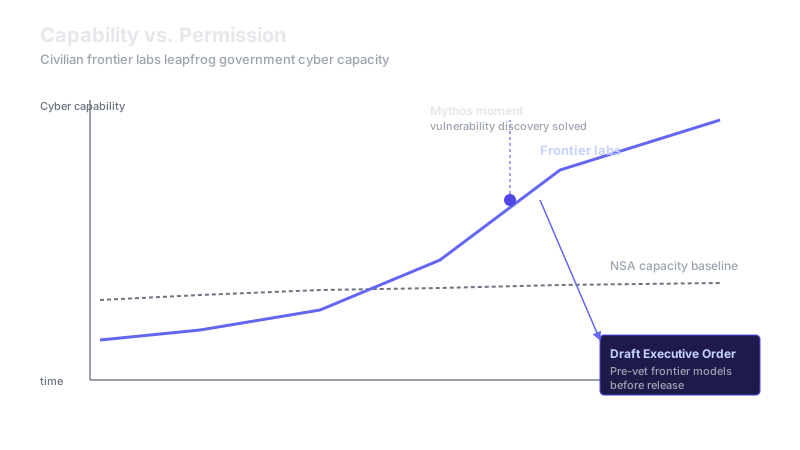
Until April, the prevailing White House posture was deregulatory. Pump the models out, let the market run, win the geopolitical race. Mythos broke that. Alex Wissner-Gross’s read on the pod is that cybersecurity vulnerability discovery, an entire discipline historically held inside NSA-grade government capacity, got effectively solved in the private sector for the first time. A civilian lab leapfrogged the agency that exists to do exactly this work. Even an AI-friendly administration has to notice that.
The draft executive order is what an administration writes when it suddenly cannot let the next release out of the building without seeing it first. Brian Elliott’s framing on the pod was that the capabilities now grow exponentially, the military finds them incredibly valuable, and “the government ultimately has to preview these things, but it can’t gatekeep.” The line between preview and veto is where this fight gets fought for the next two years.
Alex’s real worry is not the White House. It is the frontier labs self-censoring more aggressively than any executive order would. New models too compute-intensive to share, or too commercially valuable to release, or too sensitive to expose. A government pre-vet is, in his read, the less scary outcome.
Compute is now scarcer than capability
Demis Hassabis said on a recorded clip that nobody has enough compute to build two frontier models in parallel at maximum size. Even inside Google, search, cloud, and DeepMind fight weekly for new compute allocation as it comes online. The AWS CEO said his fleet is completely sold out, with no A100 server ever retired. Blitzy’s own runtime stack throws hundreds of thousands of cross-model checks at every code generation request, using Claude against GPT-5.5 against Gemini to drive up quality. Compute consumption that scales nearly without bound.
This is the deeper story behind GPT-5.5 quietly matching Mythos. Anthropic, on Brian’s account, is so compute-starved that the model strong enough to ship cannot actually ship. OpenAI ended Microsoft Azure exclusivity, signed a $100 billion AWS deal over eight years, and is dating Oracle and Google Cloud as well. Microsoft, in the same window, has been mandated internally to build its own foundation model from the OpenAI IP it owns contractually, and is reportedly struggling to read the files.
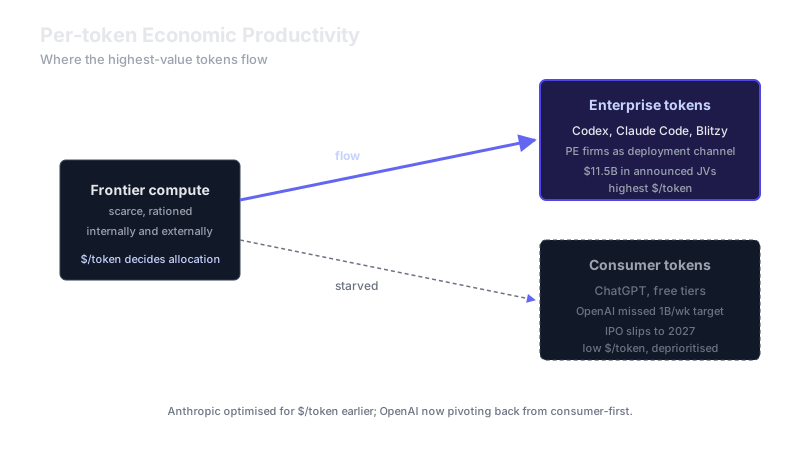
The unit of competition is now per-token economic productivity. Alex’s argument is that this metric is going to dominate not just between labs but inside them, with internal auctions deciding which workloads get to run. Anthropic’s whole product strategy already optimises for dollar value per token. That metric is going to leak into every enterprise buyer’s procurement decision before the end of the year.
OpenAI’s consumer blunder is now visible
OpenAI missed its 1 billion weekly ChatGPT user target for end of 2025. CFO Sarah Friar warned the IPO may slip to 2027 and admitted the company doesn’t yet meet public-company reporting standards. The pod’s read was direct. The bet on consumer revenue was the blunder. Consumers do not want to pay for reasoning tokens. Enterprises do.
Anthropic, partly because compute constraints forced enterprise focus earlier, was right by accident. Codex is now outpacing Claude Code in Dave Blundin’s working setup. Google search ad revenue is not collapsing the way the 2024 doomers projected, because the highest-value tokens are flowing to enterprise use, not to consumer chat. The companies tied to Google ad revenue that traded down 70-90% on the death-of-search thesis look mispriced from here.
The PE-as-deployment-channel pattern makes this concrete. OpenAI announced a $10 billion venture with TPG, Brookfield, and Advent. Anthropic announced a $1.5 billion venture with Blackstone, Goldman, and Hellman. Salim Ismail’s “organisational singularity” thesis: AI enters companies top-down through governance, not bottom-up through HR or IT, because the internal immune system is too strong otherwise. PE buys the legacy company, mandates the model, books the EBITDA transformation. Alex’s skeptical read is that some fraction of these flows are circular sales between frontier labs and the PE firms whose discounted cash flows AI is otherwise about to obsolete. Both can be true.
The infrastructure stack is going vertical
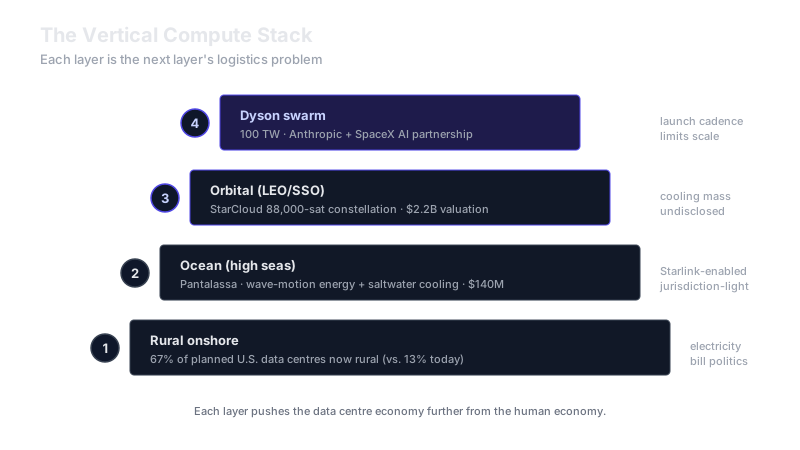
Peter Thiel’s Pantalassa raised $140 million at a billion-dollar valuation for ocean-based data centres running on wave-motion energy and saltwater cooling. Alex’s claim is that Thiel is not really doing data centres. He is doing seasteading, with data centres as the killer app that pays for ocean colonisation. The pattern matches space exactly: the killer app for orbital infrastructure turned out to be data centres, not tourism, not entertainment.
StarCloud raised at a $2.2 billion valuation a month after closing $1.1 billion, building toward an 88,000-satellite orbital data centre constellation. Anthropic, on the morning of the recording, announced an enormous partnership with SpaceX AI for Dyson-swarm-class 100 terawatt compute. Dario’s calculation appears to be that building a private Dyson swarm is not worth the cap-ex when partnering with Elon gets you the same compute. That is the vertical stack closing in real time. SpaceX AI is now part of the innermost loop of frontier model training, not because of AI but because of launch cadence.
Onshore, 67% of planned U.S. data centres are now in rural areas against 13% today. 39% of planned projects sit in counties with no existing data centres. The southern U.S. leads at 48% of planned builds. Alex’s worry is that pushing the data centre economy too far from urban centres decouples it from the human economy, with the orbital and oceanic build-out completing that decoupling. The Dyson swarm endpoint is geographically the same problem at a larger scale.
The Manus deal makes researchers national assets
Meta closed a $2.5 billion acquisition of Manus in December 2025. China is now blocking the deal, has barred the founders from leaving the country, and the Meta lead on the deal told Peter at a Singapore lunch that he personally flew the founding team out of mainland China on a midnight private jet to Singapore the night before closing. The intellectual property is now in Singapore. The founders are now political assets.
This is the Cold War extending from the company level to the individual researcher. Top-tier U.S. venture capital, on Dave’s read, is now unlikely to invest in China-based AI companies because the money may not come out and the employees may be claimed as national assets. The Benchmark $500 million valuation round on Manus was already viewed as firm-risk at the time. It was. The presence of AI talent is a national security risk, and the spheres of influence are now U.S., China, and “everything else” with no good way to straddle.
Alex’s view on the time horizon is the interesting one. If recursive self-improvement is here or imminent, the value of any individual human researcher decays fast, because most research will be done by agents on U.S. soil that cannot defect anywhere. If it is years away, the human talent war stays brutal. Jack Clark’s 60% by end of 2028 is in his words “absurdly conservative” given Anthropic’s own public statements that nearly all of its code is now Claude-generated.
The honest counterargument
The case for slowing down is real and the pod did not honour it. Insurers (Berkshire, Chubb) are dropping AI damages from standard policies with 80% exclusion requests approved. The standalone AI insurance market is projected to go from $40 million in 2024 to roughly $5 billion by 2032. That is the actuarial industry pricing risk that other parts of the AI economy are pricing as upside. Salim’s 44% Gen Z deliberately-corrupting-the-AI-they-train statistic is a labour signal that no top-down PE mandate is going to override quickly. Sam Altman’s three-year UBI study found spending went up but health and healthcare access did not improve, which is awkward for the universal-basic-income-solves-it narrative the abundance camp has been running on.
The economy now indistinguishable from the AI infrastructure buildout (Q1 was 75% AI-driven on David Sacks’s numbers, $805 billion of hyperscaler CAPEX projected, roughly $3 billion a day) is also a concentration risk. If any of the assumptions underneath that buildout breaks, the GDP tailwind reverses fast.
What Episode 254 actually argued, even when it did not say so directly, is that governance has finally noticed the curve. Pre-vet executive orders, frontier labs unionising in London, China seizing researchers, insurers excluding AI damages, PE firms buying legacy companies to mandate model adoption, and an oceanic-orbital infrastructure layer pricing as the next logistics problem. The institutions are catching up. The companies and teams that win the next two years are the ones that get a working governance stack first.
Sources
- Moonshots with Peter Diamandis, Episode 254: “Google’s Record Quarter, the White House Intervenes, and GPT-5.5 Silently Matches Mythos.” Recorded May 9, 2026. Hosts: Peter Diamandis, Salim Ismail, Dave Blundin (Link Ventures), Alex Wissner-Gross. Guest: Brian Elliott, CEO of Blitzy.
- Alphabet Q1 2026 earnings release.
- White House draft executive order on frontier model pre-release vetting, April 2026.
- Anthropic-SpaceX AI partnership announcement, May 9, 2026.
- Morgan Stanley hyperscaler CAPEX update.
The governance-catches-up framing assumes that what is being measured is capability and what is being delayed is institutional response. Read it the other way and Episode 254 looks different. The institutions are not catching up. They are pricing in risks the AI boosters are still treating as upside. The Mythos moment may matter less than the four other signals on the same tape.
Mythos may not be the actual moment
Alex Wissner-Gross argued that vulnerability discovery was effectively solved in the private sector for the first time, and that the executive order is a response to that capability leapfrog. That framing treats Mythos as a discrete capability event. The Stuxnet operators, Equation Group, and a long history of state-actor cyber operations would beg to differ on whether vulnerability discovery was ever the bottleneck for the agencies that already had it. What is new is not the capability. What is new is who owns it. That is a permission story dressed up as a capability story.
If the actual fight is about who owns frontier AI rather than about whether the technology has reached escape velocity, then the draft executive order looks less like governance finally catching up and more like incumbent capture. The compliance burden of a White House pre-vet is something OpenAI, Anthropic, and Google can absorb. The smaller labs cannot. New Hampshire passed an “AI right to compute” in the opposite direction. Both moves are about market structure, not about safety per se.
Brian Elliott’s claim on the pod is that GPT-5.5 hits the same cybersecurity benchmark levels as Claude Mythos at five times cheaper, with broad availability on Bedrock. That is the bull case for OpenAI’s strategic position. It also rests on cybersecurity benchmarks that the broader research community has not yet stress-tested against red-team conditions. Benchmark equivalence is a fragile claim. Mythos has not been released, which means the comparison is being made against capabilities Anthropic has demonstrated but not fielded. The 5x cost edge is real now. Whether it survives the second-order economics (inference quality, error rates on long tasks, jailbreak resistance) is unsettled.
The deeper question is whether Anthropic being compute-starved is a temporary supply problem or a structural one. The pod treats it as temporary. If it is structural, the per-token economic productivity argument that Anthropic optimises for unravels, because the substrate they depend on is not theirs to allocate. Codex outpacing Claude Code in Dave Blundin’s working setup may be a leading indicator of that unraveling, not just of model preference shifting.
The PE-as-deployment-channel thesis has a labour problem
Salim Ismail’s organisational singularity thesis sounds correct on the white board. PE firms top-down mandate AI adoption, bypass the corporate immune system, book EBITDA transformation. The execution problem is the 44% of Gen Z workers who, per Salim’s own number on the pod, are deliberately corrupting the AI they have been asked to help train. Top-down mandates run head-on into bottom-up sabotage. The transformation projects that have actually shipped in legacy enterprises have shipped slowly, painfully, and with much higher headcount than the white board says. Salim said as much himself: “this is going to be much harder than people think.”
Alex’s circular-sales reading deserves more weight than the dominant variant gives it. OpenAI putting in $10 billion alongside TPG, Brookfield, and Advent, with the money substantially aimed at deploying OpenAI’s own models into PE portfolio companies, is a structure where the lab is at minimum a participant in its own demand creation. The Anthropic-Blackstone $1.5 billion has the same shape. These are not necessarily wash sales. They are also not clean market signals about end-customer demand. Anyone modelling enterprise adoption off the announcement values is being sold a narrative.
The vertical infrastructure stack assumes a build cadence we have not proven
The ocean data centre at $140 million and a billion-dollar valuation, the StarCloud 88,000-satellite plan at $2.2 billion, the Anthropic-SpaceX AI partnership for 100 terawatts of Dyson-swarm-class compute. These are aspirations priced as inevitabilities. The launch cadence required for 88,000 satellites is multiples of what SpaceX is doing today. The wave-motion energy yield per buoy is not publicly disclosed and was flagged on the pod itself as the open question. The orbital cooling mass budget is not disclosed. Each of these is a real engineering problem treated as a marketing input.
Onshore, the 67% rural data centre figure is doing political work it cannot really do. The voters who blocked the Festus data centre referenced in earlier episodes did so because the electricity bill arithmetic did not work for them locally. Brian Elliott named exactly this on the pod: “having an electricity bill go 2 or 3x is actually quite substantive.” The dominant variant said leading with the electricity conversation is the tactical answer. It is. It is also the conversation that hyperscalers have largely failed to win in early-mover communities. Decoupling the data centre economy from the human economy is not just an aesthetic worry. It is a fiscal one. The wealth transfer the bulls celebrate is contingent on local social licence that is far from secured.
The Manus story argues against the recursive self-improvement timeline
Alex’s claim is that if recursive self-improvement is here or imminent, the value of individual human researchers decays fast, which is why the Manus exfiltration story is a short-term problem. Read the same evidence the other way. China is willing to bar researchers from leaving the country and pressure Meta to unwind a $2.5 billion acquisition. Beijing’s calculus says individual researchers still matter enormously. So does the U.S. visa policy that has tightened around Chinese-ethnic AI talent at frontier labs. Both spheres of influence are pricing humans as critical, not as obsolescent. Jack Clark putting recursive self-improvement at 60% by end of 2028 may be conservative, but it is at least consistent with the behaviour of the institutional actors who would know if it were closer. They are still fighting over people.
The insurance signal is the one to believe
The most reliable signal on the tape is the one the boosters mentioned in passing. Berkshire, Chubb, and the major commercial insurers are dropping AI damages from standard policies, with 80% exclusion requests approved by regulators. The standalone AI insurance market is projected to grow from $40 million in 2024 to roughly $5 billion by 2032. That is the actuarial industry, whose only job is to price risk accurately, pricing AI deployment as risky enough to require its own market. Alex correctly identified the upside framing: insurance pressure becomes a capitalist forcing function for alignment. He under-priced the downside read: insurers do not exclude categories they understand well. They exclude what they cannot model.
Sam Altman walking back UBI is the same kind of signal. A three-year study, his own money, showing spending went up but health and healthcare access did not improve. The proposed UBC/UBE/UBS substitutes are interesting policy directions, but the data point is the data point. Universal abundance did not produce the welfare improvements the abundance thesis predicted at small scale. Salim’s read on the same study is opposite to Sam’s. The pod left the contradiction unresolved.
What Episode 254 actually shows is that the institutions are not catching up to capability so much as pricing in uncertainty the capability narrative has been hiding. Insurers excluding AI risk, China seizing researchers, PE firms plugging discounted cash flow holes, governments writing pre-vet orders, and Anthropic compute-starving its own flagship model are not five proofs of the same arrow. They are five different actors pricing different risks. The companies and teams that win the next two years are not necessarily the ones with the working governance stack. They are the ones who can read which of these signals is real.
Sources
- Moonshots with Peter Diamandis, Episode 254: “Google’s Record Quarter, the White House Intervenes, and GPT-5.5 Silently Matches Mythos.” Recorded May 9, 2026.
- Alphabet Q1 2026 earnings release.
- White House draft executive order on frontier model pre-release vetting, April 2026.
- Anthropic-SpaceX AI partnership announcement, May 9, 2026.
- Sam Altman UBI study findings, 2026.
Alphabet printed $109.9 billion in a quarter at 22% growth, Google Cloud at $20 billion and 63% growth outpacing AWS and Azure. The White House drafted an executive order to pre-vet frontier models. GPT-5.5 went generally available on Bedrock at roughly 5x the cost-efficiency of Mythos, which Anthropic cannot ship because it is compute-starved. The capability curve has cleared a line the institutions did not plan for. Teams still debating whether AI is real are already behind. The fight in front of us is governance.
Mythos forced the executive order
Vulnerability discovery, a discipline that used to live inside the NSA, got effectively solved by a civilian lab. That is the Mythos moment, and it is what the draft executive order is reacting to. Even an explicitly deregulatory administration cannot let the next release ship without seeing it first. Brian Elliott’s framing on the pod is the operational one: governments have to preview these models because they are growing exponentially and they are incredibly valuable to the military. Veto rights are the wrong frame. Pre-vet with partnership is the right one.
The deeper risk is not the White House. It is frontier labs self-censoring more aggressively than any agency would, because the models are too compute-intensive, too commercially valuable, or too sensitive to ship. That is the failure mode Alex Wissner-Gross is naming. It is also the failure mode that the U.S. Cold War institutional toolkit (Invention Secrecy Act, Atomic Energy Act, export controls) was already built for, going back to the 1950s. The brave new world is not new. It is being remembered.
Compute scarcity is permanent
Demis Hassabis said outright that nobody has enough compute to build two frontier models in parallel. Even inside Google, search, cloud, and DeepMind fight weekly for new compute. AWS is completely sold out, with no A100 ever retired. Dave Blundin’s call on the pod: this is not a temporary shortage. AI is the first technology with an infinite appetite to create, and every new GPU pays itself back in cured disease, fed populations, or generated value. Corporate America still treats compute like it is milk on a grocery shelf. It is not, it will not be, and the firms that do not reserve forward capacity now will be locked out within two years.
The unit of competition is per-token economic productivity, and Anthropic’s strategy already optimises for it. That metric is going to dominate procurement decisions at every enterprise buyer by year end. GPT-5.5 is the proof. Five times cheaper than Mythos at equal or better cybersecurity benchmarks, generally available, on Bedrock for secure enterprise use. Anthropic, on Brian’s account, has the model strong enough to ship and not enough compute to ship it. Build your roadmap around that fact.
OpenAI’s consumer bet was the blunder
OpenAI missed its 1 billion weekly user target. CFO Sarah Friar admitted the company does not yet meet public-company reporting standards. The IPO is slipping to 2027. Consumer revenue does not pay for reasoning tokens. Enterprise revenue does. Anthropic, partly by accident through compute starvation, made the right strategic bet. Codex is now outpacing Claude Code. Google search ad revenue did not collapse the way the death-of-search thesis projected, because the highest-value tokens flow to enterprise use. The 70-90% drawdowns in Google-ad-revenue-tied stocks look mispriced from here.
The PE-as-deployment-channel pattern makes the implication concrete for operators. OpenAI announced a $10 billion venture with TPG, Brookfield, and Advent. Anthropic announced a $1.5 billion venture with Blackstone, Goldman, and Hellman. Salim Ismail’s organisational singularity thesis: AI enters companies top-down through governance, not bottom-up through HR or IT, because the immune system kills bottom-up adoption. PE buys the legacy firm, mandates the model, books the EBITDA transformation. If you run a small or medium-sized business, the move is to act as your own PE firm and force the mandate yourself. Do it this quarter.
The infrastructure stack is going vertical
Peter Thiel’s Pantalassa raised $140 million for ocean-based data centres on wave-motion energy and saltwater cooling. Alex’s read is correct: the data centres are the killer app that pays for seasteading. The same pattern that turned data centres into the killer app for orbital infrastructure. StarCloud raised at $2.2 billion a month after closing $1.1 billion, targeting an 88,000-satellite orbital data centre constellation. Anthropic announced a partnership with SpaceX AI for Dyson-swarm-class 100 terawatt compute the morning of the recording. Dario chose to partner rather than build. That is the correct decision when launch cadence is the rate-limiter.
Onshore, 67% of planned U.S. data centres are now in rural areas, against 13% today. This is the largest geographic wealth transfer since fracking. Local and state governments that block these builds are voting against their own tax bases. The governors who veto the votes are reading the situation correctly. Brian’s point from Middle America is the right tactical answer: lead with the electricity bill conversation, mitigate the risk, and then build.
AI researchers are now national assets
Meta’s $2.5 billion Manus acquisition is being unwound by China. The founders fled mainland China on a midnight private jet to Singapore the night before closing. China has barred them from leaving Singapore. The presence of AI talent is now a national security risk. Top-tier U.S. venture capital will not invest in China-based AI companies anymore because money and people may not come back out. The spheres of influence are now U.S., China, and everything else, and there is no good straddle.
Alex’s framing on the time horizon is the bet-the-business one. If recursive self-improvement is here or imminent (and Anthropic’s own statements that nearly all its code is Claude-generated suggest it is), the value of any individual human researcher decays fast. The agents do the research, and the agents are on U.S. soil. Jack Clark’s 60% by 2028 is conservative to the point of being wrong. Build your hiring plan and your moat assuming the curve is steeper than the public estimates say.
The infinite demand call
Every chip-stack stock is up: Sandisk +251% YoY, Samsung crossed $1T, AMD +260%, Intel +442% over the past year and +114% in April alone. Huawei +60% despite tariffs. NVIDIA could buy every company in the financial services sector. Morgan Stanley raised hyperscaler CAPEX projection to $805 billion, roughly $3 billion a day. David Sacks: AI CAPEX is a 2% tailwind to GDP this year and was 75% of Q1 growth. The economy is becoming indistinguishable from the AI infrastructure buildout. The number is going higher. It is called the singularity for a reason.
The W2 income era is over. Assets matter. AI lifts every asset class, every chip company, every cooling system vendor, every fab. If you are not investing in this curve, you are sitting out the largest capital reorganisation in human history. The advice the pod gave from Dave Blundin, Brian Elliott, and Salim Ismail in unison: get on the train, find a fast-growing AI startup, develop the soft skills the AI cannot do, and acquire ownership wherever you can. The team that builds a working governance stack first, both internally and externally, wins the next two years.
Episode 254’s actual argument is that governance has finally noticed the capability curve. The pre-vet executive order, the DeepMind unionisation, the China-Singapore researcher exfiltration, the insurer exclusions, the PE deployment channels, and the oceanic-orbital infrastructure pricing. The institutions are reorganising in real time. Get a working governance stack first, or be the institution that gets rewritten by the one that did.
Sources
- Moonshots with Peter Diamandis, Episode 254: “Google’s Record Quarter, the White House Intervenes, and GPT-5.5 Silently Matches Mythos.” Recorded May 9, 2026.
- Alphabet Q1 2026 earnings release.
- White House draft executive order on frontier model pre-release vetting, April 2026.
- Anthropic-SpaceX AI partnership announcement, May 9, 2026.
- Morgan Stanley hyperscaler CAPEX update.
Comments
Loading comments…
Leave a comment