Cerebras IPO’d at a $95 billion market cap, up 68 percent on day one, the biggest US tech IPO since Uber in 2019. Andrej Karpathy publicly job-hunted on a podcast, then joined Anthropic three weeks later. Google announced $180 to $190 billion of 2026 capex at I/O. Every one of those moves looks like a different story. They are the same story.
Episode 256 is the panel’s annual Google I/O recap with Cerebras CEO Andrew Feldman in studio. Sundar dropped numbers that should have been the headline: 3.2 quadrillion tokens a month, 7x year-over-year, 13 products with over a billion users, more than a million TPUs across multi-site training clusters. Inside the same week, a federal jury threw out Elon’s OpenAI suit in two hours of deliberation. Karpathy moved labs. Andrew rang the NASDAQ bell. The throughline Feldman kept pulling the panel back to is unsexy and almost impossible to fake. The frontier is gated by tacit knowledge that cannot be bought.
Capital is the easy part now
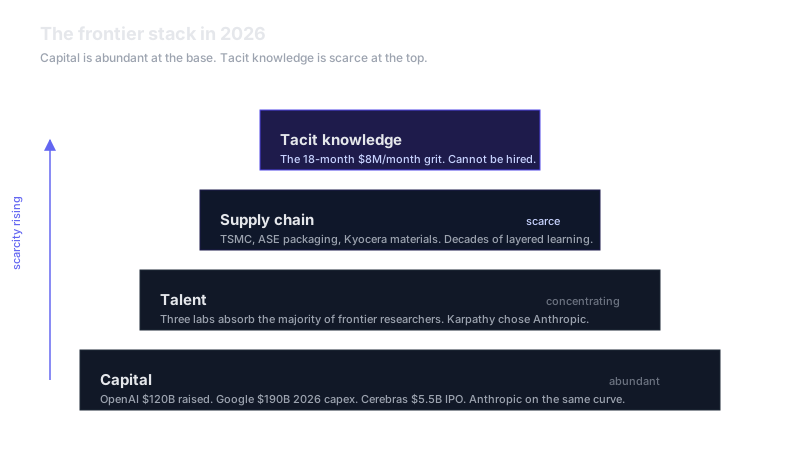
OpenAI raised $120 billion in cash. Anthropic is on a similar trajectory. Google is putting $190 billion of capex into the ground in a single year. Cerebras came public with $5.5 billion in fresh equity on top of a $20 billion OpenAI supply deal signed in December 2025 and an AWS term sheet in March. The war chests are no longer different in kind. The labs that were called cooked a year and a half ago are sitting on more cash than the ones doing the cooking.
That changes the question. If money is no longer the constraint, then the next two years get decided by something else. Feldman’s framing is direct: “Money and the acquisition of talent isn’t enough.” His proof points are uncomfortable. Intel said no to Apple’s cell-phone chip and destroyed tens of billions of shareholder value chasing the consequence. NVIDIA failed at Snapdragon, failed at Northbridge, and succeeded beyond expectations at exactly one thing. The Yankees and the big-money NFL teams don’t always win. There is something inside an organization that has to be built and cannot be hired in.
Cerebras’ 18-month failure proves it
The Cerebras founding story is the cleanest version of the argument anyone made on the show. The team made two contrarian bets in 2015: AI would need dedicated silicon the way graphics needed GPUs, and the right answer was a clean-sheet design rather than a GPU derivative. Both bets were laughed at. The team then committed to a chip the size of a dinner plate, 58 times larger than any chip ever fabbed, stuffed with 40 to 50 gigabytes of SRAM. Four years. Roughly $450 million. Even Gene Amdahl had failed at this before.
The part Feldman lingered on is the 18-month stretch where they were spending $8 million a month and could not solve a single packaging problem. Board meeting every six weeks. Still cannot solve it. $100 million in the hole. $120 million. $140 million. They solved it in 2018. Seven years later TSMC and NVIDIA hit the same coefficient-of-thermal-expansion wall on the CoWoS process and pushed B200 18 months late. Pioneering work surfaces problems early. The grit to keep paying $8 million a month into a black box is the part of the moat that doesn’t get described well in pitch decks.
The world ignored the result. First-generation Cerebras systems shipped 12 units. Second generation, 300 to 350. Third generation, many thousands, then a $20 billion OpenAI deal. The inflection was not their engineering. It was the inference market arriving in late 2024 and early 2025 and finding them already sitting at the only available answer.
The talent gravity well
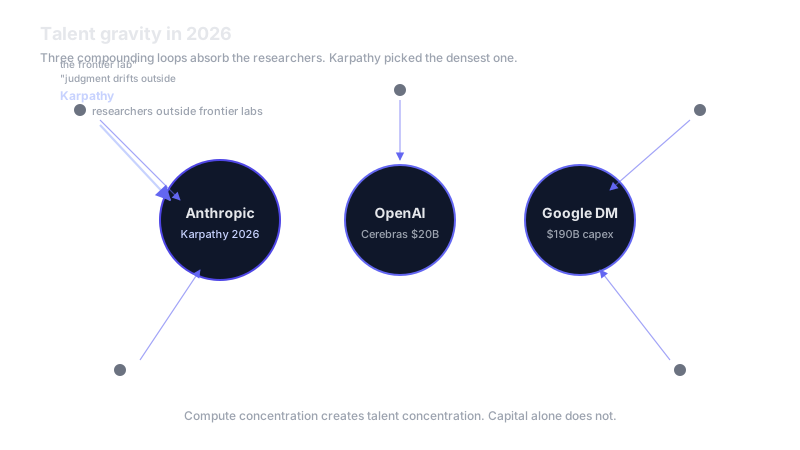
Karpathy joining Anthropic is the clip the panel kept circling. He sat on No Priors and openly job-hunted: “If you’re outside of that frontier lab, your judgment fundamentally will start to drift because you’re not part of what’s coming down the line.” Three weeks later he was on Anthropic’s pre-training team running a Claude-accelerates-Claude initiative.
Dave’s read landed hardest. Every other OpenAI co-founder has either raised billions or runs a frontier lab. Karpathy was the last one without access to the big machine, and an open-source auto-research repo was no substitute. Feldman generalised it to hardware: if you are not building silicon engaged at a fundamental level with one of Google, Anthropic, or OpenAI, your hardware will drift away from what they need just as surely as a researcher’s instincts drift away from the curve. Salim noted the timing. Karpathy was announced on the same day as Google I/O. The choice of Anthropic over OpenAI or DeepMind is its own data point about where the smartest people think the inference-train compounding loop is tightest.
The labs that win do not win because they bought Karpathy. They win because there was a place for him to go that he wanted to be at. That is also tacit and almost impossible to manufacture.
Terra Fab is a 20-year project, not a 5-year one
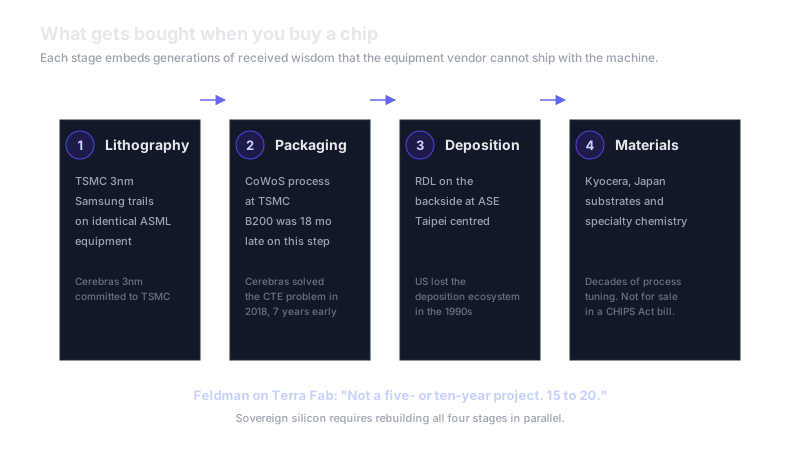
Elon’s Terra Fab pitch is to produce 50 times the chips on the planet, outstripping TSMC. Feldman, who knows this domain better than anyone on the panel, was respectful and clear: “It is not a five- or ten-year project in my humble view. I’ve been wrong before, but I put this at a 15- or 20-year project.”
The reason is the part that gets glossed over. Even with the exact same ASML equipment, Samsung is not at the same node as TSMC. The amount of received wisdom and learning that gets baked into a fab across generations cannot be bought from the equipment vendor. The packaging supply chain that surrounds the fab matters as much as the fab itself. RDL deposition at ASE. Materials manufactured in Japan, including Kyocera. The US lost this whole ecosystem in the 90s when IBM and Global Foundries walked away from manufacturing, and nobody noticed because the silicon-as-virtual-resource framing won the VC narrative between 2007 and 2016.
Cerebras has committed its 3-nanometer design to TSMC. Some components are at Samsung. Intel is not yet a credible option for them, and Feldman likes Lip-Bu Tan personally. That is what the actual frontier looks like from inside a company that has shipped real wafers. The romance of pouring capital into a sovereign fab cannot rebuild a multi-generational packaging supply chain in five years.
Google bought time but not the lead
Sundar’s keynote was the most aggressive full-stack performance Google has ever delivered. Gemini at 900 million monthly active users, more than doubled in a year. NanoBanana past 50 billion images. SynthID on 100 billion images and videos plus 60,000 years of audio, now adopted by OpenAI, Kakao, and Eleven Labs. Gemini Omni as the only credible American frontier multimodal model after OpenAI cut Sora and Anthropic walked away from anything that is not code. Gemini for Science with WeatherNext hurricane prediction and Isomorphic Labs running multiple preclinical immune and cancer programs.
The candid part nobody on the panel danced around: Silicon Valley scuttlebutt is that it is now a two-horse race between OpenAI and Anthropic for raw capability, and Gemini 3.5 Flash is solidly mid. Sundar compared Flash to 3.1 Pro instead of to frontier models. He picked throughput versus performance as the axis because that is the most flattering frame. Pro is another month out. Google DeepMind engineers are reportedly desperate for Claude Code access. Anti-gravity 2.0 is a Cursor fast-follow, Gemini Spark is an OpenClaude fast-follow, and the universal cart is a shot at Amazon retail that Amazon will not adopt.
What Google does have, and what nobody else can match, is the integration. Over a billion users on 13 different products. Search, Gmail, Sheets, YouTube, Android, Pixel. The Microsoft-versus-Netscape lesson Dave pointed to is exactly right. Google exists because the FTC stopped Microsoft from tying IE to Windows. Now Google is doing the same tying move, perfectly legally, with Gemini integrated across the entire stack. The capital and the distribution buy time. They have not bought the lead.
Sam saw the corner first, again
The line Feldman dropped that the other guests stopped to absorb was about Sam Altman locking down data center capacity in space “last year and the year before, when all the other foundation labs didn’t see it.” That is reporting from someone with quite a lot of visibility into who is buying compute and why.
Alex pulled the thread. If Elon’s Dyson swarm is 500,000 to a million satellites with a Starship launch every couple of minutes, then heavy launch becomes part of the AI compute stack the same way fabs are. Bezos and Blue Origin’s New Glenn is closer to Falcon 9 and does not hold a candle to Starship on cost per kilogram. A multi-channel strategy for Sam is SpaceX, Blue Origin, and a long-game bet that fabs themselves end up in low Earth orbit and on the moon. If you believe the singularity exponential, you do not need to be addicted to terrestrial heavy launch five to ten years from now.
Feldman’s softer take on orbital compute: production silicon in space is seven to ten years out. Communication and clustering are the hard parts, not radiation. Wafer-scale fault tolerance maps neatly to ionising-radiation hardening. Cerebras already shuts down faulty cores and routes around them. The advantage is real. The timeline is not 2027.
What’s actually being decided
Karpathy moved because the curve is steepest where the tacit knowledge is densest. Cerebras IPO’d because they grit-paid $8 million a month into an unsolved problem for 18 months and emerged with the only chip on Earth that ships 1,000 tokens per second on Kimi K2 across a handful of wafers. Google is throwing $190 billion of capex at a stack that catches up on infrastructure but does not yet catch up on capability. Sam is buying spectrum, orbit, and option value years before everyone else realises those are the constrained inputs.
The honest counterargument is that capital still matters and that some of these gaps close with brute force. NVIDIA built the Bay Area’s most expensive talent machine and nobody is going to catch them on aggregate GPU throughput this decade. TSMC is a $50 billion, six-year project per fab, and that is exactly why the lead compounds. Recursive self-improvement from frontier labs designing chips that train the next generation of frontier models could collapse the timelines that the panel quoted in years.
Both can be true. Capital is necessary and not sufficient. The teams that win the next two years are the ones who built the institutional muscle to keep paying $8 million a month into an unsolved problem and saw, before anyone else, that the input nobody was buying was the one about to become scarce.
What Episode 256 actually argued is that the frontier has stopped being a leaderboard. It is a question of which organisations have the patience, the supply-chain depth, and the talent gravity to compound for a decade. Andrew Feldman just got rewarded for compounding. The next decade rewards the same trait at higher stakes.
Sources
- Moonshots with Peter Diamandis, Episode #256: Google I/O 2026, Karpathy Joins Anthropic, and Cerebras’ $95B IPO. Recorded May 21, 2026. Hosts: Peter Diamandis, Salim Ismail, Dave Blundin (Link Ventures), Dr. Alexander Wissner-Gross. Guest: Andrew Feldman, Co-founder and CEO of Cerebras.
- Google I/O 2026 keynote, Sundar Pichai and Demis Hassabis, May 20, 2026.
- Cerebras S-1 and post-IPO market data, May 2026.
- Andrej Karpathy interview on the No Priors podcast, May 2026.
The “money can’t buy the frontier” framing makes for a satisfying podcast arc, especially with an in-studio IPO winner saying it out loud. It is also the kind of post-hoc story that survivors of expensive industries always tell. Cerebras spent a decade and roughly $450 million getting to the first wafer. The narrative is not wrong. It is incomplete in ways that change what you should actually do about it.
Episode 256 lands on the claim that capital is now necessary but not sufficient, and that tacit knowledge plus institutional muscle decide the next decade. Andrew Feldman makes the case as well as it can be made. The questions worth asking are the ones the panel did not really press. What counts as the frontier? Whose tacit knowledge are we talking about? And how much of the IPO is the thesis and how much is the inference market arriving at a moment of compute panic that will not last forever?
”Tacit knowledge” is the survivor’s explanation
Every successful contrarian bet looks, after the fact, like a moat of irreplaceable institutional intuition. Most contrarian bets fail, and the failures get described as bad ideas, not as missing tacit knowledge that the team never built. We do not have a clean count of how many wafer-scale or unconventional-silicon attempts crashed and burned over the same decade Cerebras was being ignored. Gene Amdahl is named on the show. The dozens of less-famous attempts are not.
Feldman is honest about this. “We’ll take luck over skill,” and then “extremely hardworking people with tremendous grit end up more lucky.” That is a survivorship-aware framing. The podcast version flattens it into a clean story about MTP and grit beating capital. The cleaner story is that Cerebras made two correct bets in 2015, then survived long enough for the inference market to arrive in late 2024. Both halves matter. The arrival of the market is the part that no amount of internal muscle controls.
Capital is doing more work than the framing admits
Cerebras’ first chip cost between $400 and $500 million and four years to ship. That is not money being insufficient. That is money being the entry ticket to a club so expensive that almost nobody else even attempts membership. The two NVIDIA-failed-at-Snapdragon stories are real, and they also obscure the fact that NVIDIA has the highest market cap of any chip company on Earth because capital allowed it to ride the GPU wave for two decades while building exactly the institutional muscle the show is now praising.
The Karpathy story is similar. The talent gravity well argument assumes the labs that have the gravity have it because of tacit knowledge. They have it because they have the compute. Anthropic, OpenAI, and Google are the three options because they are the three places that can absorb $100 billion of training spend over the next few years. If a fourth lab raises $80 billion next year, it becomes a fourth option, and the gravity rearranges. Capital is not sufficient, but it is closer to sufficient than the panel’s framing suggests.
The Google “fast follow” critique cuts both ways
Anti-gravity 2.0 is described as a lazy Cursor copy. Gemini Spark is a lazy OpenClaude copy. The universal cart is dismissed as unable to dent Amazon. These reads might be right. They might also be exactly the kind of premature dismissal that the same panel members made about Google’s ability to self-disrupt search 18 months ago, just before Google self-disrupted search.
Fast-follow is not weakness when you have a billion-user installed base on each of 13 products. Dave’s own observation, almost in passing, is that 80 percent of users click the default. Google’s default is 900 million MAUs on Gemini, up from 400 million in a year. Frontier capability matters when the frontier is far ahead of the average use case. For consumer agents reading Gmail and managing calendars, “solidly mid” Gemini 3.5 Flash with deep Workspace integration probably beats a frontier-capability standalone product that requires onboarding friction. The two-horse race framing might describe research benchmarks. It does not describe the consumer market Google has cornered.
Terra Fab dismissal might be exactly the Cerebras mistake in reverse
Feldman is careful and respectful about Terra Fab. He puts it at 15 to 20 years, not 5 to 10. The reasoning is solid: ASML equipment alone does not equal TSMC nodes, the packaging supply chain is in Asia, and US fab politics cross administrations.
That reasoning is exactly the kind of received wisdom that the Cerebras bet contradicted. In 2015 the received wisdom was that you could not build a chip the size of a dinner plate. Cerebras built it. In 2026 the received wisdom is that you cannot build sovereign manufacturing in less than two decades. Elon’s track record on building “impossible in five years” projects in five-to-eight years is unusually strong. Tesla in Fremont was supposed to be impossible. SpaceX reusable rockets were supposed to be impossible. The pattern is not that Elon hits his deadlines. It is that the over-shoots are smaller than the established players assume. Twenty years might be right. Eight years would also not be shocking, and the strategic implications are enormous if it is even half-right.
Orbital compute is mostly a story, not a plan
Feldman puts production silicon in space at seven to ten years out. Alex’s enthusiasm puts fabs on the moon. The Sam-Altman-locked-down-orbital-capacity reveal is striking, and the Falcon 9 versus Starship math is real.
The skeptical read is that orbital data centers solve a power problem, not a compute problem, and they do it at a 100x cost-per-kilogram delta that Starship has not actually demonstrated at scale. Cooling in vacuum is unsolved at server-rack densities. Bandwidth to and from orbit at the data volumes a frontier training run requires is unsolved. The launch cadence math for a million-satellite Dyson swarm is unsolved with anything Starship has yet flown. A multi-year heavy-launch monopoly for SpaceX is real and may or may not be permanent. The orbital compute story is plausible. It is also exactly the kind of speculation that historically gets timed wrong by a factor of three.
The IPO is not the thesis
The Cerebras IPO is a beautiful outcome. It is also happening at the peak of an inference-compute panic where every frontier lab is locking down multi-year supply. That panic is real and probably has another two or three years to run, then might compress as the recursive-self-improvement loop the panel keeps describing collapses model costs by another order of magnitude. Salim’s own framing of intelligence becoming abundant and the marginal cost trending toward zero is in tension with the thesis that the moat is silicon manufacturing. If the cost of intelligence is collapsing, then the value of being the sole fast-inference vendor is also under pressure. Cerebras’ moat is durable for now. Durable forever is a different claim.
What the episode actually shows
Capital is not sufficient. It is also not as overrated as the survivors’ explanation suggests. Tacit knowledge matters. The institutions that have it might also lose it inside a decade if the inference economics shift. Google’s “fast follow” capability gap might compound or might evaporate the moment Gemini Pro ships next month. The orbital story is the kind of clean narrative that the singularity framing demands and that physics does not always deliver on schedule.
Episode 256 makes a strong case that the next two years reward institutional muscle. The honest version is that the next two years reward whichever combination of capital, muscle, market timing, and luck happens to compound first. The teams that confuse that combination for an inheritable moat are setting themselves up to be the next Intel, telling a tacit-knowledge story all the way down.
Cerebras IPO’d at a $95 billion market cap, up 68 percent, the biggest US tech IPO since 2019. Karpathy job-hunted on a podcast and was at Anthropic three weeks later. Google announced $190 billion of capex at I/O. Anyone still arguing that the AI race is about money is already behind. The frontier moved to tacit knowledge two years ago and the institutions without it have lost.
Episode 256 makes the case explicit through Andrew Feldman, in studio, the morning after the third-biggest US tech IPO ever. The Cerebras founding bets in 2015 were laughed at. Dedicated silicon for AI rather than a GPU derivative. A wafer 58 times larger than any chip in history. The team paid $8 million a month for 18 months unable to solve a single packaging problem, and seven years later NVIDIA hit the identical wall on CoWoS and was 18 months late on B200. That is the moat. It cannot be hired, bought, or summoned with a press release.
The capital arms race is over and capital lost
The “Google is cooked” narrative from 18 months ago has aged badly. Google is putting $190 billion into capex this year, six times its 2022 number. OpenAI raised $120 billion. Anthropic is on the same trajectory. Cerebras came public with $5.5 billion in fresh equity sitting on top of a signed $20 billion OpenAI deal and an AWS term sheet. The labs that were called dead are now richer than the labs that were called inevitable.
Capital is no longer scarce, which means it is no longer the variable. Feldman’s framing is the only one that survives contact with reality: “It turns out in our industry that money and the acquisition of talent isn’t enough.” Intel had the best fabs and the best architects on the planet when Apple asked them to build the iPhone chip. They said no. They destroyed tens of billions in shareholder value chasing the consequence. NVIDIA failed at Snapdragon, failed at Northbridge, and succeeded at exactly one thing. The teams that keep losing are the ones that keep assuming the next bet is the same as the last one.
Cerebras compounded for a decade. Everyone else is still trying.
The Cerebras arc is the cleanest proof on the show. Gen 1 sold 12 systems. Gen 2 sold 300 to 350. Gen 3 sells thousands and signs a $20 billion deal with OpenAI. The capability did not change. The market arrived. WSE3 now runs Kimi K2, a trillion-parameter open-source model, at 1,000 tokens per second across a handful of wafers. Fireworks, a genuinely strong GPU shop, runs the same workload at 70. That is a 15x gap that did not exist for the buyers in 2019 and exists for them now.
Feldman’s tell on NVIDIA was the sharpest moment of the interview. The NVL-72 generates 35 tokens per second at aggregate throughput. Push it to 200 tokens per second per user and it serves one or two. That is a $4 million box working on a single user. NVIDIA quotes the flattering number. Cerebras quotes both, and the gap is the product. Anyone telling you the GPU monopoly is unassailable has not read Cerebras’ Kimi K2 numbers yet.
Karpathy chose Anthropic. That is a signal.
Karpathy on No Priors: “If you’re outside of that frontier lab, your judgment fundamentally will start to drift.” Three weeks later he was running a Claude-accelerates-Claude pre-training initiative at Anthropic. He had his pick of the three labs and chose the one that has been quietly building the tightest recursive loop between researchers and product.
The decision matters more than the hire. Every other OpenAI co-founder is at a frontier lab or runs one. The last hold-out picked Anthropic over OpenAI and Google. Same-day-as-Google-I/O timing was not an accident. The talent gravity well around the inference-train compounding loop is now obvious to the people who actually understand which one is tightest, and the public capital-markets bets are still mispricing it.
Terra Fab is a 20-year project. Stop pretending otherwise.
Elon’s Terra Fab pitch is to outproduce TSMC by 50x. Feldman, who has spent a decade running real wafers through real fabs, said it cleanly. “It is not a five- or ten-year project. I put this at a 15- or 20-year project.” That is not skepticism. That is information.
Even with identical ASML equipment, Samsung is not at TSMC’s node. The generations of received wisdom inside the fab cannot be bought from the equipment vendor. The packaging supply chain around the fab is the part the policy crowd never mentions. RDL deposition at ASE. Materials from Kyocera. The US deleted this entire ecosystem in the 90s and the CHIPS Act has not rebuilt it because the multi-decade learning curve cannot be subsidised into existence. Cerebras has its 3-nanometer design at TSMC because there is no second viable option in 2026 and there will not be one in 2030. Anyone betting on sovereign silicon timelines shorter than a decade is reading the marketing instead of the supply chain.
Google bought distribution. It did not buy the lead.
The I/O numbers were the most aggressive Google has ever shipped. 3.2 quadrillion tokens a month. 900 million Gemini MAUs. 13 products over a billion users. NanoBanana past 50 billion images. The integration story across Gmail, Sheets, YouTube, Pixel, and Android is the actual moat, and it is real.
The capability story is not. Gemini 3.5 Flash is solidly mid by any honest comparison. Sundar pitched it against 3.1 Pro instead of GPT 5.5 high or Mythos because that is the most flattering frame available. Anti-gravity 2.0 is a Cursor fast-follow. Gemini Spark is an OpenClaude fast-follow. The universal cart is a shot at Amazon retail that Amazon will not adopt. Google DeepMind engineers are reportedly desperate for Claude Code access. Capital and distribution buy time, integration buys default behaviour, and neither buys frontier capability when the frontier is being defined inside two buildings in San Francisco.
Sam Altman is already two corners ahead
Feldman’s most quietly explosive line was that Sam Altman was locking down space-based data center capacity “last year and the year before, when all the other foundation labs didn’t see it.” Read that twice. The CEO who built the fastest-growing company in capitalism was buying orbital compute capacity before anyone else recognised it as a category.
The Dyson-swarm logic is now obvious. SpaceX dominates mass to orbit. New Glenn is Falcon 9 class and not Starship class. If the singularity exponential holds, terrestrial fabs are an addiction the smart operators are already exiting. Sam is exploring SpaceX, Blue Origin, geothermal, and probably lunar fab options in parallel. The slow players are still arguing about whether to permit data centers in suburban Missouri.
The pattern is clear
Capital is necessary. It is not sufficient. The teams winning the next decade are the ones who paid $8 million a month into unsolved problems for 18 months, who chose the steepest compounding loop over the loudest brand, and who bought constrained inputs before they were priced. Cerebras did the first. Karpathy did the second. Sam Altman did the third. Every team not already executing on all three is behind, and the gap compounds.
Episode 256 closed the question of what the next two years are about. Not chips. Not models. Institutional muscle, supply-chain depth, and the willingness to bet a decade on a contrarian read. Andrew Feldman just got paid for that pattern. The next round of winners will be the ones who already started.
Comments
Loading comments…
Leave a comment