SpaceX filed for a $75 billion IPO at a $1.75 trillion valuation, 2.5 times Saudi Aramco. Buried in the prospectus is a $15 billion-per-year line item: Anthropic is now paying SpaceX for Colossus 1 and Colossus 2 compute. The same week, an internal OpenAI model disproved an 80-year-old Paul Erdős conjecture in combinatorial geometry, and mathematicians reading the chain of thought said the model was not just faster, it was smarter. Episode 257 of Moonshots is the moment three separate stories rhyme.
The rhyme is consolidation. Capital is consolidating into one IPO window with SpaceX about to vacuum it dry. Compute is consolidating onto SpaceX racks under Anthropic models. Talent is consolidating around Dario, with Karpathy and Shane Longpre confirmed in the past 48 hours and a Stanford PhD tracking talent flight out of xAI. The frontier has collapsed to what Alex Wissner-Gross calls two and a half American labs, and the half is being generous.
SpaceX is becoming Microsoft in space
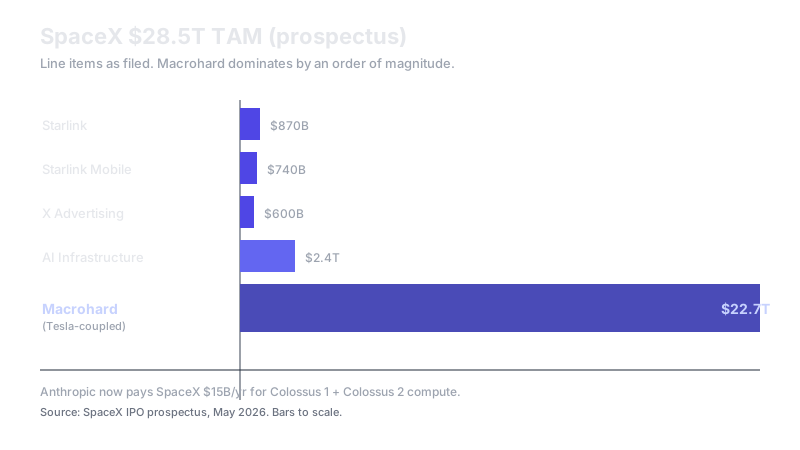
The $28.5 trillion TAM in the prospectus is the size of US GDP. Dave Blundin walked through the breakdown over dinner with Erik Brynjolfsson the night before. Starlink at $870 billion. Starlink Mobile at $740 billion. X advertising at $600 billion. AI infrastructure at $2.4 trillion. Macrohard, the Tesla-coupled plan to absorb the entire enterprise software stack, at $22.7 trillion. Brynjolfsson’s read was that nobody can disprove it and nobody can really price it either.
The interesting structural move is what is missing. SpaceX’s foundation model story is gone. Cursor closes 30 days after the IPO and Cursor is now built on a Kimi derivative, which means SpaceX’s frontier model lineage routes through a Chinese open-weight base with American reasoning-trace fine tuning. The labs that wanted to be vertical are picking sides. SpaceX is the infrastructure layer and the application layer. Anthropic is the model layer. Microsoft and OpenAI five years on, in space.
Math is cooked
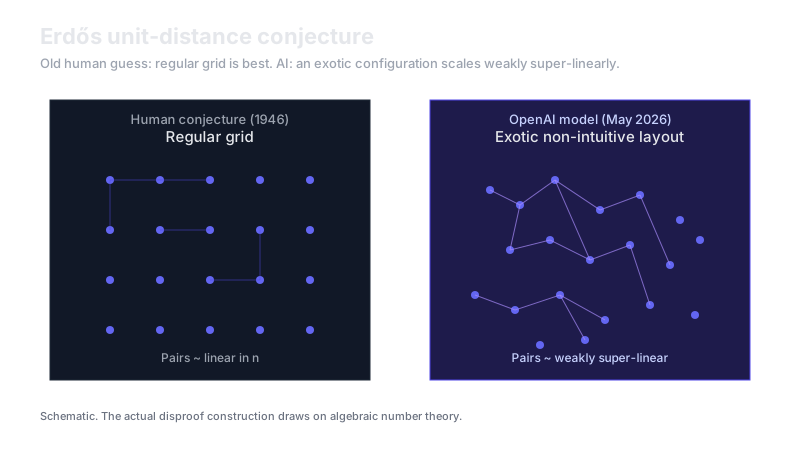
Erdős posed the unit-distance problem 80 years ago. Place n points in a plane. What is the maximum number of pairs separated by a fixed unit distance? His conjecture, holding since the 1940s, was that the answer could not be materially better than linear in n. An OpenAI model that has not been publicly released found weakly super-linear scaling. The conjecture is dead.
The interesting part is the texture of the proof. Mathematicians reading the chain of thought commentary on OpenAI’s site flag a specific line: “optimistically, if I pursued this, something might happen.” The model arrived at a creative leap by being willing to chase exotic possibilities humans were too exhausted to consider. This is not the four-color theorem, where a computer brute-forced a million cases and people argued it lacked human brilliance. The top combinatoric geometers in the world are calling this brilliance.
Alex’s call: this is Move 37 for math. Dave’s call: the value is not in the math, it is in what comes next. Magnetic confinement, protein folding, chip layout, every problem that looks like points-in-a-plane with an optimal but non-intuitive configuration. The trillion-dollar tail starts in physics, chemistry and biology. The starting gun went off the week of recording.
Forecasting is becoming a frontier capability
OpenAI’s GPT-5.5 Codex is scoring 25% on FutureSim, a benchmark that replays the internet a day at a time and asks models to forecast real events past their knowledge cutoff. The headline number is that it beat Polymarket crowd predictions for the Super Bowl. The benchmark is not run by OpenAI, which makes the result more interesting, not less.
Alex framed it as Asimov’s psychohistory: the worst forecasting models we will ever see. If you can predict outcomes at planetary scale, you can predict interventions at planetary scale. Dave saw the financial angle first. Every prime brokerage in New York exists to support specialised hedge funds. If one model is better than every specialist, the entire structure collapses into two or three mega-funds and the wealth concentration is severe. The financial singularity is what he called it.
There is a thread running through Macrohard, FutureSim and the Erdős result. AI is no longer benchmarking against tasks. It is benchmarking against industries.
OpenAI is becoming Google. Anthropic is not.
OpenAI shipped Personal Finance Mode with 12,000 financial-institution integrations on the same day Dario announced no ads on Anthropic. Alex’s read was the only honest one. OpenAI is not trying to become a financial institution. Financial queries are advertising-lucrative, and OpenAI is running the Google playbook on a consumer surface that already has 200 million users asking financial questions. Dario’s “no ads” was easy because Anthropic has no consumer surface.
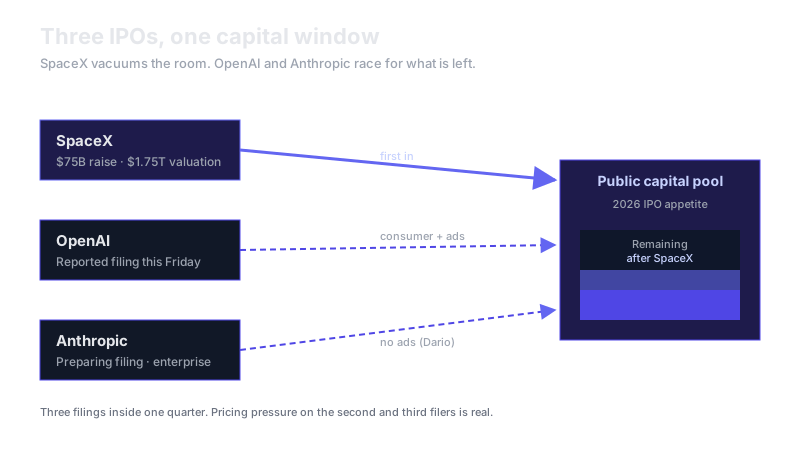
The race condition is now visible. OpenAI is reportedly preparing to file an IPO as early as the Friday of the recording week, racing to get to the capital pool before SpaceX consumes all the oxygen. Anthropic is preparing its own filing. Three IPOs in a window the public markets cannot absorb without violent re-pricing.
The split is structural. OpenAI is becoming a consumer ads business with an enterprise wedge. Anthropic is becoming an enterprise model business with a SpaceX-scale compute contract. There is no middle ground anymore. The half-lab is whoever loses the next IPO race.
The social contract is the rate-limiter
Eric Schmidt was booed at the University of Arizona commencement for saying the rise of artificial intelligence is the next industrial revolution. Gloria Caulfield at Tavistock got the same treatment. Salim’s framing was sharper than the panel’s first reaction: the backlash is not anti-technology, it is anti-extraction. There is a legitimacy gap between AI elites and the graduating class of 2026, and the data underneath it is brutal. The Build With Gemini XPRIZE pulled 2,000 registrations in 24 hours against a $3 million purse, which is the optimistic counter-signal.
The Stanford honor code is effectively dead. 49% of 849 computer science majors said they would rather cheat than fail. Proctored exams are back for the first time. Alex’s read was that the skills being tested are being automated away, and an honor code is a recipe for lazy proctoring at $80,000 tuition. Salim’s read was that universities have a binary choice. Become credentialing museums, or become AI-native talent accelerators. There is no third option.
Meta’s mouse-and-click employee surveillance launched the same week it cut 10% of its workforce. 44% of Gen Z workers are deliberately sabotaging the AI they are supposed to train. Alex’s hot take cut through it: the frontier labs are buying enormous amounts of synthetic computer-use data and there is not enough diversity in Meta’s internal usage to justify the goodwill cost. Whatever Meta thought it was getting, it was not pre-training signal.
The organizational singularity is the real thesis
Salim’s pitch at the end of the episode is the one that ties everything together. Coase’s 1937 paper said transaction costs are lower inside the firm than outside. That equation has flipped. The transaction cost of any task inside a typical company is now higher than doing it outside with an AI agent. Salim’s quote from someone else, which kept circulating in the chat: it is easier to build a product feature than to hold the meeting about building it.
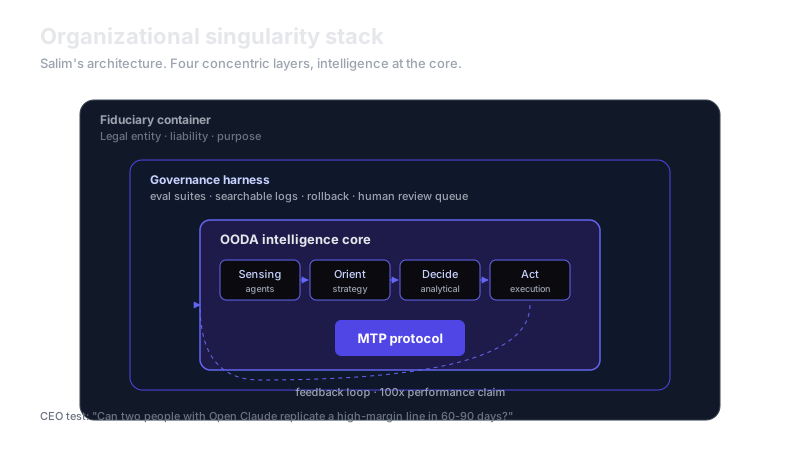
The proposed architecture is four layers. An MTP protocol at the centre. An OODA-loop intelligence stack with sensing, orientation, decision and execution agents. A governance harness with eval suites, searchable logs, rollback and a human review queue. And a firm-as-fiduciary container around it, because the legal entity still has to exist even when the operational entity is mostly agents. The trucking-company example is the cleanest version: sensing agents pick up a competitor’s new refrigerated line, strategy agents assess, analytical agents lay out options, decision agents recommend, execution agents act, humans approve at every checkpoint.
The benchmark Salim offered was the one that lands. Can two people with Open Claude replicate a high-margin line of your business in 60 to 90 days? If yes, you have an existential threat right now. The historical proxy was EXO 1.0. The top 10 of the Fortune 100 by EXO alignment delivered 40 times the shareholder returns of the bottom 10 over seven years. He says he is a year ahead of the market this time instead of seven or eight. That is the right amount of head start to act on.
The honest counterargument
The Erdős result is one model on one problem and OpenAI has incentive to publish it loud. FutureSim is one benchmark and 25% accuracy on three-month horizons is interesting, not yet psychohistory. The SpaceX prospectus is a sales document with a $22.7 trillion line item that is closer to vision than revenue. Eric Schmidt got booed at Arizona, not at Stanford, and Alex’s selection-bias argument is real. Mark Cuban’s token tax is, on inspection, trivially routed around by switching tokenisers. Most of the boldest claims in 257 are early indicators, not settled facts.
The harder pushback is on the organizational singularity itself. 80%-plus of AI projects are failing today, by Salim’s own number, and the failure mode is companies cramming AI into human workflows. The proposed fix is rewriting the organisation from scratch with a digital twin at the edge. The historical track record of “rewrite from scratch” transformations in established firms is not encouraging. Salim’s answer is that legacy organisations cannot do it and only edge digital twins can, which is consistent with the Buckminster Fuller quote he likes, and also conveniently unfalsifiable on a five-year horizon.
What episode 257 actually argues is that the two-and-a-half-lab frontier is now the operating assumption, that AI has crossed from pattern matching into creative search on at least one hard problem, and that the only sensible response from a builder is to start a company before ASI commodifies the rung above. None of that is hedged. Capital, compute, talent and now mathematical creativity are all consolidating in the same direction.
Sources
- Moonshots with Peter Diamandis, Episode #257: SpaceX’s $75B+ Historic IPO, GPT-5.5 Outperforms Polymarket, and AI Solves an 80-Year-Old Math Problem. Episode date May 23, 2026. Hosts: Peter Diamandis, Salim Ismail, Dave Blundin (Link Ventures), Dr. Alexander Wissner-Gross.
- SpaceX IPO prospectus, filed May 2026.
- OpenAI mathematical reasoning post on the Erdős unit-distance conjecture, May 2026.
- FutureSim benchmark, independent research group.
- Build With Gemini XPRIZE, launch May 2026, $3 million purse.
A duopoly thesis built on a single quarter is a duopoly thesis built on sand. Episode 257 reads like a victory lap for two labs and one rocket company, but the data points underneath are early indicators, sales documents, and one extraordinary math result that nobody outside OpenAI has reproduced. The case for “two and a half labs forever” is weaker than the panel makes it sound.
Worth taking the contrarian side on each pillar.
The prospectus is a sales document
A $28.5 trillion TAM is what investment bankers do when they cannot value a company on revenue. Macrohard at $22.7 trillion is a Tesla-coupled plan to absorb the global enterprise software stack, with no shipped product, no go-to-market, and a governance question that even Alex flagged. How does IP flow between SpaceX, xAI and Tesla when the Optimus split has a digital fork and an embodied fork? The prospectus does not say.
The Anthropic-pays-SpaceX-$15-billion-a-year framing has a less convenient read. SpaceX has expensive data centers, depreciating GPUs in Colossus 1, and a foundation model team that lost Karpathy and Shane Longpre. Selling compute to Anthropic at $15 billion a year is a great revenue line if the alternative is owning a model business that is structurally behind Anthropic on talent and behind OpenAI on consumer surface. Calling it “Microsoft in space” is a flattering frame. “SpaceX abandons foundation models and rents the racks” is the same data with the marketing stripped off.
One math result is not a generalisation
The Erdős unit-distance disproof is real and important. The leap from “AI solved one famous combinatoric geometry problem” to “math is cooked” is not. Mathematicians have read the chain of thought and called it creative. They have also, historically, been generous with the word “creative” when the alternative is admitting that pattern matching at scale looks indistinguishable from insight. The line “optimistically, if I pursued this, something might happen” is the kind of sentence that reads as profound in retrospect when the search lands and as noise when it does not.
The four-color theorem comparison cuts both ways. Yes, this problem is harder. The proof is also embedded in a search over exotic configurations that humans were too exhausted to consider. The question Alex did not ask: how many other Erdős-grade conjectures did the model fail on before this one was announced? Publication bias on AI breakthroughs is severe. OpenAI has not released the model, has not released the chain of thought beyond curated excerpts, and is reportedly preparing an IPO filing the same week. Read the timing carefully.
FutureSim is a benchmark, not psychohistory
25% accuracy on three-month forecasting horizons is interesting. It is not Asimov. Polymarket on the Super Bowl is one event with a near-binary outcome, prediction markets are noisy on single events, and “beats Polymarket once” is not a robust claim. Alex called it the worst psychohistory model we will ever see, which is technically true and also true of every model on every benchmark on the day it ships.
The financial singularity argument has a missing piece. Markets are reflexive. If one model is publicly known to beat Polymarket, the market re-prices around the model, and the edge collapses. Hedge fund alpha is a function of information asymmetry and execution speed, not raw forecasting accuracy. The history of quant finance is littered with models that worked beautifully in backtest and decayed within months of deployment because the rest of the market adapted. A general-purpose forecaster does not change that dynamic. It just gets adapted to faster.
OpenAI as Google may not be the right frame
Alex’s “where is the value per token” pivot to advertising is internally coherent and externally weak. OpenAI’s consumer business is 200 million users, most of them on free tiers, with retention and engagement metrics that the company does not publish. Google reached its ad model with twenty years of search query data, a deeply tuned auction stack, and a public-internet crawl. OpenAI is starting from scratch on auction mechanics, has no inventory of advertisers integrated, and has to build the entire ad stack in parallel with shipping models.
Personal Finance Mode with 12,000 financial-institution integrations is a serious distribution story. It is also a serious regulatory exposure story. Personal finance advice has Fidicuiary rules, suitability standards, and state-by-state licensing that Google never had to navigate for search ads. The advertising thesis assumes OpenAI can ship at the velocity of a model lab while operating under the compliance burden of a financial advisor. That has not been demonstrated.
The booing is real and not a selection-bias artefact
Alex’s selection-bias argument on the Arizona booing is too convenient. The graduating class of 2026 is anchoring to stagnation because their lower rungs are visibly disappearing. Calling that a failure to leverage AI is the kind of move that plays well on a podcast and badly with the parents whose kids cannot get a software job at 23. Software developer employment in the 22 to 25 bracket dropped nearly 20% since 2024, and there is no equivalent expansion happening at the entrepreneurial rung that absorbs the missing headcount.
The Build With Gemini XPRIZE got 2,000 registrations in 24 hours against a $3 million purse. That is real engagement. It is also a fraction of one percent of the affected cohort. The XPRIZE model has historically produced one or two unicorns per cycle, not the mass labour absorption that the AI displacement curve requires. The math does not work. There are not enough entrepreneurial seats to replace the developer, paralegal, junior analyst and customer service roles disappearing in the same year.
Salim’s “they should be booing the universities” is correct on the diagnosis and weak on the prescription. Even if every university converts to an AI-native talent accelerator tomorrow, the cohort currently in the system has four years of debt and a job market that does not want them. Telling them to start a company is the right advice for the 2% who will. It is not a policy.
The organizational singularity is unfalsifiable on the timescale that matters
80%-plus of AI projects fail, by Salim’s own number. The proposed fix is to rewrite the organisation from scratch with a digital twin at the edge, run workflows in parallel, deprecate the old, and slowly hand control to agents. The historical track record of “rewrite from scratch in parallel with the legacy system” transformations is well-documented and bad. Most fail. The successful ones tend to be greenfield builds, not transformations.
Salim’s pre-emptive answer is that legacy organisations cannot do it and only edge digital twins can, which is the Buckminster Fuller “build the new system at the edge” frame. It is also conveniently unfalsifiable on any horizon shorter than the seven years EXO 1.0 took to prove out. If the thesis works, we will know in 2031. If it does not, the venture fund Salim is launching alongside the methodology will absorb the cost of being wrong, not the CEOs taking the methodology batches now.
The benchmark question, “can two people with Open Claude replicate a high-margin line of your business in 60 to 90 days,” is the right question. The honest answer for most regulated industries is no, because the moat is licensing, distribution, trust, and capital, not feature parity. Two people with Open Claude cannot replicate an insurance underwriter, a clinical trial sponsor, a bank, or a utility on a 90-day clock. The replicable surfaces are SaaS features, content workflows, and customer support. The argument has merit there. Generalising it to “every high-margin business” is too strong.
The honest summary
The two-and-a-half-lab frontier is a useful frame for one quarter. The actual frontier is messier. China is winning consumer video with Seedance 2.0 and Kling, not because of better models but because of more video data. Mark Cuban’s token tax is trivially routed around by switching tokenisers. Nevada is redirecting Lake Tahoe’s electricity supply not because of AI but because California is voting on a wealth tax and the rich are moving north. Most of the panel’s strongest claims are correct on the headline and complicated in the substrate.
The case for builders to act now is independently strong. The case that the world has already collapsed into a fixed duopoly is weaker than 257 makes it sound. Both can be true at the same time. The episode’s framing optimises for urgency at the cost of precision, which is the right tradeoff for a podcast and the wrong tradeoff for a board strategy memo.
What 257 actually shows is one extraordinary quarter for two labs, one rocket company, and one math result. Extrapolating that to the operating assumption for the next 24 months is a bet on continuation, not on physics. Make the bet if you want. Just price the uncertainty correctly.
Sources
The frontier closed this week. SpaceX filed for a $75 billion IPO at a $1.75 trillion valuation. Anthropic is paying SpaceX $15 billion a year for Colossus 1 and Colossus 2. An internal OpenAI model disproved an 80-year-old Paul Erdős conjecture by being smarter, not just faster. If you are not building, you are not in the game.
Episode 257 is the receipt for a thesis the panel has been pushing for six months. Two and a half American frontier labs. One IPO window. One $28.5 trillion TAM. Everything else is noise.
SpaceX is Microsoft in space and the prospectus says so
Erik Brynjolfsson tried to push back on the $28.5 trillion TAM at dinner. Dave Blundin’s answer was clean: nobody can disprove it, and if Elon’s 10x-the-global-economy thesis hits, the number fits. Macrohard alone is $22.7 trillion. Starlink Mobile is $740 billion. AI infrastructure is $2.4 trillion. The prospectus is not a forecast. It is a claim on the next two decades of capital formation.
The structural move is the one to watch. SpaceX is no longer pretending to be a frontier model company. Cursor closes 30 days post-IPO on a Kimi-derivative base. Foundation models are leaving the building. The data centers stay. The compute stays. Anthropic gets the model layer. SpaceX gets the application layer through Macrohard. Microsoft and OpenAI, twenty years on, in orbit.
If you are running a strategy team and you have not modelled what an Anthropic plus SpaceX vertical means for your business, you are already behind.
Math is cooked
Erdős posed the unit-distance problem 80 years ago and his conjecture held until last week. The new result is weakly super-linear scaling, and the top combinatoric geometers in the world have read the chain of thought and called it creative. Not brute force. Not exhaustive. Creative. The exact line from the reasoning trace that led to the solution was “optimistically, if I pursued this, something might happen.”
This is the math equivalent of Move 37. Read the OpenAI commentary if you do not believe it. The solutions look exotic, not human, the way the AlphaGo move looked exotic to Go masters until it won. The trillion-dollar tail is not in math. It is in physics, chemistry, biology, chip layout, every optimization problem where the answer is non-intuitive and the search space is too large for human exhaustion.
The starting gun went off on the week of recording. There is exactly one correct response: figure out which optimization problem in your industry looks like points-in-a-plane, and get a model on it.
Psychohistory is now a benchmark
GPT-5.5 Codex on FutureSim hit 25% on three-month forecasting horizons, beating Polymarket on the Super Bowl. Alex called it the worst psychohistory model we will ever see. Dave called the implication a financial singularity. He is right. Every prime brokerage in New York exists because specialised hedge funds need infrastructure. A general-purpose forecaster that beats specialists across markets eats the entire scaffolding.
The pattern is the one that matters. AI is not benchmarking against tasks anymore. It is benchmarking against industries. Personal finance, legal, customer service, advertising, hedge funds, drug discovery, chip design. Each one falls when a frontier model crosses the threshold of being better than the median professional. The threshold is being crossed quarterly now, not yearly.
OpenAI is becoming Google. That is the entire story.
OpenAI launched Personal Finance Mode with 12,000 financial-institution integrations on the same day Dario announced no ads on Anthropic. The two announcements are the same announcement. OpenAI has 200 million consumer users asking financial questions. Financial queries are the most ad-lucrative surface on the internet. OpenAI is running the Google playbook, exactly. Anthropic has no consumer surface, so “no ads” costs nothing.
OpenAI is racing to file an IPO as early as the recording-week Friday. Anthropic is preparing its own. SpaceX is about to drain the capital pool. There is no neutral position left to take. You are an enterprise model lab, a consumer ads business, or a half-lab waiting to be acquired.
Booing the wrong target
Eric Schmidt was booed at Arizona for saying AI is the next industrial revolution. Gloria Caulfield got the same. The graduating class of 2026 is anchoring to stagnation, and that is a fatal anchor in a year when the lower rungs of every professional ladder are getting automated. Salim’s read was the right one. The students should be booing the universities that sold them a $200,000 credential that depreciates to zero on graduation day. 49% of Stanford CS majors would rather cheat than fail. Proctored exams are back. The honor code is dead.
The answer is not to defend the system that broke. The answer is the Build With Gemini XPRIZE: pick a problem that affects 100,000 people, build in public for three months, ship something that generates real revenue. 2,000 registrations in 24 hours against a $3 million purse. That is the leading indicator. Salim’s pitch lands harder. Universities have a binary choice. Credentialing museums or AI-native talent accelerators. The ones that pick wrong will be gone.
Meta’s mouse-tracking on employees the same week it cut 10% of the workforce was an own-goal. The frontier labs buy synthetic computer-use data at scale and there is not enough diversity in Meta’s internal usage to be worth the morale cost. 44% of Gen Z workers are sabotaging the AI they are supposed to train. Meta did not get pre-training signal. It got a recruiting problem.
The organizational singularity is the only correct response
Coase is broken. Transaction costs inside the firm are now higher than outside, because AI agents do the transaction at a fraction of the cost and ten times the speed. The metabolism of every legacy company is slower than the outside world. Jack Welch wrote that line in 2000 and it reads like 2026 commentary.
Salim’s architecture is the only credible response on the table. An MTP protocol at the core. An OODA-loop intelligence stack with sensing, orientation, decision and execution agents. A governance harness with eval suites, searchable logs, rollback and human review queues. A firm-as-fiduciary container around the whole thing. The trucking-company example is the cleanest test case in the episode. A competitor announces refrigerated trucks. Sensing agents pick it up. Strategy agents assess. Analytical agents lay out three options. Decision agents recommend. Execution agents act. Humans approve. Weeks-to-months becomes days.
The benchmark is the question every CEO must answer this quarter. Can two people with Open Claude replicate a high-margin line of your business in 60 to 90 days? If yes, you have an existential threat. The historical proof is EXO 1.0. The top 10 of the Fortune 100 by EXO alignment delivered 40 times the shareholder returns of the bottom 10 over seven years. Salim is running the same play one year ahead this time, not seven. That window is shutting fast.
The only sane response is to build
Capital, compute, talent and now mathematical creativity are all consolidating in one direction. The two-and-a-half-lab frontier is the operating assumption for the next 24 months. AI has crossed from pattern matching into creative search on hard problems. The IPO window is closing. The job market for college graduates is collapsing on the lower rungs and expanding on the entrepreneurial rung.
There is one correct move. Start a company. Pick a domain, point Claude or Gemini at it, ship in 90 days, and surf the closing window before ASI commodifies the rung above you. The teams doing this now will own the agentic economy for the next decade. Everyone else is optimising for a labour market that will not exist in 2028. The decision is binary. The window is now.
Sources
Comments
Loading comments…
Leave a comment