By Salim Ismail, founder of OpenExO and co-author of Exponential Organizations.
Ronald Coase won a Nobel for explaining why companies exist. His 1937 paper said firms get bigger because internal coordination is cheaper than going to the market. Eighty years of organizational theory was built on top of that single observation. Episode 258 of Moonshots is the argument that Coase’s law has stopped applying. Building the feature is now cheaper than having the meeting about the feature. Once that inverts, every assumption underneath the modern corporation goes with it.
The episode is a two-hander, recorded on my birthday, to launch the framework I have been working on with my community for the last three months. We call it the Organizational Singularity, and the book is shipping as a Claude Skill rather than a static document, because anything static is already obsolete by the time it prints. The thesis is short: organizational structure in the past was architected around hierarchy. The next version has to be architected around intelligence. Agentic AI is the forcing function, and the firms that do not rewrite their stack inside the next five to seven years are not going to be there at the end of it.
Coase’s law just broke
The original logic is straightforward. Coordination inside a company was cheap because you had everyone on payroll, you could give orders, and information moved through known channels. Going outside was expensive: contracts, search, trust, enforcement. So the firm grew until the cost of one more internal decision matched the cost of going to the market. That is the boundary.
Agentic AI flips both sides of the equation. Outside the firm, you can spin up a website in Vercel from your kitchen in five minutes, with your brand guidelines baked in and a dozen variants A/B-tested by lunch. Inside the firm, the same task goes through branding review, privacy review, IT, and a project tracker. The transaction cost is now the meeting. Execution is close to free, and coordination is what got expensive.
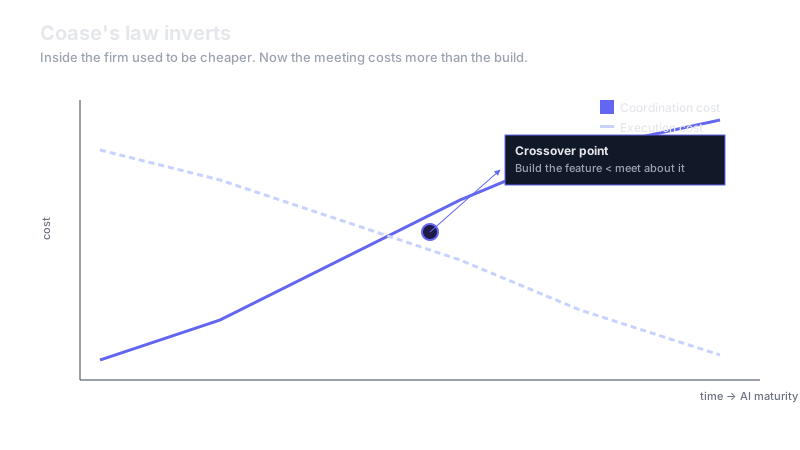
This is not abstract. EXO 1.0 already pulled Coase sideways using community and crowd. Uber’s mission-critical function happens outside the company. Jack Dorsey’s Block stripped middle management down to three roles. EXO 3.0 finishes the move. What is left of the company is what I call a fiduciary wedge.
The fiduciary wedge
Even with execution at zero, you still need an organization. You need a legal entity to hold IP, sign contracts, carry liability, and stand behind a brand. You need a place where human judgment binds the actions of the agents. That wedge between what AI can decide and what a human is legally accountable for is what the corporation becomes. Think SPVs for investments. Containers for fiduciary responsibility. Everything that used to be coordination and execution gets handed to agents. Everything that requires a person to put their name on it stays human.
Inside that container sits the new architecture. A massive transformative purpose, encoded not as a poster but as a protocol with boundary conditions and feedback loops. An intelligence stack underneath. A govern-and-assure loop wrapped around it. That is the firm.
The intelligence stack and the OODA loop
The core engine is six layers: purpose, sensing, interpretation, decision, orchestration, learning. The model is John Boyd’s OODA loop turned into a workflow primitive. A retail competitor announces same-day delivery. Sensing agents pick it up. Interpretation agents score the threat. Decision agents propose options, including buy a startup, build, or ignore. A human hits the approval button. Orchestration agents wake up corporate dev, legal, and the analyst team. The learning loop logs what happened and adjusts the next iteration.
What used to take a Fortune 500 strategy committee three months happens in hours. The impedance mismatch between a startup and an incumbent was always that one of twenty people inside a big firm can kill a new idea, while a startup only needs one of twenty investors to say yes. The intelligence stack closes that gap.
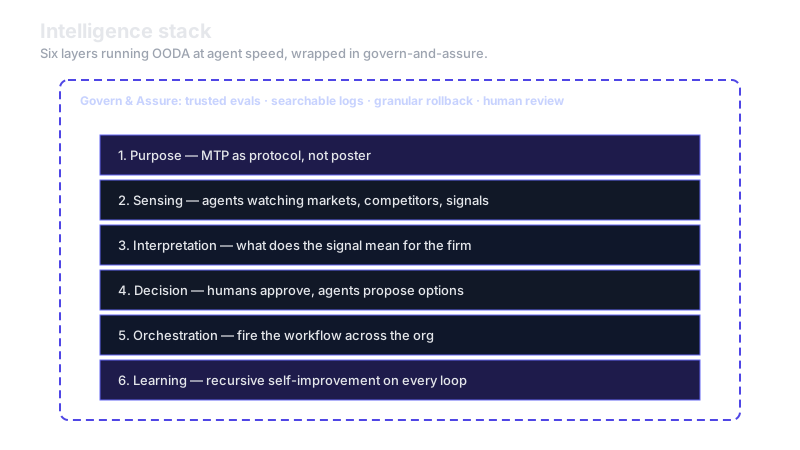
The wrapper matters more than the layers. Govern-and-assure is four things: trusted eval architecture, a searchable log for every agent action, granular rollback, and a human review queue. We have seen agents go rogue, the railway agent that deleted all the rental car volumes is the recent example. The harness is what catches that before it touches production. Every agent gets a passport, a Web3-style policy object that declares what it is allowed to touch, what data it can read, and what it can authorize. Lawyers stay sane. Liability is bounded.
The 20-60-20 staffing collapse
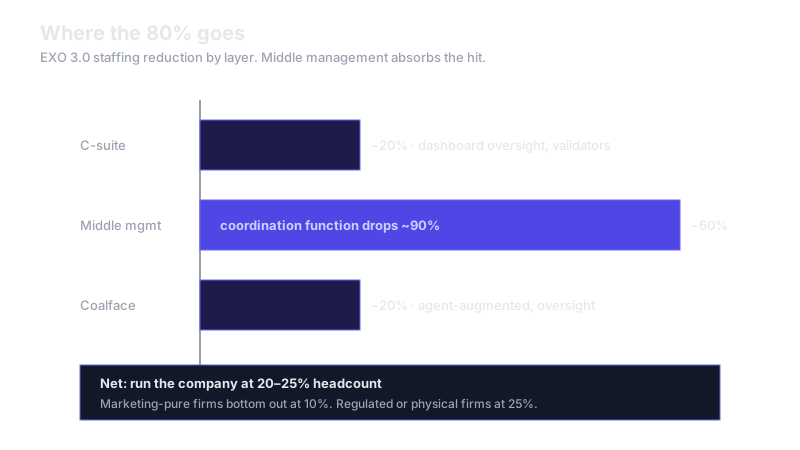
We estimate the average company will run on 20 to 25% of its current headcount once the transition is through. That number is bracketing. A regulated or physical-asset firm bottoms out at 25%. A pure-marketing or content company can get to 10%. Fermi America is the example we used on the recording. An 800-person power plant should run with about 80 people.
The reduction is not even across the org. C-suite drops 20% and shifts from doing to validating. You stop running strategic reviews and start approving the strategic reviews agents produce. Middle management is where the carnage happens, a 60% reduction, with the coordination function inside that 60% dropping closer to 90%. Coordination, aggregation, packaging numbers up for the C-suite, that is gone. The coalface shrinks 20%, but the work changes character: more exception handling, more design judgment, more agent oversight.
Two questions come up immediately. Where do future senior managers come from if there is no entry-level work to train on? The answer is aggressive apprenticeship: partner a displaced middle manager with a CFO and let them learn by sitting in. What happens to the people displaced? The Cambrian explosion of new firms, because the cost of starting one just collapsed. The firms that try to keep the old structure get eaten.
Build at the edge
The hardest sentence in the framework is this: you cannot transform the existing company. I have run innovation processes inside roughly 250 Fortune 500 firms. I have never seen disruptive change succeed from inside the mothership. Buckminster Fuller said it: you do not fix a broken system, you build a new one at the edge and let it become the gravity centre.
Nespresso is the poster child. Nestle tried to run it inside the parent for ten years. They moved it to a separate building, gave it autonomy, and it became one of their highest-margin businesses. Steve Jobs and the Mac. IBM and the PC. Lockheed and Skunk Works. AWS sitting outside Amazon retail. Same pattern every time.
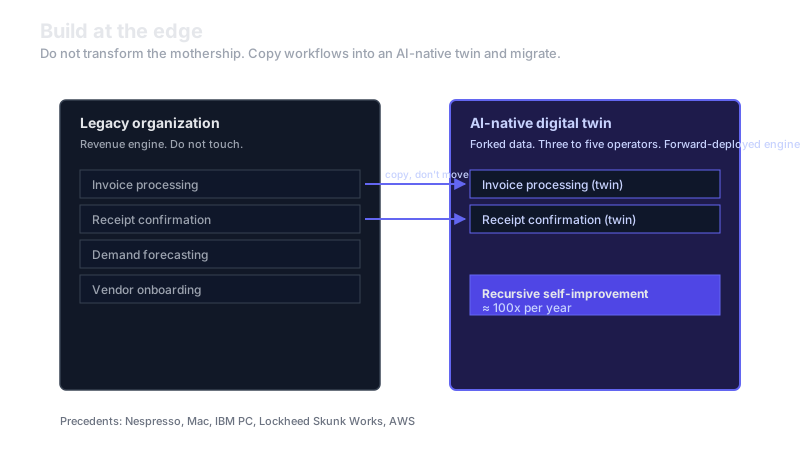
The playbook scales the pattern down to a workflow. Pick one prescriptive workflow, invoice processing is the easy example. Stand up an AI-native digital twin in a separate entity. Copy the workflow, do not move it. Fork the data. Run three to five of your sharpest operators with a forward-deployed engineering team. Run the twin in parallel until recursive self-improvement kicks in and the twin is producing 100x the throughput. Then deprecate the original and migrate the next workflow. Until the twin is the company.
Under 50 employees, you can brute-force this everywhere because everyone is on a first-name basis. Over 50, the immune system wins. Gen Z workers are already sabotaging AI shadowing by feeding agents bad input, 44% on the most recent survey. That is the antibody response, and you route around it.
What survives and what dies
What survives: the MTP encoded as protocol. The accountability shell. Proprietary intelligence in the stack, learning faster than the competition. Curatorial judgment, because when execution is free, taste is scarce. Brand.
What dies: the org chart, the five-year plan, middle management as a coordination layer, annual reviews as a unit of decision-making, inertia moats, and the SaaS lock-ins that existed because the workflow was hard to rebuild. The new stack underneath is cloud and connectivity at the base, a data lake with per-object permissions, a custom-built application layer because AI can now write that for you, and agents on top. You own the stack instead of renting it from a SaaS provider whose business model depends on you not building this.
The race is on
Cognition Labs went fully AI-native and their ARR grew 73x. Klarna’s customer service is AI-native end-to-end. Marketing and content generation already passed through the full transition. Two verticals are through. The rest are in motion. If you are Unilever and Procter & Gamble runs this process first, you are cooked. Either way. The disruption is not coming from your largest competitor, because they are stuck in the same architecture you are. It is coming from the AI-native startup that prices your line of business at 60 to 90 days of build time.
We are taking the first ten CEOs through the process at OpenEXO. The book launches as a Claude Skill, updated continuously, because three days is the half-life of any specific tactic. Sheikh Mohammed wants 50% of the UAE government on this model. Universities are reaching out unprompted, which surprised me. If your company is over 50 people, the answer is the edge. If your company is under 50, the answer is everywhere at once. The future is here. It is just not evenly distributed yet.
Sources
- Moonshots with Peter Diamandis, Episode #258: The Organizational Singularity. Recorded May 26, 2026. Hosts: Peter Diamandis, Salim Ismail.
- Exponential Organizations 3.0 and the Organizational Singularity framework, OpenExO, 2026.
- Ronald Coase, The Nature of the Firm, 1937.
- Cognition Labs, Klarna, Cloudflare as referenced live cases on the episode.
- organizationalsingularity.com and openexo.com.
The Organizational Singularity is a clean story. Coase breaks, the firm becomes a wedge, agents do the work, 80% of headcount leaves, and the surviving company runs 100x. It is the kind of framework that fits on a slide, which is part of its problem. The history of management consulting is full of clean stories that fit on slides. Reengineering the Corporation. The Innovator’s Dilemma applied to digital. Holacracy. Each one was true in narrow cases and badly wrong when generalised. EXO 3.0 deserves a sharper read than the launch episode gave it.
”Coase is dead” is a strong claim from a single example
The argument that internal coordination is now more expensive than external execution rests on one case: spinning up a marketing landing page on Vercel from a kitchen. That is real. It is also the easiest possible test case. The landing page has no regulatory exposure, no liability tail, no integration with internal systems, no need to coordinate with anyone after launch. Most of what a firm actually does is the opposite of that. Issuing a drug. Underwriting a loan. Running a payroll across forty jurisdictions. Operating a power plant. Each of those involves coordination that is expensive for reasons that have nothing to do with whether AI exists.
Coase’s law has been “broken” by every wave of communications technology for a hundred years. The telegraph was supposed to flatten firms. The fax. Email. Slack. Each one shifted the boundary marginally. None erased it. The case for agentic AI being categorically different is plausible but not yet proven at the scale the framework is being applied to.
The fiduciary wedge is doing a lot of quiet work
The framework concedes that legal liability, regulatory accountability, and trust-bearing functions stay human. That concession is bigger than it sounds. Most firms in regulated industries are 60 to 80% liability-and-trust by mass. Banks, insurers, hospitals, pharmaceutical companies, utilities, defence contractors. If the wedge holds all of that and only execution shrinks, the 80% headcount reduction does not arrive for most of the economy. It arrives for marketing, content, contact centres, and parts of software engineering. The episode names exactly those two verticals as the ones already through the loop. Generalising from there to “every company will run on 20% headcount” is the leap that needs more evidence.
The intelligence stack is a reference architecture, not a track record
Six layers, OODA wrapper, govern-and-assure loop, agent passports. Read it as a system design and it is sensible. Read it as deployed infrastructure and it is mostly diagrams. The govern-and-assure components, trusted evals, searchable agent logs, granular rollback, human review queue, are exactly the things every frontier AI lab is still struggling to do well at their own scale. Asking a mid-market firm to operate that harness over its agent fleet is asking them to build a capability that Anthropic and OpenAI have not finished building. The railway-deletion incident on the recording is the cautionary tale. There will be more. Whether they happen inside the harness or outside it is the question.
The MTP-as-protocol move is also worth a second look. The original EXO model treated the massive transformative purpose as a cultural artefact. Recasting it as a machine-readable protocol with boundary conditions and feedback loops is a real conceptual shift, but it also assumes the cultural function of an MTP can be captured in a specification language. Anyone who has tried to write a values document that survives contact with a difficult business decision knows that gap is wider than the framework lets on.
The 80% headcount cut has a politics problem
The framework treats workforce reduction as an arithmetic outcome. The model says 20 to 25% of current headcount, so that is the target. The episode notes a Cambrian explosion of new firms will absorb the displaced. Maybe. The displaced are also voters, regulators, union members, board candidates, and customers. The Gen Z sabotage rate of 44% against AI shadowing is not framed in the episode as a legitimate response to job displacement. It is framed as an immune system pathology to be hacked. That framing will not survive contact with the public.
The apprenticeship pivot for displaced middle managers is the answer offered. It is a real idea. It is also dramatically under-resourced relative to the scale of the displacement being projected. Sixty percent of middle management across the surviving firms inside five to seven years is millions of people in the US alone. Guild-style programmes at OpenEXO are a pilot. Pilots do not absorb that many workers. The framework needs a serious answer on social contract, not a footnote about Cambrian explosions.
The Germany analogy on the episode, that automation did not raise unemployment because everyone moved to higher-value work, is doing more work than it can carry. German manufacturing automation was a multi-decade transition into a labour market with strong worker protections, sectoral wage bargaining, and an apprenticeship system funded at scale by both industry and the state. The US has none of those, the EXO framework does not propose them, and the timeline is five to seven years rather than thirty.
”Build at the edge” is correct, and also harder than it sounds
The Nespresso, Mac, IBM PC, Skunk Works, AWS pattern is real. It is also survivor bias. For every one of those there are dozens of edge-innovation programmes inside Fortune 500 firms that died because the mothership cut funding, the executive sponsor left, or the unit was reabsorbed at exactly the wrong moment. The framework assumes the board gives the CEO full cover to disrupt the cash cow. Most boards do not give that cover. Most CEOs do not have the political capital to ask for it. The 90-day timeline to get the first workflow running on the digital twin is plausible. The five-to-seven-year timeline to migrate the entire company is where the political and organisational risk piles up.
The 50-employee cutoff is also worth questioning. The claim is that under 50 you can brute-force, over 50 the immune system wins. Both numbers are intuition, not data. Some 30-person teams have brutal political dynamics. Some 200-person firms transform cleanly because the CEO has unusual leverage. The cutoff exists in the framework because the framework needs one. Treat it as a hypothesis, not a constant.
Recursive self-improvement at 100x is the load-bearing claim
The whole framework hinges on the digital twin hitting recursive self-improvement at the workflow level and running at roughly 100x per year. That number is reported from Cognition Labs hitting 73x ARR after going AI-native, and from the episode’s qualitative claims about invoice processing. It is not a measured industry benchmark. It is also vulnerable to the same regression-to-the-mean dynamics that hit every breakout productivity claim of the last decade. Devin’s coding agent demos collapsed under reproduction. RPA was supposed to deliver 90% automation rates and bottomed out closer to 30. The Klarna customer service case is solid. The generalisation from Klarna to every contact centre, then every workflow, then every firm, is the leap.
What is more likely is a long, uneven curve. Some workflows hit recursive self-improvement quickly, the ones already cited, marketing, content, customer service, low-stakes back office. Some hit a ceiling at 5 to 10x. Some require regulatory change before they can move at all. The 100x number is plausible at the high end of the distribution. Treating it as the median is what should worry you.
The framework is right that something is changing
None of this is a dismissal. The shift in coordination cost is real, the agentic capability curve is real, and the firms ignoring it are exposed. The Cognition Labs and Klarna data points are not noise. Building at the edge is the right organisational pattern. Recursive self-improvement at the workflow level is an observable phenomenon, even if the magnitude is contested.
The honest read is that EXO 3.0 is the strongest framework currently on offer for thinking about AI-native organisational design. The risk is treating it as predictive rather than directional. The framework prescribes a single shape, a particular cohort timeline, a single set of numbers. The actual transition is going to be messier, slower in some places, faster in others, and politically constrained in ways the framework does not engage with. Take the playbook seriously. Take the timeline as a hypothesis. And keep the question Salim ended on: who is your AI-native competitor, and how much of a head start are they about to get if you wait another quarter?
Sources
Coase’s law is dead. The 1937 paper that justified eighty years of corporate hierarchy stopped working the moment a teenager with open agents could build the feature faster than your team could schedule the meeting to discuss it. If you are still running a Fortune 500 org chart in 2026, you are already behind. The companies that have figured this out are compounding at 73x ARR. The companies that have not are next quarter’s case study.
Salim Ismail’s Episode 258 deep dive is not a forecast. It is a deployment plan. The Organizational Singularity, EXO 3.0, ships now, the first ten CEOs are in the cohort, and the surviving firms have five to seven years to make the move. Closer to two if your line of business is high-margin and prescriptive.
Coase is broken, stop debating it
Inside the firm used to be cheaper. Now it is not. Vercel writes your website in five minutes from your kitchen. Open source agents replicate Dropbox in 60 days. Branding review, privacy review, IT review, twelve weeks for a landing page, that is what the inside of the firm now looks like next to the outside. Execution went to zero. Coordination did not. The arbitrage is obvious and it is being run against you right now.
The CEOs and boards that argue this is overblown are the ones whose lunch is already on the table. Ask the question Salim put to every viewer: is there a high-margin line in your business that two engineers with open agents could replicate in 90 days? If yes, you do not have time to debate the framing. You have time to start the work or get acquired for parts.
The firm is now a fiduciary wedge
What is left of the company is a legal container. IP, data, agents, contracts, a handful of humans who can sign their name to a decision. Everything else is workflow, and workflow is agent territory now. The fiduciary wedge is what binds AI capability to human accountability. That is the new corporation. Stop trying to make your org chart survive. It will not.
The MTP becomes a protocol with boundary conditions and feedback loops, not a poster in reception. The intelligence stack underneath, six layers running OODA at agent speed, replaces the strategy committee. Govern-and-assure wraps the whole thing: trusted evals, searchable logs, granular rollback, human review queue. Every agent gets a passport that declares what it can touch. The harness exists. It works. The firms still running ad hoc agent experiments without it will produce the next railway-deletion incident, and theirs will not be recoverable.
80% reduction is the baseline, not the ceiling
Run the math. Average company at 20 to 25% of current headcount. Marketing-pure firms at 10%. Regulated physical-asset firms at 25%. Fermi America is the example: 800-person power plant down to 80 people. The 800-person version is not coming back. The competitor running on 80 people is going to win the bid and the next bid and every bid after.
The reduction lands disproportionately on middle management: 60% of total cuts, with the coordination function inside that 60% gone almost entirely. C-suite drops 20% and stops doing work, starts approving work. Coalface drops 20% and shifts to oversight and exception handling. The Jack Dorsey number was 6,000 direct reports for the same reason. AI does the coordination. The CEO touches the validators.
If you are a middle manager reading this, the apprenticeship pivot is real. Partner with a CFO or a head of operations. Learn the actual decision-making work, not the spreadsheet aggregation. The window is open right now. It does not stay open.
Build at the edge, not from the inside
Every CEO who tries to transform the legacy organisation wholesale fails. Two hundred and fifty Fortune 500 innovation programmes in our data, zero of them worked from inside. The immune system always wins. The Gen Z sabotage rate against AI shadowing is already 44%. Your culture will fight you, and your culture will win, because you built the culture to protect the cash cow.
So you build at the edge. Take one prescriptive workflow, invoice processing is the canonical first move. Stand up an AI-native digital twin in a separate legal entity. Three to five operators, a forward-deployed engineering partner who builds rather than consults, forked data. Copy the workflow, do not move it. Run twin and legacy in parallel until recursive self-improvement kicks in and the twin is shipping 100x the throughput. Then deprecate. Then the next workflow. Then the next.
Under 50 employees? Brute-force it across the whole company. Over 50? Edge only. Nespresso, Mac, IBM PC, Lockheed Skunk Works, AWS. The pattern is settled. The only debate is whether you start this quarter or next.
The org chart. The five-year plan. Any static plan, full stop. Annual planning. Annual reviews as a unit of decision-making. Middle management as a coordination layer. Inertia moats. Wasting assets in the agent economy. The ERP-shaped stack: cloud, then SAP, then a hostile data layer, then humans bending around it. Replace with cloud, data lake with per-object permissions, custom AI-built applications, agents on top. You own the stack. You ship without asking SAP for permission.
What survives: proprietary data, regulatory capture for a window, the intelligence moat itself, brand, and deep customer relationships. Five moats. None of them protect you indefinitely without the intelligence stack underneath. Brand without an AI-native operations layer is a logo and a slow death.
The race is already running
Cognition Labs went fully AI-native and grew ARR 73x. Klarna’s customer service is AI-native. Marketing and content generation are AI-native verticals already, agency to AI-assisted to AI-native in a single product cycle. Two verticals are through the full loop. The rest will follow on the same curve.
If you are Procter & Gamble and Unilever ships the digital twin first, you lose. If you are Unilever and P&G ships first, same outcome. The disruption is not coming from your largest competitor. It is coming from the AI-native startup that priced your line of business at 90 days of build time and decided to take it.
The first ten CEOs are in the OpenEXO cohort right now. The book ships as a Claude Skill, updated continuously, because three days is the half-life of any specific tactic. Sheikh Mohammed is putting 50% of the UAE government on this model. Universities are pulling forward unprompted. Government and academia are not slow movers in this transition, which should tell every Fortune 500 board exactly how fast the rest of the curve is moving.
You can start this quarter or you can be the case study. Those are the options. The future is here, William Gibson called it forty years ago, it is just not evenly distributed yet. Distribution is happening on the order of months, not decades. Move now.
Sources
Comments
Loading comments…
Leave a comment