Three numbers from one episode. One terawatt of AI chips per year, which is fifty times what the entire planet currently produces. 170 million Waymo miles with 92 percent fewer serious crashes than human drivers. And the S&P 500 trading at twenty-two times forward free cash flow on the assumption that competitive moats will keep the cash coming for two decades, even as the people building the disruption say five years is the new ceiling.
Episode 242 of Moonshots is a panel doing back-of-envelope math at the scale of nation states. The interesting move is not whether the math is right. It is what the math implies if the panel is even directionally correct, and where the panel itself is rounding scenarios into forecasts.
TerraFab is a war on the chip ceiling, not another fab
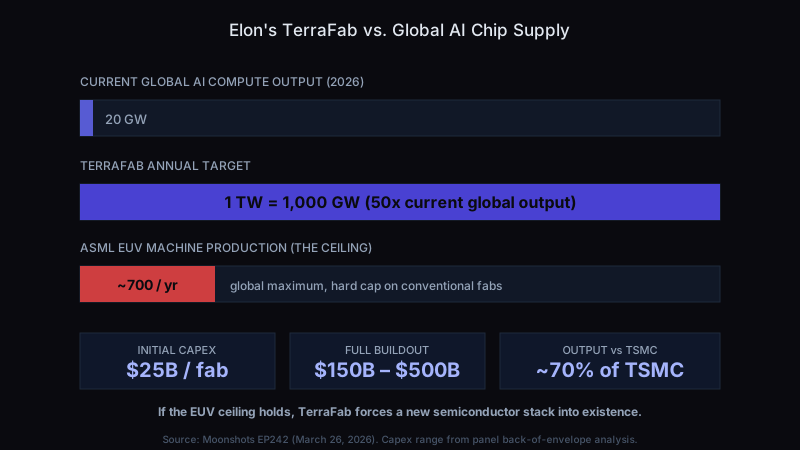
Elon’s announcement is the kind of number people stop reading once it lands. One terawatt of AI compute output per year, vertically integrated across Tesla, XAI, and SpaceX, with the Austin site eventually growing to 100 million square feet. The world currently produces 20 gigawatts of AI compute. The TerraFab target is 50x that.
The capital number underneath is similarly load-bearing. Twenty-five billion dollars to turn on a single fab. By Dave Blundin’s read, the full buildout to hit Elon’s target is 150 billion at minimum and could realistically run to half a trillion. Multiply by the number of fabs that get you to 50x and the math stops looking like a company and starts looking like a national project.
The bottleneck is not money. It is ASML EUV machines. The world makes roughly 700 of them a year, and that ceiling alone is the reason TSMC and Samsung have not raced to ten-times their own output. Alex Wissner-Gross’s bet is that the only way Elon clears the ceiling is by inventing a different stack. New process physics, alternatives to photolithography, single-atom self-organizing deposition. The kind of work that only gets funded when there is a buyer at the other end with a 50x demand curve to absorb whatever falls out.
The geopolitical case writes itself. A US-controlled supply at this scale changes China’s calculus on Taiwan and gives every Western government a fallback that does not pass through TSMC. The pricing is already starting to flow into the SpaceX IPO prediction markets, which moved from a 1.5 trillion dollar valuation to north of 2 trillion in the days after the announcement. That is not the company being repriced, it is the option on the singleton being repriced.
Robotaxis are a real estate event, not a transportation event
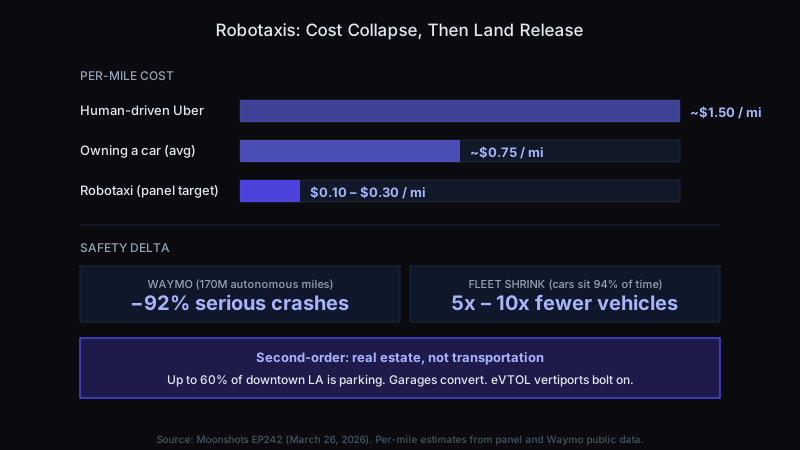
Waymo is at 170 million fully autonomous miles with a 92 percent reduction in serious crashes. Uber’s 1.5 billion dollars into Rivian comes with a plan to deploy 50 thousand robotaxis. CyberCab is priced at roughly thirty thousand dollars per vehicle, which makes Peter Diamandis’s plan to buy fifty of them and run a fleet out of Santa Monica look less like a stunt and more like a small business plan.
The economics are the part that changes urban life. The driver is the majority of the cost of an Uber. Strip the driver out and you get a 10x reduction on the per-mile rate before you account for the fleet shrinking. Salim Ismail’s number was a 5x to 10x reduction in vehicles needed once cars stop sitting in driveways 94 percent of the time. The ride lands at ten to thirty cents a mile. That is four to five times cheaper than owning the car.
Then come the second-order effects, which is where the panel got animated. Sixty percent of the land area in downtown Los Angeles has parking spots. All of that is releasable. Garages convert to bedrooms, gyms, workshops. Stadium parking lots become anything else. Joby and Archer are running FAA conformance tests on eVTOLs in California right now, with Joby flying over the Golden Gate Bridge. Salim’s pitch for autonomous Winnebagos is not far-fetched once you accept that humans become packets routed by the AV system, with sleeper cars meeting calendars halfway across the country overnight.
If you buy any of this, the practical advice from Dave is the line worth keeping. Do not buy in a city you can already get in and out of cheaply. Buy the spot that gets a 10x accessibility upgrade in a decade and is going to be coveted by the people who get rich from the same curve.
The compute ceiling almost no one is pricing
The most underweighted moment in the episode is Wissner-Gross’s offhand warning that a self-driving car burns roughly a full GPU. By the end of this year, the same GPU could be running brain surgery, discovering new physics, or carrying a reasoning model. In a scarcity world, robotaxis lose that auction.
The panel did not engage with it. Peter and Dave assumed compute abundance and moved on. That is the silence to listen to. The full robotaxi rollout is implicitly priced as if the supply curve clears every demand. AWG is saying the demand curve has competitors that pay more per GPU-hour than a fleet operator can ever justify.
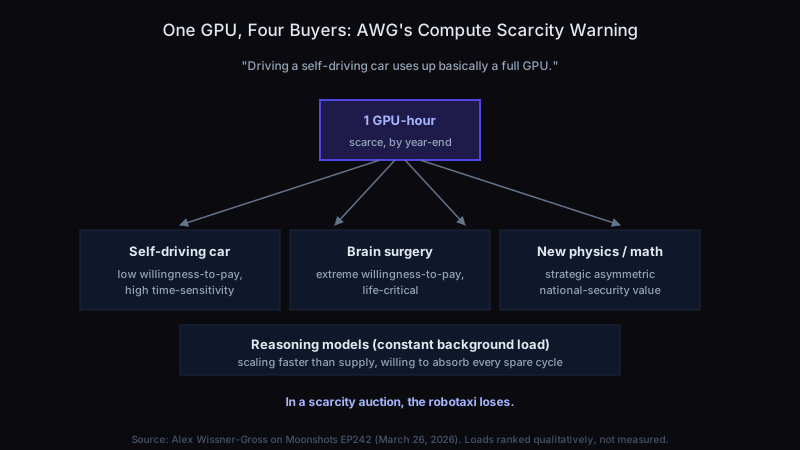
The TerraFab argument and the AWG warning are two sides of the same coin. If Elon clears the ceiling, the warning does not bite. If he does not, the rollout schedules every panel on the show is treating as inevitable get pushed by the same chip shortage that is forcing TerraFab to exist in the first place.
The token-spend metric is the new W2
Jensen Huang’s line is the one CEOs are quoting at each other this week. If a 500-thousand-dollar engineer is not consuming at least 250 thousand dollars of tokens, he is “deeply alarmed.” Dave’s internal target across Link Ventures companies is 80 percent token spend, 20 percent salary. PWC is telling its partners to AI-tool themselves or leave. G42 posted a job listing for AI agents, not humans.
The metric itself is not the right one. Hours are useless. Tokens can be wasted. Wissner-Gross’s better point is that tokens are the first measurable, introspectable, gradable input to white-collar work. You spend more tokens to grade the original tokens. Dave’s practical version is the part to act on. Capture the prompt history. Bedrock dumps it into S3 by default. Whatever tool your team uses, do the same. The grading happens later.
The harder edge is who gets cut. Dave’s read is that the bottom 20 percent gets evaluated on the quality of their prompt history before this year is over. Salim’s read is gentler, that companies will run on 20 to 25 percent of current headcount but will spawn four or five times more companies to absorb the displaced labor. Both can be true. Neither is comforting if you are inside an org that has not started.
Chamath’s terminal value collapse is real, but the loss does not stay in the SaaS column
Chamath’s argument is the one that should make every CFO sit up. The S&P 500 trades at 22x forward free cash flow, which is 58 trillion dollars of market cap built on the assumption that today’s moats keep producing. Compress that multiple to 7x and you wipe out 39 trillion. Compress it to 2x, the kind of multiple a business with no terminal value gets, and you destroy 52 trillion. The mid-cap world is already trading at roughly 7x. The S&P is being held up by passive index flows, not by belief.
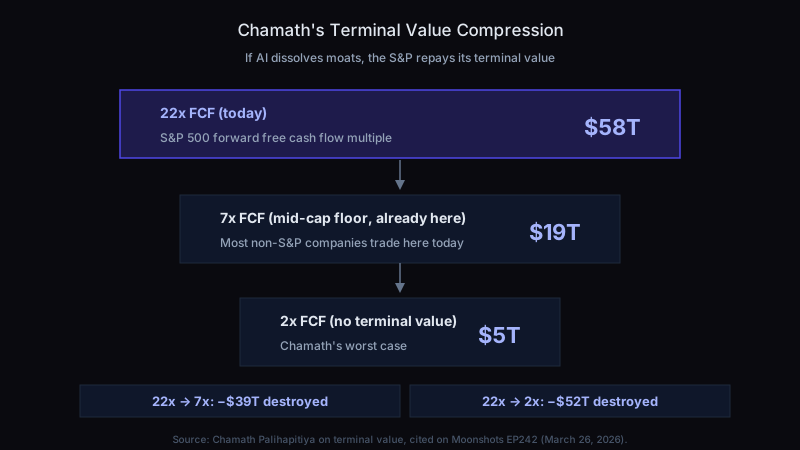
Dave’s counter is the one that matters. The 10x economic tailwind from AI over the next decade does not disappear just because the multiple compresses. Capital gets reallocated, not destroyed. Wissner-Gross is sharper: capital flows to infrastructure, lunar mining, agility, and physical assets that are harder to copy in bits. Salim’s framing is the one to remember. The only moat left is the living system that learns faster than its competitors. Everything else is cost cutting until the next acquirer shows up. The private equity playbook of buying cash cows and AI-ifying them at one-thousandth the cost of two years ago is already running. Anthropic and OpenAI are partnering with PE firms to do exactly this.
The counter-read the panel keeps dodging
Most of the load-bearing numbers in this episode were generated on the call. The trillion-dollar TerraFab valuations are back-of-envelope math from Claude. The ten-times cost reduction in robotaxis assumes a 50-thousand-vehicle fleet that does not exist yet. The eVTOL networks and the autonomous Winnebago futures are vivid but not modeled. The 22x to 7x compression is a thesis, not a price discovery event. None of this means the panel is wrong. It means the panel is consistently rounding scenarios into forecasts, and the listener has to do the un-rounding.
The other thing the panel waved away is political risk. The Ohio constitutional amendment to ban data centers over 25 megawatts is the leading indicator nobody in San Francisco is pricing. The FAA is the reason the eVTOLs will be piloted before they are autonomous. Permitting nuclear plants is a multi-year process even when everyone agrees on the math. Every five-year timeline in the episode assumes the politics catches up. They usually do not.
The episode’s real value is that three independent shocks all start to compound at once. Compute supply, autonomous mobility, and the moats argument. The teams that get through the next decade will have done the boring work of separating which numbers are forecasts, which are scenarios, and which are wishes. The moats argument is the one everyone in the room secretly agrees with, and it is the only one with a deadline.
Sources
- Moonshots with Peter Diamandis, Episode #242: Elon’s $5 Trillion Bet, the End of Human Drivers, and Chamath’s Market Warning. Recorded and published March 26, 2026.
- Chamath Palihapitiya on terminal value collapse and the 22x to 7x free cash flow compression thesis (X / personal blog post referenced in episode).
- Waymo public safety report: 170 million fully autonomous miles with a 92 percent reduction in serious crashes versus human drivers.
- Joby Aviation FAA conforming aircraft testing and Golden Gate Bridge demonstration flight, March 2026.
- FDA announcements on the Bayesian approval framework and the move from a two-trial to a one-trial process for certain drug categories.
The episode runs four extraordinary claims at extraordinary speed and almost none of the load-bearing numbers were measured. They were generated on the call, by the same panel that has equity exposure to the outcomes they are pricing. Read the transcript twice and a different shape appears. The trillion-dollar TerraFab valuations are back-of-envelope math from Claude. The robotaxi cost collapse assumes a fleet that does not yet exist. The terminal value thesis has its own rebuttal embedded inside the same conversation. None of this means the panel is wrong. It means the consensus is significantly softer than the consensus thinks it is.
TerraFab is a vision statement priced as if it were a balance sheet
One terawatt of AI compute per year. Fifty times current global output. The number is genuinely audacious and the strategic logic is real. The math underneath it is not.
Twenty-five billion dollars to turn on a single fab. Multiply by the number of fabs needed to hit 50x and you get a half-trillion-dollar build with timing that depends on the ASML EUV ceiling, which currently produces 700 machines a year. Wissner-Gross’s escape hatch is that Elon will force a new semiconductor stack into existence: alternatives to photolithography, single-atom self-organizing deposition. That is a hope, not a roadmap. None of those technologies has been shown to work at production yield, and the panel did not name a single line of research that is close.
The valuation work was done with Claude on the call. “On the order of a trillion to multiple trillions” is Dave’s quote, and even Dave admitted the number was probably off by an order of magnitude. The SpaceX IPO prediction markets repricing from 1.5 to over 2 trillion is real, but it is repricing the option, not the build. Elon’s own historical timing accuracy is “about 15 to 20 percent,” in Salim’s words. Build in three times slippage and the question becomes whether the demand curve is still in the same shape when the supply lands.
Robotaxi unit economics are downstream of a fleet that does not exist
170 million Waymo miles is real. The 92 percent crash reduction is real. The CyberCab pricing is real. Every claim downstream of those is conditional on a 50-thousand-vehicle fleet that nobody has built, run at scale, or stress-tested against weather, edge cases, regulatory rollback, or insurance underwriters who have not yet seen the long tail.
The “ten to thirty cents a mile” number assumes the driver-out, fleet-shrunk steady state. Pricing the steady state today, before the fleet exists, is the same move public market analysts made on Uber’s path to profitability ten years ago, and it was wrong by half a decade. The 60 percent of LA land area as parking number is a meme that has been bouncing around since the early 2010s. The original studies put it closer to 14 to 30 percent depending on how you define “downtown.” The autonomous Winnebago vision is delightful and unmodeled.
The political risk is the part the panel waved away. The Ohio constitutional amendment to ban data centers above 25 megawatts is the leading indicator on permitting. The FAA is the reason the eVTOLs are going to be piloted before they are autonomous. Joby has been three years away from an autonomous service for a decade. None of these timelines move at panel speed.
The compute scarcity warning is the line the panel told on itself
The most underweighted moment in the episode is Wissner-Gross’s offhand observation that a self-driving car burns roughly a full GPU. By the end of this year, the same GPU could be running brain surgery, discovering new physics, or carrying a reasoning model. In a scarcity world, robotaxis lose that auction.
Peter and Dave then walked past it. They assumed compute abundance and moved on. That is the silence to listen to. If Wissner-Gross is right, every robotaxi rollout schedule the panel cited is implicitly priced as if the supply curve clears at infinity. The same panel that just spent twenty minutes celebrating TerraFab as the answer to the chip ceiling is then pricing the rest of the episode as if the chip ceiling is irrelevant. Both claims cannot be true at once.
Token-spend metrics are Nvidia revenue with a haircut
Jensen’s “250 thousand dollars of tokens per 500-thousand-dollar engineer” line lands like a productivity rule. It is also, exactly as Wissner-Gross noted, a circularity. Jensen runs the company that sells the chips that produce the tokens. He is taking the global engineering payroll and proposing that half of it should flow back to him. Wissner-Gross’s “huge grain of salt” is the right read.
The deeper issue is that tokens are an input metric. The whole century-long fight to escape input metrics in white-collar work, the long retreat from billable hours and lines of code, was a reaction to exactly this kind of measurement. Saying “tokens are at least introspectable” is true, but it is also the exact rhetorical move every previous bad input metric was sold under. The “spend tokens to grade the tokens” recursion is real, and it is also a reason to be skeptical that the grading is actually independent. The grading model is trained on the same kind of work the grading is being asked to evaluate.
Chamath’s collapse is real, and Dave already wrote the rebuttal
The 22x to 7x compression math is correct as arithmetic. The S&P is at 22x. Mid-caps are already at 7x. Compress 58 trillion to 19 trillion and you get a 39-trillion wipeout. The arithmetic is not the question. The question is whether the wipeout is the right framing.
Dave’s rebuttal, on the same call, is the version that should sit alongside the headline. The 10x economic tailwind from AI does not disappear when the multiple compresses. It reallocates. Wissner-Gross pushed the same point. Capital flows somewhere. It might be infrastructure, lunar mining, agility, or physical assets. The “terminal value collapse” framing is dramatic, and the “capital reallocation” framing is boring, and the boring one is closer to what actually happens to wealth in a transition. Salim’s line that “the entire SaaS business model is broken” is also a Salim opinion, not a market consensus. SaaS revenue is still growing. The companies that adapt their models will be repriced inside the new regime, not eliminated by it.
The honest version of Chamath’s argument is narrower than the headline. Software businesses with shallow moats and a high terminal-value contribution to their multiple are exposed. Hardware-heavy and physical-asset-heavy businesses are less so. Index funds papering over the spread are a real risk to the headline number. None of this is the same as a 39-trillion-dollar destruction event. It is a repricing, and repricings are uncomfortable for the people who own the wrong things, not catastrophic for the system.
The episode is worth listening to for the audacity. The audacity is also the reason to discount almost every number that came out of it by exactly the amount the speakers themselves would, in private, if you asked them.
If you are still arguing about whether AI is real, the panel just told you which decade you live in. Three shocks land in the same month and they compound. Compute supply blowing through the chip ceiling. Robotaxis hitting unit economics that strand the entire ride-share industry. The S&P trading on a moat assumption that the people building the disruption say has five years to live. Read the episode and act, or be the case study.
TerraFab is not a fab, it is a chokepoint kill
Elon does not build a fab. He builds the move that ends a chokepoint. One terawatt of AI compute per year, vertically integrated across Tesla, XAI, and SpaceX, on a 100-million-square-foot Austin site. The world makes 20 gigawatts today. He is going to 50x it, and the SpaceX IPO prediction markets already moved from 1.5 to over 2 trillion dollars on the announcement.
The bottleneck is ASML. The world produces about 700 EUV machines a year. That ceiling is the entire reason TSMC and Samsung have not 10x-ed their own output. Wissner-Gross’s call is the right one. Elon is not going to build to the existing physics. He is going to force a new stack: alternatives to photolithography, single-atom self-organizing deposition, anything that breaks the EUV ceiling. The buyer is sitting at the end of the line with a 50x demand curve. That is the only condition under which the bench-side physics of the last twenty years finally gets funded.
Strategically, this is the move that takes Taiwan off the chessboard. Every Western government with a national security desk is going to cheer this through. If you are running an enterprise that depends on chip supply, your two-year plan is now built on the existence of TerraFab. You should be writing the LOI now.
Robotaxis just collapsed the car industry
Waymo: 170 million fully autonomous miles, 92 percent fewer serious crashes. Uber: 1.5 billion into Rivian and a 50-thousand-vehicle robotaxi plan. CyberCab priced at thirty thousand dollars per vehicle, which is the price point at which buying a fleet is a small business plan, not a moonshot.
The math is the part to internalize. The driver is the majority of the cost of an Uber. Strip the driver and you get a 10x reduction on the per-mile rate before you account for fleet shrinkage. Fleet sizes drop by 5x to 10x because cars stop sitting in driveways 94 percent of the time. The ride lands at ten to thirty cents a mile. Four to five times cheaper than owning the car. The 100-million-cars-a-year manufacturing industry just lost half its volume on a single panel discussion.
Now run the second-order effects, because that is where the wealth shows up. Sixty percent of downtown LA land area has parking spots. All of it is releasable. Garages convert. Stadium lots become anything else. Joby is flying over the Golden Gate Bridge in FAA conformance testing. The land repricing is going to dwarf anything the auto industry loses, and the people who buy the right second home in the right place between now and 2028 capture the upside.
The compute scarcity warning is the trade
Wissner-Gross said it once and the rest of the panel walked past it. A self-driving car burns roughly a full GPU. By the end of this year, the same GPU could be running brain surgery, discovering new physics, or carrying a reasoning model. In a scarcity world, robotaxis lose that auction. The entire fleet rollout is implicitly priced as if compute clears at infinity.
That is the trade of the year. Long compute supply, long the people who break the EUV ceiling, short anyone who priced a five-year robotaxi rollout against current chip output. TerraFab and the AWG warning are two ends of the same lever. Both move in your favor if you are positioned on the supply side. Both flatten you if you are not.
Token spend is the new W2 and you are already late if you are not measuring it
Jensen drew the line. A 500-thousand-dollar engineer who does not consume 250 thousand dollars of tokens a year is not earning the seat. Dave’s internal target across Link Ventures companies is already 80 percent token spend, 20 percent salary. PWC told its partners to AI-tool themselves or leave. G42 posted a job listing for AI agents, not humans. The frontier labs have internal token-maxing leaderboards and the engineers are competing on them voluntarily.
The metric is the easy part. The actionable part is data capture. Bedrock dumps prompt history into S3 by default. Whatever stack you run, do the same, today, before your team starts using their personal accounts and you lose the audit trail. The grading happens later, with another model. The point is to have the artifacts to grade. Every CEO who is not capturing prompt history this quarter is going to spend next quarter explaining why their bottom 20 percent are still on payroll.
Chamath is right and the wrong people are pricing it
The S&P trades at 22x forward free cash flow. 58 trillion dollars of market cap built on the assumption that today’s moats hold for two decades. Chamath’s argument is that no moat survives an AI that can rebuild a competitor’s stack in one-thousandth the time. Compress 22x to 7x and you wipe 39 trillion. Compress to 2x and you wipe 52 trillion. The mid-cap world is already at 7x. The S&P is being held up by passive index flows, not by belief.
Dave’s counter is the part to internalize, because it is the version that prints money. The 10x economic tailwind from AI does not vanish because the multiple compresses. It reallocates. Capital flows to infrastructure, agility, physical assets, and the small number of public companies whose management teams know how to keep reinventing the product. Salim’s line is the keeper. The only moat left is the living system that learns faster than its competitors. Everything else is cost-cutting until the next AI-enabled acquirer shows up. Anthropic and OpenAI are partnering with private equity firms right now to do exactly this. The transformation wave is already running.
The teams that move on these inside the next twelve months will compound through the next decade. Everyone else is the next acquisition target. That is not a forecast. That is the panel’s read on the live deal flow.
Comments
Loading comments…
Leave a comment