The sharpest question in Episode 244 of Moonshots came from a 13-year-old named Ilia. She stood at the microphone and asked Dara Khosrowshahi whether she would even need a driver’s license by the time she turned 16. Dara’s answer was the most compressed AV timeline anyone has given in public: three years from now, yes, still get the license. Ten years from now, the choice is hers, since by then there will be “plenty of choices”. Twenty-five years from now, humans will be “demonstrably less safe than autonomous”.
That is the timeline everyone will quote. It is not the biggest number he said that hour. The biggest number was 20 million.
The 10 million to 20 million claim
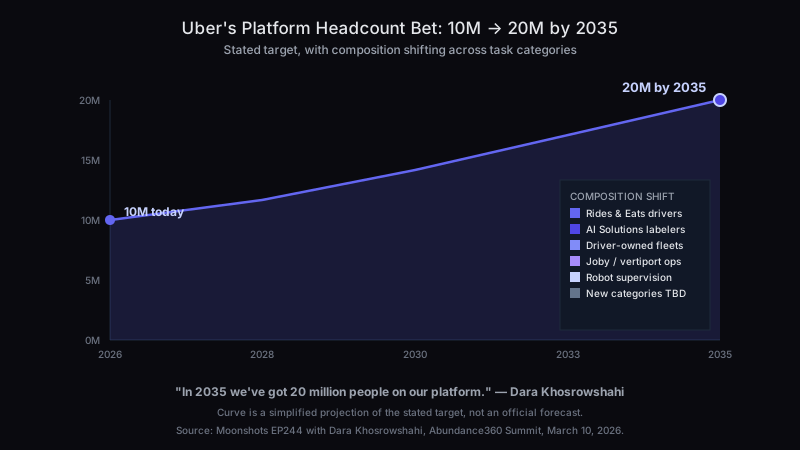
Uber runs a global platform with “probably 10 million drivers now globally”, in Dara’s own words. His stated target for 2035 is 20 million people on the platform. Not 20 million drivers. 20 million workers, explicitly including “different kinds of tasks” that do not exist today. The word he used was platform, not driver, and the distinction is the whole point.
That is a doubling of headcount inside a decade, quoted by the CEO of a Fortune 100 company, on a panel about the AI transition, in the same breath as him conceding the transition may arrive faster than his own timeline expected. There is no other large-cap CEO on record with a comparable number. The public statements from most of the other names in the S&P 500 on AI and labor sit somewhere between hedge and silence. Dara gave a ratio.
Augmentation is the historical base rate
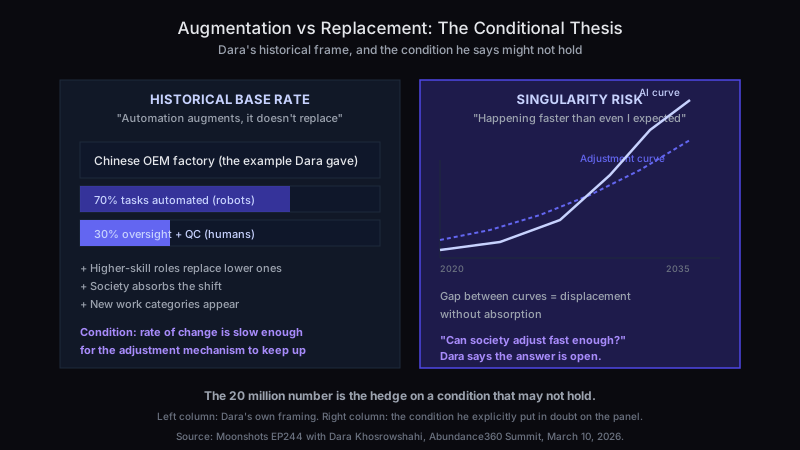
His defence of the number is the historical one. “Automation typically doesn’t replace work, but it augments work.” The example he reached for is Chinese OEM factories. Robots do the assembly. Humans oversee the robots, do quality checks, handle edge cases. The 200-year industrial record is clear enough: the mechanical loom did not eliminate clothing work, the ATM did not eliminate bank tellers for thirty years, spreadsheets did not eliminate accountants. The new category of work always shows up, often bigger than the one it replaced.
The framing matters because it is the only live argument any established CEO currently has against the “AI takes everyone’s job” narrative. Dara runs it forward cleanly: Uber is looking to automate tasks inside its own offices, but usually it gets to 20 or 30 percent automation per task, not 100. That leaves the human in the loop, doing the harder work.
The honest admission
Then he says the line most of his peers will not say. “The pace of change that we’re seeing as it relates to AI and automation over the past five years is just happening faster than even I expected.” And: “There’s an open question as to how quickly is society going to adjust, and just as it has historically, can it adjust fast enough?”
Read that twice. The CEO of Uber, an optimist on technology by his own admission, is telling you the augmentation thesis is conditional. The condition is speed. If the curve is slower than the adjustment mechanism, work gets augmented and reallocated and life gets better. If the curve outruns the adjustment, something else happens, and nobody has a plan for it. Every other major CEO is betting the condition holds. Dara is the first to say out loud that it might not.
The 20 million number is what he does with that doubt. It is a hedge, not a forecast. If the historical pattern holds, Uber wants to be the platform that catches the augmented worker on the way down. If it does not hold, Uber wants to be the platform that catches the displaced one. The mechanism is the same either way: push the platform into as many new work categories as fast as possible, and grow headcount on the thing that absorbs.
The new task categories
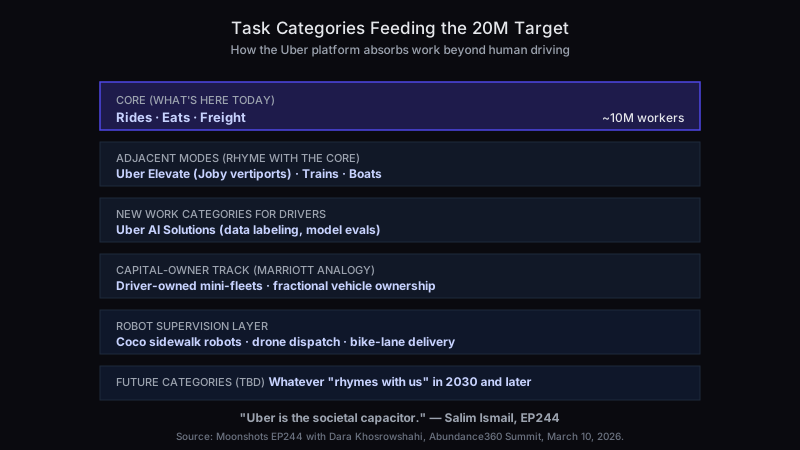
The pieces of the 20 million he named are worth listing. Uber AI Solutions is a line where drivers label images, compare model outputs, and test new models as paid flexible work. Dara offered it as the canonical example of how new work shows up inside a labor platform that already has the supply side. He also described a driver-owned fleet model on a Marriott analogy: the driver becomes a small fleet operator running a couple of vehicles, managing them while spending afternoons at the gym. On top of that are the multimodal expansions, Joby vertiport operations, Coco sidewalk robot supervision, drone delivery dispatch, freight, eats, and whatever comes next that “rhymes” with the core.
Salim Ismail landed the metaphor in one line. “Uber is the societal capacitor: being able to absorb and then disgorge electrons as required.” The useful reframe is that Uber is not a ride-hail company, it is a liquidity mechanism for human work, and the number of categories it can run liquidity on is the number of ways the 10 million becomes 20 million.
“Do the right thing, period” is the operating condition
The culture section was the one nobody expected. Dara explained that Uber’s core value is “do the right thing, period”, and that when the value was introduced the description under the headline was a single word: period. The intent was to push individual agency down four and five levels from the CEO, because a company with 30,000 employees cannot run a global labor marketplace by central decision. Three and four levels down from him, people still impact the direction of the whole company.
That is not a poster. It is the operating condition for the 20 million bet. A company big enough to absorb labor at that scale has to act smaller than its org chart, which is the exact opposite of what scaled companies usually do. His exact framing: “Companies tend to get more conservative as they get bigger. The exact opposite should be true.” He described that as the fight he has every day, with himself, his board, and his team. You can read the 20 million number as a single-sentence bet on whether that fight is winnable at Fortune 100 scale.
The counter-read
The ways this number does not land are worth saying out loud. A “platform worker” in the public Uber filings is anyone who completed at least one trip or delivery in the quarter. Gig-work research has repeatedly shown that the headline number overstates the economically meaningful labor force by a factor of two or three. A 10 million to 20 million jump measured that way is not the same thing as 10 million new full-time jobs. It can also be 20 million people each doing a smaller fraction of a living.
The data labeling story has its own problem. The same AI wave that is supposed to displace drivers is also automating labeling. OpenAI, Anthropic, and the labeling vendors Scale and Surge are all publicly working to replace human labelers with synthetic and self-supervised pipelines. Uber AI Solutions is a real line, but it is running on a surface that is itself eroding fast.
The driver-owned fleet idea carries the same contradiction the EP243 skeptic already flagged. A 40 to 200 thousand dollar capital stake in a depreciating asset, bought at the top of a price curve that is about to fall as Cybercab-class vehicles hit the market, is not the Marriott trade. It is the opposite of the Marriott trade. And the Chinese OEM factory Dara picked as the augmentation exemplar cuts the other way on inspection: those factories have “less humans working” than they did ten years ago, just with nicer job descriptions. The augmentation thesis smuggles a contraction through the back door.
None of that makes the 20 million number wrong. It means the number is load-bearing on a set of assumptions Dara himself said might not hold.
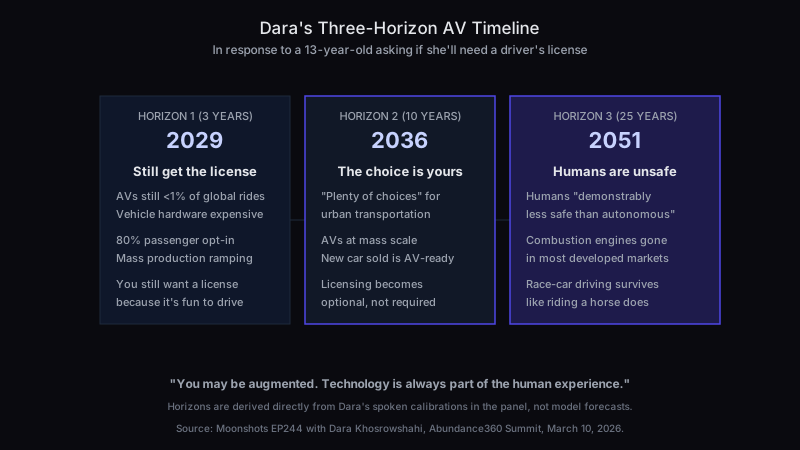
Return to the 13-year-old. Three years from now, she still takes the driving test. Ten years from now, the choice is hers. Twenty-five years from now, the roads look nothing like they do today. The same three-horizon logic applies to the worker. Three years, you are dispatching rides. Ten years, you are training the agent that dispatches you. Twenty-five years, the job is something we do not have a name for yet. The 20 million is the company’s best guess at whether the curve in between is soft or hard. The part to notice is that a Fortune 100 CEO has put a number on it at all.
Sources
- Moonshots with Peter Diamandis, Episode 244. “Uber’s Robotaxi Playbook, the End of Human Driving, and the 10 Billion Dollar Bet on Robots.” Live Q&A recorded at the 2026 Abundance360 Summit, March 10, 2026.
- Dara Khosrowshahi, live panel remarks on Uber platform worker count (10 million today, 20 million target by 2035).
- Uber AI Solutions public announcements on driver-facing data labeling work.
- Uber Q4 2025 results cited on the panel: over 10 billion dollars in annual cash flow.
- Salim Ismail, founder of OpenExO, on Uber as “societal capacitor” (EP244 panel).
The 20 million number is the headline of Episode 244, and it deserves a harder read than it got in the room. Dara Khosrowshahi did say something nobody else at his level has said out loud: the pace of AI change may be faster than society can adjust to. That admission is real and it is rare. The plan he attached to it is weaker than it looks, because almost every component of the 20 million number is load-bearing on an assumption that Dara himself was openly skeptical of on the same panel.
The base number is not what it sounds like
“We’ve got probably 10 million drivers now globally” sounds like 10 million jobs. It is not. In Uber’s own public filings, a “platform worker” or “active driver” is someone who has completed at least one trip or delivery in the reporting quarter. Academic work by Cornell, JPMorgan Chase Institute, and the Fed’s household surveys has repeatedly shown that the economically meaningful portion of a gig workforce, the subset earning anything close to a primary income, is somewhere between a third and a half of the headline number.
A doubling from 10 million to 20 million under that definition is consistent with a lot of different underlying realities. It can mean 10 million new full-time drivers. It can also mean that each existing driver’s hours are cut in half and 20 million people now each do a few trips a month because the labeling job they used to do has been automated away. Both outcomes are reported as “20 million on the platform”. The number is a liquidity statement, not an employment commitment, and the panel did not distinguish.
The augmentation thesis is the weakest link
Dara leaned on the historical base rate. Automation augments, it does not replace. His example was the Chinese OEM factory with robots on the line and humans supervising. The example is accurate. It also undercuts his point. His exact phrasing was that those factories have “less humans working in that plant than there would have been 10 years ago”. The augmentation did happen. It shifted the humans into higher-skill roles. But the total headcount went down, and Dara acknowledged it in the same sentence that he used the example to argue for headcount growth.
The pattern is well-established. ATMs did not destroy bank tellers immediately, but US bank branch employment peaked in 2007 and has been falling ever since. Spreadsheets did not destroy accountants, but the number of accounting jobs per unit of GDP has contracted steadily for 30 years. Augmentation and contraction are compatible. They usually happen at the same time. Invoking augmentation as the reason your workforce doubles is an argument only a CEO could make with a straight face, and only on a panel where nobody pushed back.
Data labeling is the first domino to fall
Uber AI Solutions is the cleanest new-work-category Dara pointed to. It is also the category with the shortest remaining life expectancy. The frontier labs have been actively working to automate their labeling pipelines for the last 18 months. OpenAI’s RLHF-from-AI-feedback work, Anthropic’s constitutional methods, and the public roadmaps of Scale, Surge, Labelbox, and Snorkel all point the same direction: a synthetic pipeline that uses a cheaper model to generate and grade training data for a more expensive model.
In that world, human labelers do not vanish, but the price per task collapses, and the type of task shifts toward edge-case rework and ethical review. That is still work, and it still pays. It is almost certainly not enough work to absorb 10 million people. Building a 2035 growth story on a labor category that is itself being automated by the same wave that the growth story is meant to survive is circular. It is the corporate equivalent of saying you will beat the housing crisis by starting a moving company.
The fleet-owner pivot is a debt trap
The Marriott analogy is the part that needs the hardest look. Dara’s sketch: the driver becomes a small fleet operator, owns a couple of cars, manages them, spends afternoons at the gym. The economic mechanism is the driver converting their labor income into a capital asset and then earning off the asset. In theory, that is a wealth-building move. In practice, it requires the driver to take on 40 to 200 thousand dollars of debt on a depreciating asset, at the top of a price curve that every panelist at the same conference said was about to collapse.
The EP243 discussion made the point directly. Cybercab at 30 thousand. Price per mile at 10 to 30 cents. Vehicle turnover inside a decade. If any of that is correct, a driver who bought a fleet of vehicles in 2026 is underwater on their assets by 2029. The Marriott comparison breaks at the point that hotels appreciate and vehicles do not. Asking drivers to buy the thing that is in the middle of a disinflation shock is not a wealth transfer, it is a liability transfer. The people who take that deal are the ones who lose the least optionality to say no.
The honest admission is the thing to believe
The strongest single moment in EP244 was the one Dara was probably least rehearsed for. “There’s an open question as to how quickly is society going to adjust, and just as it has historically, can it adjust fast enough?” That is the line, and it deserves to be taken at face value, not wrapped back into a reassurance. Dara is telling you the curve may outrun the mechanism. The 20 million number is his answer for the optimistic scenario. He did not offer a number for the pessimistic scenario. Nobody asked.
A skeptic should keep both numbers in mind. In the soft-landing scenario, Uber grows from 10 million to 20 million platform workers by 2035 on the back of new work categories Dara named. In the hard-landing scenario, the base shrinks as autonomous vehicles absorb rides faster than the new categories absorb labor, and the 20 million becomes a PR number that quietly disappears from the investor deck. Both are possible. The evidence does not yet pick between them.
What a skeptic should actually believe
None of this makes Uber a bad business. Dara’s turnaround is real. The marketplace liquidity is real. The 40 million trips a day number is real. The three-horizon AV timeline he laid out for the 13-year-old is a defensible read of the evidence, and the honesty of the “faster than I expected” admission is the thing other CEOs should copy immediately. What should not be copied without inspection is the assumption that an aggregator can hedge the AI transition for its workforce by adding new task categories at the same rate that old ones get automated.
Read the 20 million number as a plan, not a forecast. It is the number Uber wants to be true because the alternative is a political crisis that no ride-hail app can buy its way out of. The evidence for it is the historical base rate and a set of new work lines that themselves face the same automation pressure as the old ones. That is a reasonable plan. It is not a credible forecast, and the gap between “plan” and “forecast” is the part that matters. If you are holding Uber stock on the thesis that the 20 million is already in the bag, you are front-running an experiment the CEO himself said might not land.
The best single thing Dara said in EP244 was the question. The second best thing was that he did not pretend to have the answer.
Dara Khosrowshahi is the first Fortune 100 CEO to publish a number for the AI labor transition, and nobody in the room realized how big the moment was. Ten million Uber platform workers today. Twenty million by 2035. Said out loud, on a panel, in the same hour he conceded the AI curve is moving faster than his own optimistic timeline expected. Every other large-cap CEO is still writing carefully worded blog posts about “reskilling” and “partnership with labor”. Uber has a ratio.
The honest admission is the entire signal
“The pace of change that we’re seeing as it relates to AI and automation over the past five years is just happening faster than even I expected.” That is the line. He follows it with the direct question: “can society adjust fast enough?” It is the most candid public statement on the AI labor question from any CEO running a platform of this size. Every investor call you have sat through in the last two years has been an exercise in not saying it. Dara said it, and then he said what Uber is going to do about it.
The augmentation thesis is the historical base rate. The Chinese OEM factories he described are real. Robots on the line, humans supervising, quality control, exception handling, training the next generation of robots. Two hundred years of industrial history says the new kind of work shows up bigger than the old kind, and Uber is betting the pattern holds. But the pattern is conditional on speed, Dara knows that, and the 20 million number is how he hedges the condition.
The augmentation is happening inside Uber already
Uber AI Solutions is not a slide. It is a paid work line where drivers and non-drivers label images, compare model outputs, and run evaluations on frontier models. Dara offered it as the canonical proof that new work categories appear on the supply side of a labor platform the minute the platform has distribution. That is the lesson the rest of the S&P 500 has missed: once you own a labor supply mechanism at 10 million scale, the cost of launching the next adjacent work category is effectively zero. You already have the workforce. You already have the dispatch system. You already have the tax, payment, and trust infrastructure. The thing that took 15 years to build is the same thing that makes the next task category trivial to stand up.
Driver-owned fleets on the Marriott analogy are the other piece. Drivers become capital owners of the assets they operate. Uber handles dispatch and demand, the driver-owner handles ownership and maintenance. The workforce transitions from labor provider to capital provider, which is the same trajectory the hotel industry took over 40 years, compressed into ten.
The societal capacitor is the point
Salim Ismail handed Dara the best metaphor of the panel, and Dara accepted it: “Uber is the societal capacitor, able to absorb and disgorge electrons as required.” Read that as the job description. Uber is no longer a ride-hail business. It is the liquidity provider of last resort for human work in a developed economy where the traditional employer is dying. When a retail chain lays off 20,000 associates, Uber wants the fastest on-ramp to paid work in the country to be a button press on a phone the laid-off worker already owns.
Rides. Eats. Freight. Uber Elevate with Joby. Uber AI Solutions data labeling. Driver-owned fleets. Coco sidewalk robot supervision. Drone dispatch. Every new category “rhymes” with the core capability of a supply-led labor marketplace, in Dara’s own word. The pattern of the company for the next decade is visible now: launch the next work category every 12 to 18 months, and grow the platform worker count in parallel with the economic displacement elsewhere.
“Do the right thing, period” is an operational weapon
Big companies get more conservative as they scale. Dara said the opposite should be true, and he called that the fight he has every day with himself, his board, and his team. He is right, and the line deserves to travel. A company that has ten billion dollars of cash flow can take a billion dollar swing and survive. A company that has four billion in losses cannot. The paradox is that the company with more freedom to take risk is usually the one that takes the least. Uber is the exception, and the cultural mechanism is “do the right thing, period”, which pushes agency three and four levels below the CEO.
Without that culture, the 20 million number is unreachable. The strategy for growing the platform depends on dozens of independent product bets, each one started by someone who is not the CEO, most of which will fail, and some of which will become the next Uber AI Solutions. That is how you get from 10 million to 20 million: not by a single trillion-dollar bet, but by 40 or 50 parallel bets that each add a few hundred thousand to the platform headcount. The culture is the mechanism that lets the 40 parallel bets actually happen.
Three horizons, one compressed timeline
The 13-year-old’s question clarified the timeline better than any analyst report. Three years, you still get a license. Ten years, the choice is yours. Twenty-five years, humans are demonstrably less safe than autonomous, and the road is almost entirely machine. Apply the same three-horizon logic to work. Three years, you dispatch rides on Uber. Ten years, you supervise a fleet of robots that dispatch themselves. Twenty-five years, the job description is something we do not have a name for yet. The platform has to carry you across all three, and the 20 million number is Uber’s bet that it can.
What to do before Q4
If you run a company with labor exposure, the question is not whether AI automates some of your work. The question is whether you have a number for how many people your platform can carry across the transition. Uber has one. The rest of the Fortune 500 does not. Boards that accept “we are investing in reskilling” as a plan in 2027 are going to look exactly the same as boards that accepted “we are investing in mobile” as a plan in 2012. Put a headcount ratio in the 10-K, or get ready to explain why you do not have one when everyone else does.
If you run a labor platform, the question is whether your surface area matches Uber’s. The answer is almost certainly no, because nobody else has eats, rides, freight, air, robots, and data labeling all under one app. But the mechanism is portable. Own the dispatch. Own the trust layer. Own the payments. Then add categories as fast as the core stays liquid. Every platform with a worker supply side and an unused trust infrastructure is leaving a 20-million-worker equivalent on the table.
The transition Dara described is the real one. He is betting his company that it can be absorbed. Every other CEO who has not said out loud what Dara said on that panel is betting their company that it does not need to be. One of those two positions is a strategy. The other is a prayer.
Comments
Loading comments…
Leave a comment